
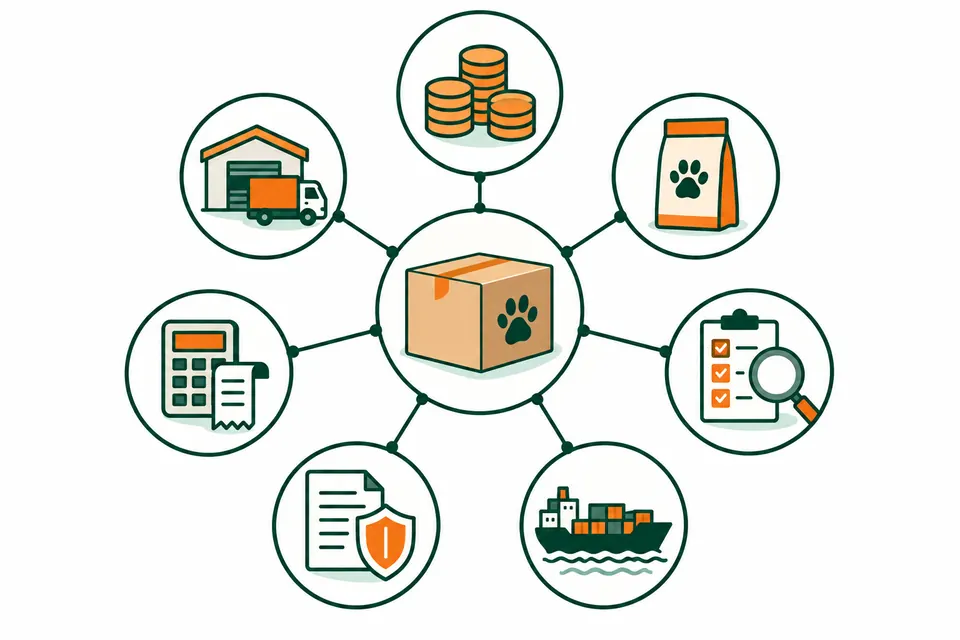
Landed cost is the total amount required to put an imported pet product into saleable inventory at the buyer’s named destination. Add product price, packaging, sampling and inspection, origin charges, international freight, insurance, duty, customs fees, broker charges, tax where applicable, and final warehouse delivery. Then divide by saleable units—not merely ordered units—to obtain a working unit cost.
For an actionable landed cost pet products model, every input needs a date, currency, quantity, Incoterm, route and evidence source. A supplier’s unit price or a freight quote alone cannot tell a buyer whether the product will support the intended wholesale or retail margin.
Key takeaways
- Calculate to a precise named destination, such as a warehouse address, not just “to the United States.”
- Keep product cost, customs value, freight, duty and destination charges as separate lines so each assumption can be updated.
- Use final packed-carton dimensions and chargeable weight; bulky pet beds can move more on freight than on factory price.
- Compare quantities with current quotes. Fixed-cost dilution can be offset by higher inventory, storage and cash exposure.
- Treat duty rates, tariffs and customs fees as dated inputs. Verify the exact classification and current treatment before placing the order.
1. Define landed cost
The U.S. Commercial Service defines landed cost as the total price of a product once it has reached the buyer’s destination, including the product price, insurance, freight, tariffs, taxes and other fees. For a pet-product importer, the practical finish line should be defined more precisely: the point at which conforming, saleable units are received at the named warehouse and available for the next fulfilment step.
That definition prevents three common errors:
- Stopping at FOB and excluding ocean or air freight, customs clearance and destination delivery.
- Accepting a DDP total without separating the duty, taxes, freight and service assumptions inside it.
- Dividing by ordered quantity when damage, inspection rejection, samples or channel preparation reduce the number of saleable units.
Use this planning equation:
Estimated landed cost = product purchase + packaging + samples + inspection + origin charges + freight + insurance + duty + customs fees + broker charges + applicable tax + destination delivery + verified exceptional costs
Then calculate:
Estimated landed cost per saleable unit = estimated landed cost ÷ expected saleable units received
Fix the scope before calculating
Write the following fields at the top of the model:
| Scope field | Example | Why it matters |
|---|---|---|
| Model date | 13 October 2026 | Freight, tariffs and fees change over time |
| Currency | USD | Prevents an unrecorded exchange-rate assumption |
| Product and SKU | Adjustable dog harness, one size mix | Classification, cube and defect risk depend on the product |
| Quantity | 1,000 units | Drives purchasing, packaging and cost allocation |
| Incoterm and named place | FOB named port or DDP named warehouse | Identifies which party pays each transport and customs cost |
| Origin and destination | China to a specified U.S. warehouse | Route and destination charges need precise locations |
| Shipment mode | Ocean, air or courier | Controls rate basis, chargeable weight and some fees |
| Cartons and volume | 40 cartons; 2.40 m³ model assumption | Converts the approved pack-out into a freight input |
| Gross and chargeable weight | Route-specific measured or quoted value | Carriers may rate by actual or dimensional weight |
| Expected saleable units | 1,000 unless a supported allowance is applied | Produces a usable per-unit denominator |
The Incoterm allocates costs and responsibilities between seller and buyer; it does not remove the costs from the supply chain. Under DDP, ICC guidance places maximum delivery and import-clearance responsibility on the seller up to the named destination. Buyers should still ask for a transparent quote and confirm who acts as importer of record. Petlland’s FOB vs DDP guide explains the operational differences.
2. List every cost line
A reliable landed-cost calculation is a controlled cost build rather than one formula fed by a single supplier quote. The table below separates the main lines, their usual rate basis and the evidence needed before approval.
| Cost line | Typical basis | Evidence to request | Frequent omission |
|---|---|---|---|
| Product purchase | Unit price × quantity | Supplier quotation, specification and purchase order | Unapproved options or accessories |
| Retail and transport packaging | Per unit or per carton | Packaging BOM and approved pack-out | Inserts, labels, master cartons and overage |
| Samples and courier | Flat project cost | Sample invoice and courier receipt | Revision rounds and approval samples |
| Inspection and testing | Flat visit, man-day or test fee | Inspection quotation and agreed checklist | Reinspection after a failed result |
| Origin pickup and export | Shipment or weight/volume basis | Forwarder origin-charge schedule | Trucking, handling, documentation and export clearance |
| International freight | Chargeable weight, volume, container or route | Dated forwarder quote with validity and inclusions | Peak, fuel, security and route surcharges |
| Cargo insurance | Shipment value or flat premium | Policy or forwarder quote | Deductible and excluded risks |
| Customs duty and additional tariffs | Customs value × applicable rate | HTS classification, origin and current tariff treatment | Extra trade-remedy duties or wrong origin assumption |
| Government user fees | Entry type, value and transport mode | Current customs schedule | Minimum/maximum fee and ocean-only charges |
| Customs broker and filing | Per entry plus services | Broker quotation | Bonds, classification work and partner-government filings |
| Tax | Destination-specific tax base and rate | Customs or tax adviser confirmation | Treating recoverable tax as a permanent product cost |
| Destination handling and delivery | Shipment, pallet, weight or distance | Terminal, carrier and warehouse quote | Port, chassis, appointment, liftgate or residential fees |
| Storage, demurrage or detention | Time-based exception | Actual tariff or invoice | Hiding avoidable delay inside a standard estimate |
| Finance and exchange effects | Payment timing and currency | Bank terms and dated FX assumption | Transfer fees and currency change between deposit and balance |
Keep customs value separate from landed cost
For U.S. imports, CBP explains that the commercial-invoice value normally starts from the price paid or payable for the goods, not the future U.S. resale price. Certain items—such as packing costs, assists, selling commissions, royalties or proceeds—may need to be added when applicable. International freight and insurance are generally excluded from the U.S. duty base when separately identified, although another valuation method may apply in a particular case.
The buyer should therefore maintain at least two totals:
- Customs value: the declared valuation basis reviewed for the entry.
- Landed cost: the commercial management total used to understand inventory cost and margin.
Do not apply a duty percentage blindly to the grand landed-cost total. Confirm the classification in the current U.S. International Trade Commission HTS and ask a customs broker whether additional tariff programs or other agency requirements apply. If classification remains uncertain, CBP’s binding-ruling program can provide a pre-entry decision for a fully described product; CBP notes that classifications can be binding while duty rates can still change.
Record current U.S. user fees as dated assumptions
CBP’s user-fee guidance published on 13 February 2026 states that the formal-entry Merchandise Processing Fee is 0.3464% of merchandise value, subject to the published minimum and maximum. The same guidance states that the Harbor Maintenance Fee is 0.125% of commercial cargo value for qualifying ocean shipments and is not collected on air or mailed shipments. The downloadable model uses those published values as editable dated assumptions. Recheck them before every live quotation.
Tax needs a separate decision. CBP does not collect state and local taxes on behalf of U.S. states, and other destination countries may calculate VAT or goods-and-services tax on a different base. Record whether a paid tax is recoverable, deferred or a permanent cost instead of treating every tax payment identically.
3. Build a worked example
The following example is a planning model, not a freight quotation or customs entry. It shows how a buyer can make every assumption visible and replaceable.
Model assumptions
- Model date: 13 October 2026.
- Currency: USD.
- Product: illustrative adjustable dog harness order.
- Quantity and denominator: 1,000 ordered and 1,000 expected saleable units.
- Route: China to a named U.S. warehouse.
- Mode: illustrative ocean shipment.
- Pack-out: 40 cartons at an assumed 0.06 m³ each, or 2.40 m³ total; the freight input is a route quote that already reflects the pack-out.
- Customs value: $4,800 in this simplified example, subject to broker review.
- Duty rate: 7.5% example only; it is not a recommended or universal harness classification rate.
- MPF and HMF: dated CBP fee assumptions described above.
| Cost line | Calculation | Total | Per unit |
|---|---|---|---|
| Product purchase | 1,000 × $4.80 | $4,800.00 | $4.80 |
| Packaging | 1,000 × $0.35 | $350.00 | $0.35 |
| Inspection | Flat example input | $280.00 | $0.28 |
| Samples and courier | Flat example input | $120.00 | $0.12 |
| Origin transport and export | Flat example input | $260.00 | $0.26 |
| International freight | Dated route quote | $1,850.00 | $1.85 |
| Cargo insurance | Flat example input | $40.00 | $0.04 |
| Customs duty | $4,800 × 7.5% | $360.00 | $0.36 |
| Merchandise Processing Fee | Published minimum used in model | $33.58 | $0.03 |
| Harbor Maintenance Fee | $4,800 × 0.125% | $6.00 | $0.01 |
| Customs broker and filing | Flat example input | $175.00 | $0.18 |
| Warehouse and final delivery | Flat example input | $420.00 | $0.42 |
| Estimated landed cost | Sum of all rows | $8,694.58 | $8.69 |
The unit purchase price represents only 55.2% of this model’s landed total. Freight represents about 21.3%. That difference matters when a buyer tests retail margin. Using $4.80 as cost would overstate gross margin before marketing, fulfilment, payment fees, returns and overhead.
Reconcile the estimate after receipt
Keep the original estimate, then add an actual column when the shipment is complete. Match invoices and customs documents to the same cost lines. Record the variance and its reason: carton cube, rate expiry, duty treatment, customs examination, delivery appointment, storage or another supported cause. The next purchase order should use the actual variance history rather than simply copying the first quote.
If several factories supply one launch, model the consolidation cost and the freight benefit explicitly. Petlland’s multi-supplier consolidation guide explains the handover, warehouse and document controls that keep combined shipments traceable.
4. Compare cost per unit by quantity
Larger orders often reduce factory price and spread fixed inspection, broker and delivery costs across more units. They do not automatically produce the best business result. More units can require more freight, cash, storage and markdown risk. Compare current supplier and logistics quotes at each realistic quantity.
This illustrative comparison uses one calculation structure but different quantity-specific inputs:
| Model input or result | 500 units | 1,000 units | 2,000 units |
|---|---|---|---|
| Unit purchase price | $5.20 | $4.80 | $4.45 |
| Packaging per unit | $0.42 | $0.35 | $0.30 |
| International freight | $1,350.00 | $1,850.00 | $2,700.00 |
| Other fixed costs | $1,145.00 | $1,295.00 | $1,700.00 |
| Example duty rate | 7.5% | 7.5% | 7.5% |
| Estimated landed cost | $5,536.83 | $8,694.58 | $14,612.21 |
| Estimated cost per unit | $11.07 | $8.69 | $7.31 |
| Change vs 1,000-unit model | +27.4% | Base | -16.0% |
The 2,000-unit model has the lowest cost per unit, but it commits twice the inventory of the 1,000-unit model. Make the order decision only after adding expected sell-through, cash conversion time, storage capacity, defect exposure and the cost of a slow-selling size or colour.
For bulky categories, run the comparison using the actual product pack-out. Pet beds can compress differently by foam, fill and retail packaging. Review the final carton plan alongside the product specification; Petlland’s pet bed range provides category context, while a route quote should use measured production-equivalent cartons rather than catalogue dimensions.
5. Show sensitivity to cube and duty
A landed-cost estimate should reveal which assumptions can change the decision. For many pet products, the two fastest tests are freight exposure and duty treatment.
Using the 1,000-unit worked example:
| Scenario | Freight assumption | Duty assumption | Landed total | Cost per unit |
|---|---|---|---|---|
| Base | $1,850 | 7.5% | $8,694.58 | $8.69 |
| Freight increases 25% | $2,312.50 | 7.5% | $9,157.08 | $9.16 |
| Duty rises 5 percentage points | $1,850 | 12.5% | $8,934.58 | $8.93 |
| Both changes occur | $2,312.50 | 12.5% | $9,397.08 | $9.40 |
In this model, a 25% freight change adds about $0.46 per unit. A five-percentage-point duty change adds $0.24 per unit because it applies to the $4,800 customs-value assumption, not the total landed amount. Together they increase unit cost by about $0.70.
Test cube before negotiating cents
For courier and many air services, chargeable weight can be the higher of actual and dimensional weight. Carrier formulas and divisors vary by service, account and unit system. FedEx’s current U.S. dimensional-weight guidance, for example, uses length × width × height in inches divided by 139, with the greater of dimensional or actual weight used for rating. Sea freight also depends on volume, shipment type, origin/destination charges and route conditions.
Before finalising the calculation:
- Measure the production-equivalent unit pack and master carton.
- Confirm units per carton and total carton count.
- Calculate total cubic volume and gross weight.
- Ask the forwarder which chargeable measure and minimum applies.
- Obtain the complete charge schedule and quote validity.
- Re-run the model after any packaging or assortment change.
Reducing unused carton space can improve unit economics without changing the product. But do not compress a pet bed, deform a harness or weaken protection merely to reduce freight. Packaging damage and returns can cost more than the space saved.
Use a decision threshold
Set a maximum delivered inventory cost from the intended sales model. If the product must land below $9.00 to support the target margin, the combined sensitivity case at $9.40 does not pass. The response is then specific: reduce pack-out volume, change the shipment mode or timing, revise the assortment, negotiate supported cost lines, raise the selling price or stop the order. Do not force the model to pass by deleting a likely charge.
Download the landed-cost calculator. Replace the yellow cells with current product, packaging, inspection, freight, customs and warehouse inputs. Petlland can also coordinate supplier quotations, pack-out data, QC and consolidated logistics through its sourcing services.
Frequently asked questions
What costs should be included in landed cost for pet products?
Include product purchase, retail and transport packaging, samples, inspection, origin handling, international freight, insurance, duty, customs fees, broker charges, applicable tax, destination handling, final delivery and any supported exceptional cost. Define the destination and denominator before calculating.
Is landed cost the same as the supplier’s DDP price?
Not necessarily. A DDP price may represent delivery to a named destination with import clearance allocated to the seller, but the buyer still needs the exact named place, exclusions, importer-of-record arrangement, tax treatment and a breakdown sufficient to compare offers and reconcile actual costs.
Should freight be included in the U.S. customs value?
CBP generally bases transaction value on the price paid or payable for the merchandise, with specified additions. International freight and insurance can generally be excluded when separately identified, but the facts and valuation method control. Confirm the declared value with a customs broker.
How do I find the duty rate for a pet product?
Classify the exact product in the current U.S. HTS using its material, construction, function and other relevant characteristics. Check current additional tariff measures and origin treatment. Use CBP CROSS rulings or request a binding ruling when the classification remains uncertain.
Why does carton volume change landed cost so much?
Carriers often rate low-density shipments by space or dimensional weight rather than only actual weight. Bulky pet beds, scratchers and carriers can therefore incur more freight per unit than dense, compact accessories. Calculate with production-equivalent carton dimensions.
Should I divide landed cost by ordered units or received units?
Use expected saleable received units for decision-making. If samples, damage, rejected goods or channel preparation reduce sellable inventory, dividing by ordered quantity understates the usable unit cost. Keep any loss assumption evidence-based and reconcile it after receipt.
How often should a landed-cost model be updated?
Update it whenever the specification, quantity, packaging, carton data, route, Incoterm, freight quote, exchange rate, tariff treatment, fee schedule or destination changes. At minimum, refresh every variable before the purchase order and again before the balance payment or shipment booking.
Evidence sources used
- U.S. Commercial Service, Determine Total Export Price — landed-cost components, HS code workflow and the need to treat results as estimates.
- U.S. Customs and Border Protection, Commercial invoice value and Importing into the United States — transaction value and additions.
- U.S. Customs and Border Protection, Duty, taxes and other fees — dated MPF and HMF guidance.
- U.S. International Trade Commission, Harmonized Tariff Schedule — current U.S. tariff schedule.
- U.S. Customs and Border Protection, Binding Ruling Program — pre-entry classification and valuation rulings.
- International Chamber of Commerce, DDP Incoterms 2020 — delivery, cost and import-clearance responsibilities.
- FedEx, Dimensional weight — dimensional-weight rating principle and current divisor example.
Editorial note: All numerical examples are dated planning assumptions, not supplier quotations, tariff classifications, customs entries or legal advice. Verify product classification, customs value, tariff treatment, fees and tax with qualified advisers for the actual shipment.