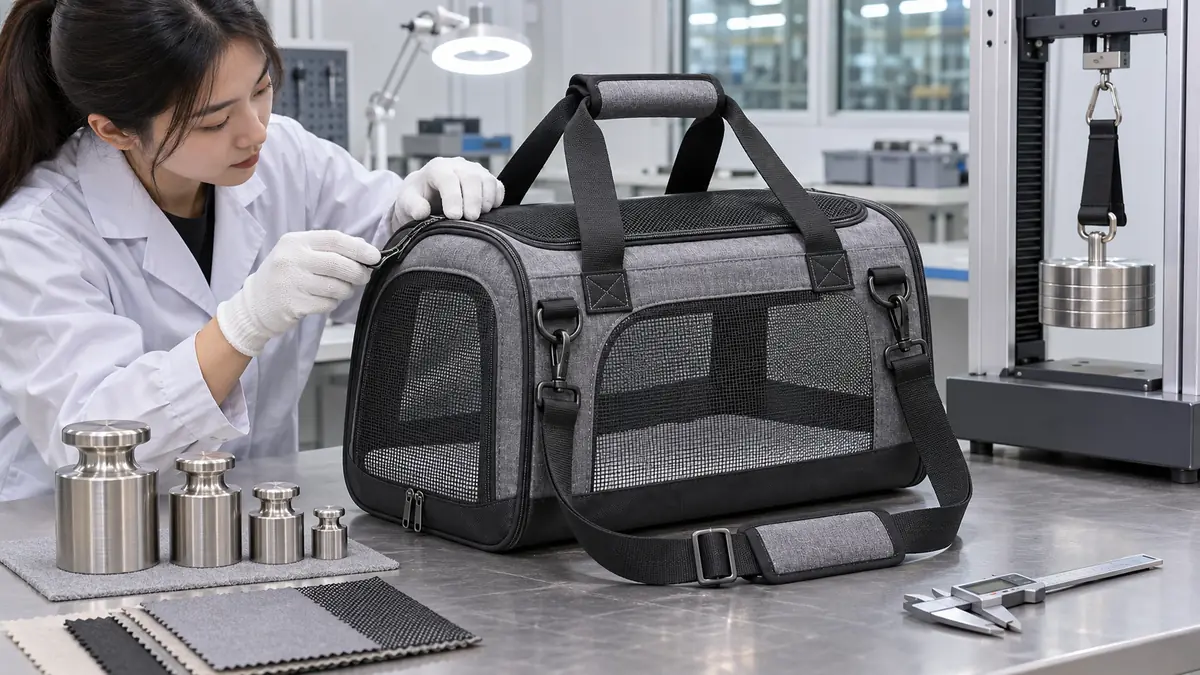
A reliable pet carrier manufacturer should be able to turn a design brief into measurable requirements—not just approve a sample because it looks right. Buyers need evidence that the carrier’s structure, ventilation, closures, straps and dimensions are consistent with the intended pet weight, retail channel and transport use.
The practical answer is to issue a product specification with defined checkpoints, test loads, durations, sample sizes and acceptance criteria. The factory should then return a sample, measurement report and test record that identify the exact materials and construction used. This guide explains what to include when evaluating a pet carrier supplier, custom cat carrier program or pet backpack manufacturer.
Choose carrier construction
Start with the use case. A soft-sided hand carrier, backpack, crossbody carrier and rigid travel crate place different loads on their materials and connection points. Define the intended pet-weight range, carry orientation, opening direction, base rigidity, storage features and expected trip duration before asking for a quotation.
For a soft carrier, specify the shell fabric, lining, mesh, piping, foam or board reinforcement, base insert and removable pad as separate bill-of-material items. Ask the manufacturer to identify fiber content, fabric weight, coating and color standard. Do not accept a vague description such as “Oxford fabric” without a measurable grade, because suppliers can source very different constructions under the same trade name.
Map every structural load path: handles to body panels, shoulder strap to anchors, backpack straps to the rear panel and base panel to sidewalls. Reinforcement should extend beyond the visible stitch line so the load is distributed into the body rather than concentrated at one seam. Buyers comparing formats can review Petlland’s pet carrier range, space capsule pet backpack and foldable crossbody cat carrier as starting references, then issue a model-specific specification.
Set size and ventilation requirements
List finished external dimensions and usable internal dimensions separately. Set tolerances for length, width and height, and state whether measurements are taken with the carrier empty, naturally expanded and with the base insert installed. For foldable products, also define folded dimensions. A useful inspection sheet records five samples, the measured range and any out-of-tolerance result.
Size claims should be linked to the animal’s posture and the intended transport channel. IATA’s current pet guidance says an animal container must provide enough space for the animal to stand, sit erect, lie naturally and turn normally while standing. IATA also provides a measurement method based on body length, elbow height, shoulder width and natural standing height. These are transport-container principles, not a blanket approval for every soft carrier.
For air travel, require the buyer or end customer to verify the exact carrier, route, aircraft and pet with the operating airline before travel. Airline limits and acceptance decisions can differ, and a product marketed as “airline compatible” must not be treated as universally accepted.
Ventilation should be specified as an open area, not only as “mesh on three sides.” Provide a panel drawing with mesh locations, finished opening dimensions and the minimum unobstructed area after seams, pockets and reinforcement are installed. The mesh must remain open when the carrier is occupied and should resist collapse against the animal. IATA notes that container ventilation, construction and size are critical, and its general air-cargo guidance calls for adequate ventilation on multiple sides while recognizing species- and container-specific exceptions.
Specify hardware and stitching
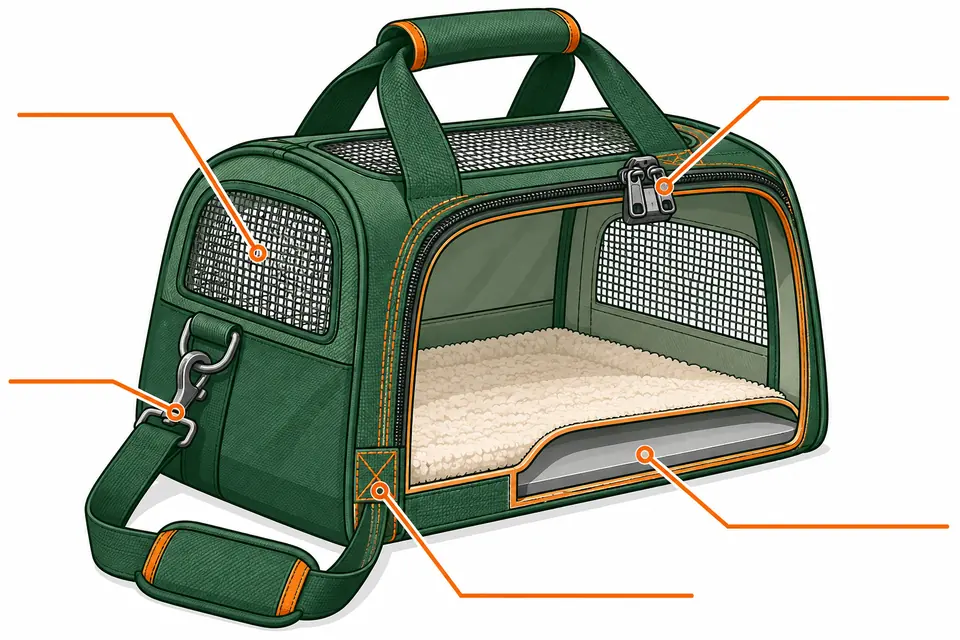
Define zipper brand or performance grade, slider count, puller shape, tape color, teeth or coil type and the closure method that prevents unintended opening. Depending on the design, an anti-escape feature may be a locking slider, clip, buckle bridge or internal tether. The tether should never substitute for closing the carrier, and its use instructions should avoid creating an entanglement risk.
The sewing specification should include stitch type, stitches per inch or centimeter, thread material and size, seam allowance, backtack length and reinforcement pattern at every load-bearing anchor. Photographs or diagrams are preferable to prose alone. Mark the exact handle, D-ring, shoulder-strap and backpack-strap anchors that require box-X, bar-tack or other approved reinforcement.
For laboratory comparison, ISO 13934-2 describes a grab method for determining maximum force in textile fabrics, while ISO 13935-2:2026 covers maximum force to rupture for straight sewn seams under a perpendicular load. These methods can inform a material and seam test program, but the buyer and laboratory must confirm whether the standards apply to the chosen fabric, coating, curved seam and finished construction. A whole-carrier load test remains a separate, product-specific requirement.
Run static and dynamic load tests
Convert the marketed pet-weight range into a written validation protocol. Record the rated load, test load, safety factor chosen by the buyer, hold time, conditioning, fixture, carry orientation and pass/fail criteria. Do not let the factory choose an unrecorded weight or shorten the duration during production testing.
- Static hold: load the carrier evenly and suspend it by each intended carry system for the specified time. Check strap elongation, anchor distortion, seam opening, hardware deformation and base sag.
- Dynamic carry: use a repeatable lifting or cyclic motion with the defined load. Record cycle count, stroke and speed. Inspect after intervals so progressive damage is visible.
- Localized anchor pull: test handle, shoulder-strap, backpack-strap and D-ring anchors individually using a documented fixture and direction.
- Closure challenge: cycle zippers and locks, then apply a controlled outward force at doors and openings to check for slider movement, tooth separation or seam failure.
- Base and drop simulation: with the agreed dummy load, evaluate base displacement and controlled handling impacts. Define surface, height, orientation and number of drops before testing.
A passing report should show the sample ID, material lot, pre-test photographs, calibrated equipment ID, method, measured results and post-test condition. “Passed load test” without those details is not adequate evidence. Align production inspections with the same critical points and use a documented sampling plan; Petlland’s guide to AQL inspection for pet products explains how to structure lot-level checks.
Inspect packaging and labeling
Packaging must preserve shape without creating unnecessary shipping volume. Define whether the product ships expanded or folded, how mesh panels are protected from creasing, where straps and hardware are secured and whether a moisture-control bag is permitted for the destination market. Run a packed-product drop or distribution test appropriate to the sales channel, then inspect the carrier for distorted frames, scuffed hardware and zipper damage.
Label artwork should match the approved bill of materials and claims. Confirm model, color, size, net weight, material composition, country of origin, care instructions, warnings, barcode and carton markings. Weight and airline-compatibility statements require particular control: state the product’s tested rating and limitations, and direct the customer to verify carrier acceptance with the airline.
Before mass production, approve a sealed reference sample and a specification pack containing dimension drawings, ventilation calculations, seam and hardware details, load-test protocol, inspection criteria, packaging and label files. The same revision number should appear on the purchase order, sample approval and inspection request.
Buyer specification checklist
- Intended carrier type, pet-weight range and use environment
- Bill of materials with measurable fabric, mesh, board, padding and hardware grades
- External, internal and folded dimensions with tolerances
- Ventilation opening locations and minimum unobstructed area
- Stitch pattern, density, seam allowance and reinforcement drawings
- Static, dynamic, anchor, closure and handling test methods
- Packaging, labeling and inspection acceptance criteria
FAQ
Which tests should a buyer require from a pet carrier manufacturer?
Require documented static and dynamic whole-carrier load tests, separate checks of every strap and handle anchor, zipper and closure cycling, seam-strength evidence where applicable, dimension and ventilation measurements, and a packaging-handling test. Each method needs a defined load, duration or cycle count, fixture, sample size and acceptance criteria.
How should ventilation be specified?
Specify mesh locations, finished opening dimensions and minimum unobstructed open area after assembly. Check that pockets, reinforcement and the animal’s body cannot block all airflow. If the carrier is intended for air transport, verify current airline and route-specific rules before making claims.
What is a sensible pet-carrier size tolerance?
There is no universal tolerance. The buyer should set model-specific limits based on material behavior, frame construction, packing method and transport constraints. State the measurement condition and inspect several units so both the average and range are visible.
Does an airline-compatible carrier fit every flight?
No. Aircraft, route, airline and pet requirements vary, and final acceptance belongs to the carrier. Buyers and end customers should confirm the exact product dimensions and pet details with the operating airline before travel.
What should be included in a load-test report?
Include sample and material-lot IDs, pre- and post-test photos, equipment identification, calibration status, test load, fixture, orientation, duration or cycles, observations and measured results. The report should identify the exact specification revision tested.