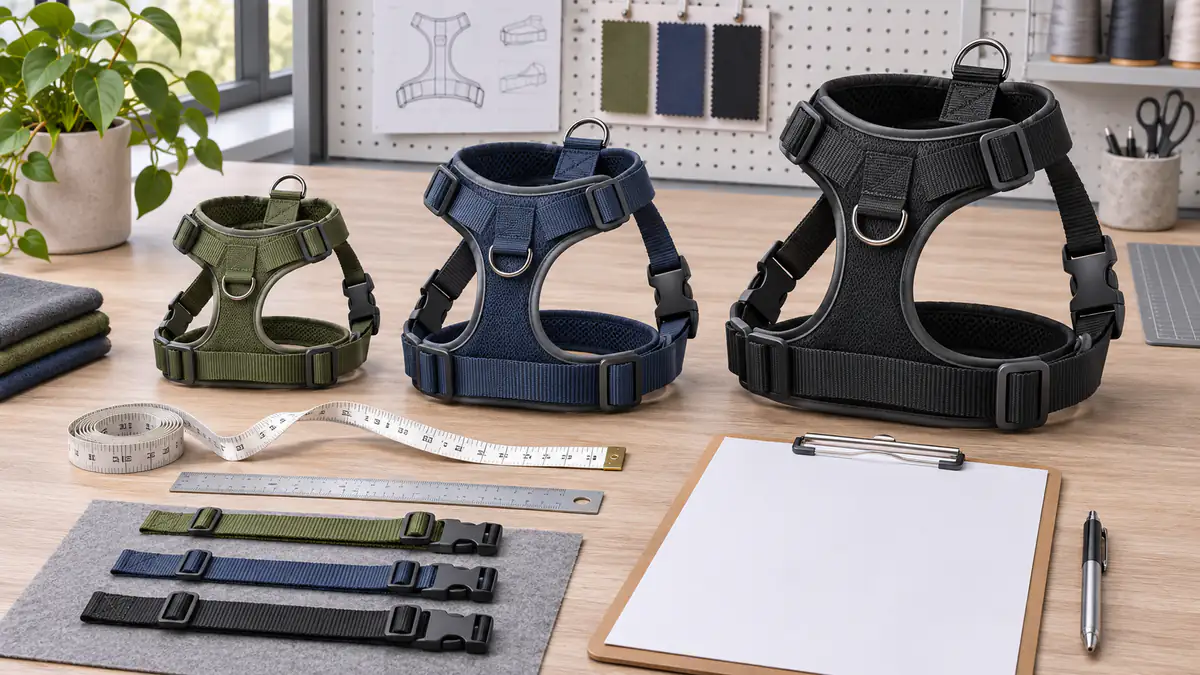
A production-ready dog harness size chart starts with two separate datasets: measurements taken from dogs and measurements taken from finished harnesses. The development team then connects those datasets through fixed anchor points, usable adjustment ranges, size overlap, component grading and fit trials. A retail chart copied from another product cannot provide that control because its numbers reflect a different pattern and hardware layout.
Quick answer: define body and product measurements in writing, set repeatable anchor points, build adjacent sizes with controlled overlap, grade each strap and panel from one master pattern, and verify the result on dogs that represent the intended body range. Release production tolerances only after the team approves the fit sample.
Define body and product measurements
Body measurements describe the dog. Product measurements describe the harness. Your specification must name each type because a chest girth taken around a dog does not equal the length of a chest strap laid flat on a table. Padding thickness, buckle length, overlap, seam allowance and webbing routed through a slider all affect the finished adjustment range.
Start the body dataset with the measurements that the pattern needs. A Y-style walking harness may use lower-neck circumference, chest girth behind the front legs, front-chest length and back length. Record posture and tape position with the number. Ask the handler to keep the dog standing in a natural position and keep the tape in contact with the coat without compressing the body.
The product dataset should include the minimum and maximum functional opening, panel lengths, strap lengths between fixed construction points, buckle and slider lengths, webbing width and adjustment reserve. State whether the inspector measures the harness relaxed, under a defined light tension or mounted on a fixture. The method belongs in the golden sample specification so the factory, buyer and inspector use the same reference.
Body data and finished-product data serve different decisions
- Body measurements help the developer assign dogs to candidate sizes and select fit-trial subjects.
- Finished-product measurements let the factory cut, sew and inspect each size against the approved pattern.
- Fit observations confirm clearance, stability, strap position and movement on the intended dog population.
Do not use weight or breed as the sole sizing input. Dogs within one breed can have different proportions, coat volume and condition. A biomechanics study involving 66 dogs found that harness effects varied across breeds and recommended individual fitting. That finding supports real measurements and fit trials instead of a universal breed promise. See the study abstract in The Veterinary Journal.
Set anchor measurement points
A measurement only works when two inspectors can reproduce it. Draw each anchor point on the technical sheet and name the start, end, path and product condition. Avoid instructions such as “measure the chest strap” because a curved or padded assembly can yield several plausible values.
Core anchor points for a harness specification
- Neck opening: measure the usable inside path between the defined junctions, including the functional adjustment range.
- Chest or girth path: measure the complete closed-loop range or the specified strap segment between fixed points.
- Front chest section: measure from the approved neck junction to the lower chest junction along the centerline.
- Back panel: measure from the front panel reference seam to the rear reference seam, excluding the D-ring unless the drawing says otherwise.
- Adjustment reserve: record the remaining webbing captured by the slider at minimum and maximum settings.
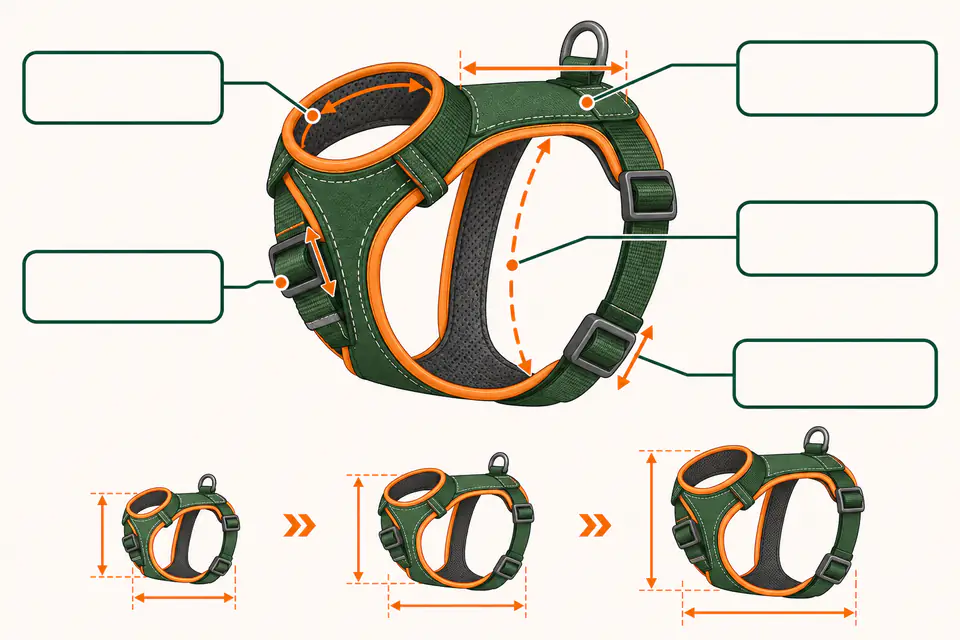
Anchor points also support fit evaluation. A guide-dog study measured different pressure distributions under three harness designs, with pressure concentrated in different regions. The study does not provide a universal sizing formula, but it shows why a development team should track strap position and contact zones during trials. Review the abstract on PubMed.
Design size ranges and overlap
Adjacent sizes need enough overlap to cover real body variation without making two sizes equivalent. Too little overlap creates gaps that exclude dogs near a boundary. Excessive overlap leaves customers unsure which size to choose and may put buckles or sliders in poor positions on one of the options.
Build each range from fit-trial data and the usable adjustment zone. The usable zone can be narrower than the mechanical maximum if a slider reaches a padded edge, a loose tail becomes excessive or a buckle shifts into the armpit area. Record both the mechanical range and the approved fit range during development.
An anonymized sample range
The table below illustrates the structure of a development sheet. The values are sample data from an anonymized concept and are not a ready-to-use consumer chart. A real project needs its own pattern, materials and fit trials.
| Size | Approved dog chest range | Finished harness chest range | Back panel | Production tolerance |
|---|---|---|---|---|
| XS | 38-48 cm | 36-51 cm | 16.0 cm | ±5 mm |
| S | 46-60 cm | 44-63 cm | 18.0 cm | ±5 mm |
| M | 57-75 cm | 55-78 cm | 21.0 cm | ±7 mm |
The overlap between XS and S lets the fit team compare buckle position and panel coverage on dogs near the boundary. The team may direct a broad-chested dog to one size and a narrow dog to another even when both chest measurements fall inside the overlap. The consumer chart should state the tie-break rule, such as choosing the larger size when the dog falls near the upper limit, only after the fit team validates it.
Grade components consistently
Size grading changes a master pattern into a controlled family of patterns. Each component needs an explicit rule. Adding the same length to every strap can distort the fit because panels, buckle placement and adjustment travel interact.
Create a component grading matrix
- Webbing: record cut length, finished exposed length, minimum captured tail and maximum functional extension for each size.
- Panels: grade length and width from fixed balance points so the neck opening and chest junction stay aligned.
- Hardware: confirm buckle, slider and D-ring size by load requirement, webbing width and user handling needs.
- Padding and binding: update perimeter lengths and corner radii without changing the intended seam position.
Use one master measurement table with a row for each component and a column for each size. The pattern file, bill of materials, work instruction and QC sheet should use the same component names. Version control matters when a fit correction changes only one size. Record the revised pattern number and sample approval instead of allowing a handwritten production adjustment.
Materials can change grading behavior. Thick padding consumes more inside circumference than thin mesh. A stiff binding can limit how a curved panel conforms. Test the production-intent material stack before approving the chart. Our dog harness manufacturer guide covers the development questions buyers should resolve with a factory, while our dog harness manufacturing page outlines available product-development support.
Verify fit and production tolerance
The approved size chart needs evidence from fit samples and production measurements. Select dogs across the lower, middle and upper parts of each proposed body range. Include different body proportions when the product targets a broad market. Record body measurements before the trial and use the same fitting instruction for each dog.
Run a fit-trial protocol
- Fit the harness according to the draft instruction and record slider positions, remaining adjustment and strap contact zones.
- Check standing fit, sitting fit and controlled walking. Observe rotation, gaping, rubbing, buckle placement and shoulder clearance.
- Repeat the trial with dogs near overlap boundaries and compare both candidate sizes.
- Revise the pattern or range, make a new sample and document the approved result.
A four-dog pilot study found that harness effects differed by dog and design, and the authors did not identify one harness as the best option for all dogs. That limited study supports the practical need for individual fit validation and avoids breed-wide guarantees. The full open-access paper is available through PubMed Central.
After fit approval, set production tolerances from functional risk and process capability. A strap length that controls the adjustment range may need a tighter tolerance than a cosmetic panel edge. Inspect the pilot run at the defined anchor points and compare actual results with the approved sample. If the process cannot hold the proposed tolerance, improve the cutting or sewing method before widening the limit.
The final release package should contain the body-measurement protocol, finished-product measurement diagram, size and overlap table, component grading matrix, tolerance table, fit-trial report, approved sample references and consumer fitting instructions. These records let the factory reproduce the design and let the quality team trace a size complaint to a measurable requirement.
Frequently asked questions
How should a dog harness size chart be built for production?
Use measured dog data, finished-product anchor points, approved adjustment ranges, controlled size overlap, component grading rules and fit trials. Connect every consumer size to a pattern revision and an inspection method.
Can a retail size chart be used as a factory specification?
No. A retail chart omits construction anchor points, component lengths, adjustment reserve and production tolerances. The factory needs a technical measurement sheet and approved sample.
How much overlap should adjacent harness sizes have?
The fit team should set overlap from adjustment travel and boundary trials. The correct amount depends on the pattern, hardware positions, padding and intended body range.
Should a dog choose a harness size by breed or weight?
Use direct body measurements as the main input. Breed and weight can help with planning, but they cannot guarantee chest shape, coat volume or fit for an individual dog.
When should production tolerances be approved?
Approve tolerances after the pattern, production-intent materials and fit sample pass review. Confirm that the pilot process can hold each limit at the defined measurement point.
Petlland can review your harness measurement points, adjustment ranges, grading logic and tolerance table before sampling. Send the intended market, design files, target size range and material plan through our contact page.