Quick answer: the quality of a corrugated cat scratcher depends on the specified paper layers and flute construction, measured board weight and thickness, bonding and odor controls, edge finish, size and load performance, loose-fiber behavior, and packaging that protects the product in transit. A buyer should compare production-equivalent samples using one written method and require the cat scratcher manufacturer to report the actual results. There is no universal board-density number that guarantees low shedding or durability for every shape.
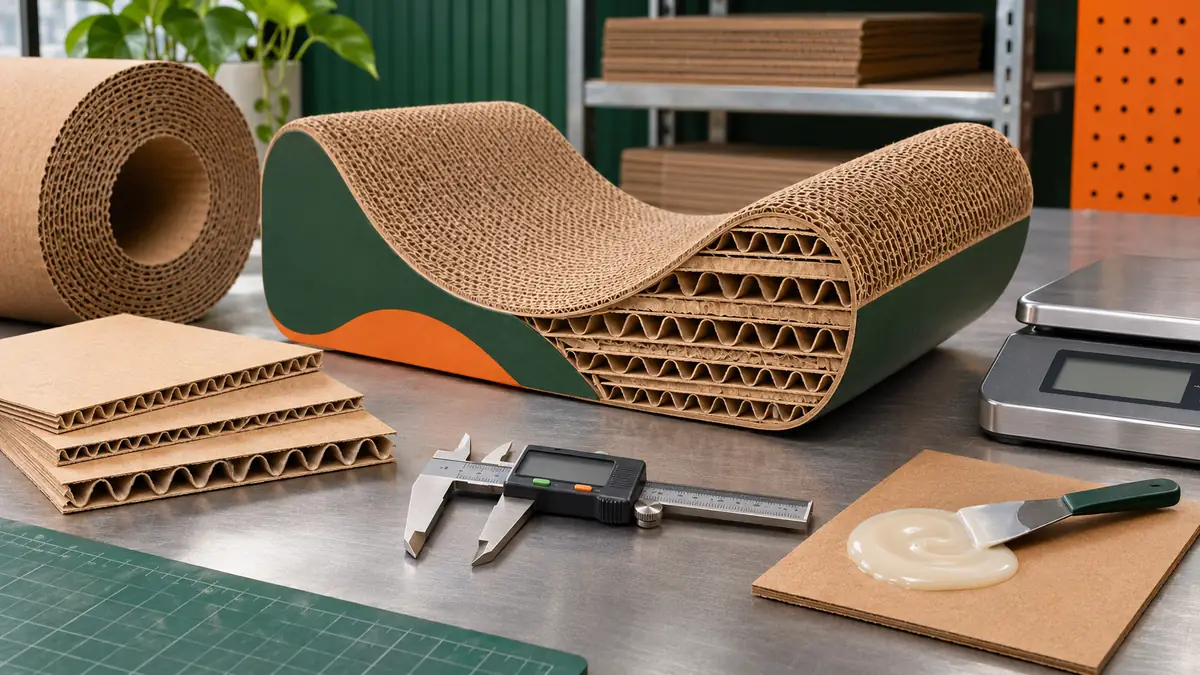
When comparing cardboard cat scratcher wholesale offers, do not rely on a catalog photograph or a single “high-density” claim. Ask every supplier for the same dimensions, net product mass, cross-section photograph, component paper specification, adhesive declaration, sample test method, and packed-carton measurements. Compare those records with the approved sample and the intended selling channel.
Explain flute and board density
The visible fluted layers create the scratching surface. Flute profile, spacing, orientation, number of layers, paper grade, glue coverage and compression during manufacture can all change how a scratcher feels and wears. “Density” is ambiguous unless the supplier says whether it means mass per unit area, mass per unit volume, paper grammage, or simply the weight of the finished product. Put the chosen metric and measurement method on the specification sheet.
For a repeatable incoming check, condition samples under agreed conditions, weigh the unwrapped scratcher, measure the external length, width and height at specified points, and photograph a clean cut through the board. Record the layer count, flute orientation and any hollow or compressed zones. A simple finished-product mass comparison is useful for production consistency, but it does not isolate paper grade or adhesive. If board-level results matter, request component-paper grammage and board thickness from a suitable laboratory method. ISO 3039 describes grammage after separating component papers; ISO 3034 addresses single-sheet corrugated board thickness. ISO 3037 covers edgewise crush resistance of corrugated fibreboard. Check each method’s specimen scope before applying it to a converted scratcher.
Ask for a dated cross-section photo with a scale, the sample or batch identifier, measured weight and thickness values, and the tolerance against the approved sample. This evidence is more useful than an unsupported “heavy-duty” label.
Review adhesive and odor controls
Bonding must hold the layers together without leaving exposed wet glue, brittle lumps, loose strips or an objectionable odor. Ask the cat scratcher supplier to identify the adhesive family, its intended use, application location, drying or curing step, and change-control process. Obtain the material or safety documentation relevant to the destination market. A statement that an adhesive is “safe” is not a substitute for a defined formulation, applicable chemical review and production control.
Inspect the finished unit at receipt and after an agreed period in its retail pack. Log odor with a consistent panel and scale, noting the test environment and time after opening. Inspect edges and cut surfaces for exposed glue or delamination. If a supplier changes paper, adhesive, coating, print or process, require a new sample and reassess the relevant tests before approving the change.
Specify shape and load
Define whether the item is a flat pad, curved lounge, corrugated cat scratcher bed, or wall-mounted form. The drawing should show length, width, height, curvature, contact area, edge radius and any side panels or attachment points. Specify the target cat size and the intended use as a scratcher, a resting surface, or both. The load-bearing path of a curved bed differs from that of a flat panel, so test the final shape rather than only a board coupon.
For a bed-style design, agree a centered and off-center load test: support the product as it will sit in use, record load, contact area, duration, permanent deformation, cracking and bond failure. The test load should come from the intended user range and risk assessment, not from a number copied from another product. For a wall-mounted format, add mounting hardware and attachment checks. Compare Petlland’s corrugated cardboard scratcher bed with the L-shape wall-mounted scratcher to see why shape and installation need different specifications. Petlland’s broader cat supplies range shows the available construction families; request a production sample before assuming any listed feature applies to a custom version.
Test shedding and drop resistance
Cardboard wear is expected. The procurement question is whether loose fibers and chips exceed an agreed limit during handling and a defined scratching simulation. Start with a clean sample, photograph the surface, then use a specified brush or abrasion fixture, force, stroke length, direction and cycle count. Collect and weigh or count the detached material using a consistent method. Photograph any torn strips, exposed adhesive, sharp edges or delamination. Repeat on multiple production-equivalent samples and record variation rather than selecting the best-looking unit.
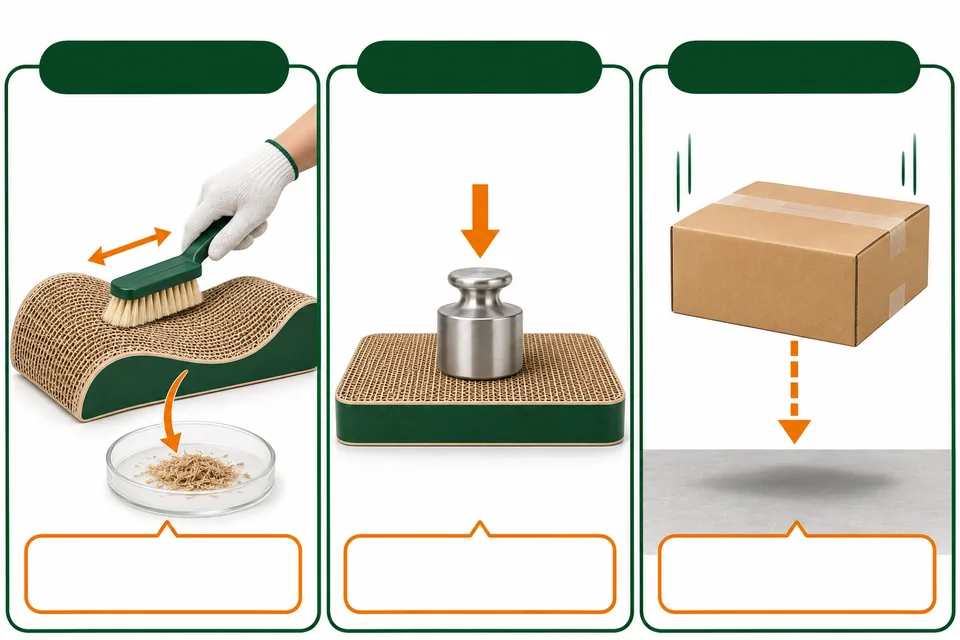
Test shipping protection on the product in its actual retail pack and export carton. Record carton count, gross weight, dimensions, board specification, orientation, closure and any insert or corner protection. Define the distribution route and a drop sequence before testing. ASTM D5276 is a free-fall method for loaded containers; ISTA’s packaging procedures offer distribution-oriented test options. These are package tests, not proof that a scratcher surface will resist cat claws. After the drops, open the pack and document crushed corners, deformed shapes, torn retail packaging, exposed adhesive, loose debris and any loss of intended function.
For stacked cartons, request compression data relevant to the anticipated pallet pattern and storage conditions. Report the test method, applied force or load, duration, carton and product condition, and pass/fail criteria. If the supplier offers only a photograph of a dropped box, the evidence is incomplete.
Compare packaging options
Compare a protective polybag, paper band, header card or full-color box against the product’s exposed edges and sales channel. A minimal pack may save material and volume but leave corners vulnerable. A rigid retail box may improve presentation yet increase packed size and shipping cost. Ask for the retail-pack dimensions, units per export carton, carton dimensions, gross weight, cubic volume, pack-out photograph and damage data for each option.
Before issuing a purchase order, lock the approved sample, drawing, board and adhesive specification, test methods and acceptance limits, packaging artwork, carton construction and inspection plan. Use a consistent defect classification and sampling process; Petlland’s pet-product AQL inspection guide explains how to frame an inspection. Include a requirement to alert the buyer before changing any paper, adhesive, shape or packaging component.
Frequently asked questions
What specifications determine the quality of a corrugated cardboard cat scratcher?
Specify the board construction and measurement method, finished-unit dimensions and mass, adhesive and odor controls, edge finish, supported load, shedding limit, packed-carton protection and change-control rules. Compare production-equivalent samples against agreed acceptance criteria.
Does a heavier cardboard scratcher always shed less?
No. Weight alone does not reveal flute geometry, paper properties, bonding quality or surface wear. Measure mass for consistency, then run the same controlled shedding test on each candidate.
Should a manufacturer test the product or only the export carton?
Both. Surface shedding and load tests assess the scratcher itself; drop and compression tests assess whether its packaging protects it through the expected distribution route.
Sources and next step
Method references: ISO 3034:2011 (board thickness), ISO 3037:2022 (edgewise crush resistance), ISO 3039:2010 (component-paper grammage), ASTM D5276-19(2023) (free-fall drop testing of loaded containers), and ISTA test procedures. Confirm current editions, scope and required conditions with the chosen laboratory. The illustration above is explanatory and does not present a measured test result.
Ready to compare suppliers against your target shape and market? Ask for cat scratcher samples and carton tests.