Quick answer: compare a dog-toy supplier by material family, intended use, construction, finished-product test method, chemical documentation, warning plan, and traceable quality records. TPR, natural rubber, rope, and plush require different controls. No material or test result proves that a toy is indestructible or absolutely safe, so buyers should define realistic use conditions, product-specific limits, supervision language, and replacement criteria.
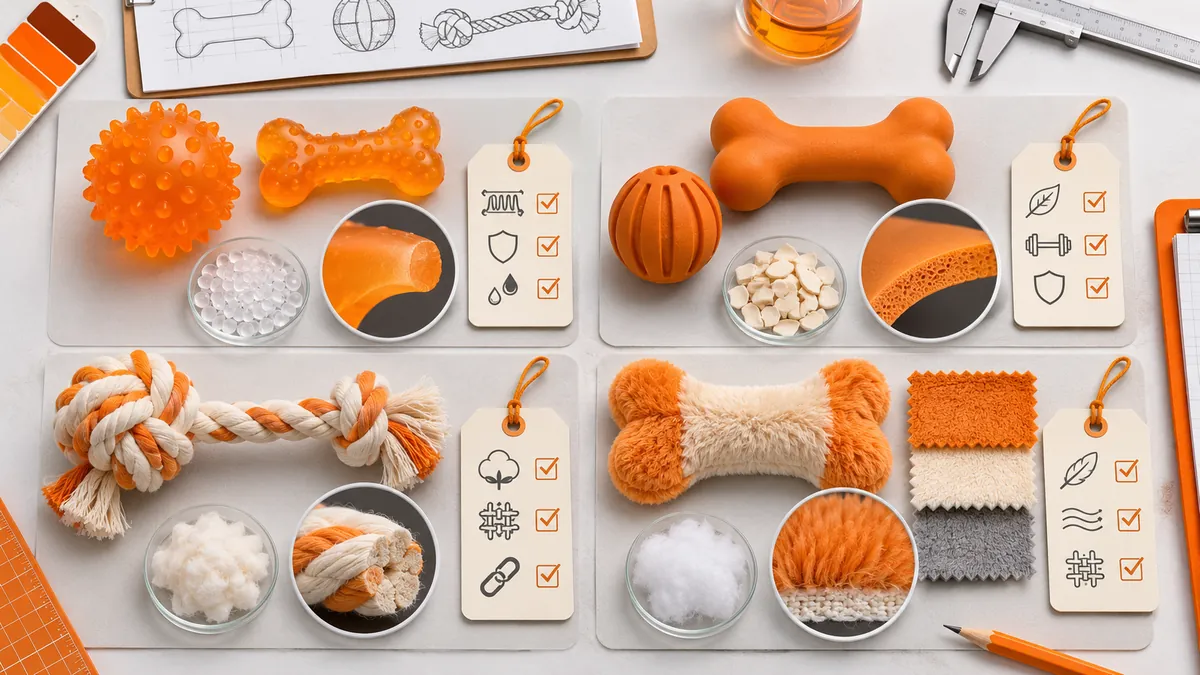
A capable custom dog toy manufacturer should be able to identify the material, control its construction, reproduce approved samples, and report how the finished toy was tested. A catalog description such as “rubber,” “rope,” or “plush” is not a specification. The RFQ should connect each material and design feature to a use case, failure mode, test setup, and acceptance decision.
Compare TPR rubber rope and plush
| Material family | Useful sourcing questions | Construction risks to review | Evidence to request |
|---|---|---|---|
| TPR | Compound identification, hardness range, colorant, odor, molding tolerance and recycled-content policy | Thin sections, knit lines, voids, sharp flash, insert bonding and inconsistent wall thickness | Material declaration, approved color/hardness sample, dimensional record and finished-toy compression or pull method |
| Natural rubber | Compound formulation controls, curing, hardness, odor and storage conditions | Tear initiation at holes or thin ribs, curing variation, surface bloom and aging change | Material declaration, hardness/tensile/tear test plan and finished-product sample results |
| Cotton or blended rope | Fiber content, yarn construction, rope diameter, twist, dyeing and end treatment | Fraying, knot slippage, exposed core, loose ends and color transfer | Fiber declaration, rope construction sheet, pull-test method and colorfastness plan where relevant |
| Plush | Face fabric, backing, filling, squeaker, thread, seam type and stitch density | Seam opening, loose pile, accessible filling, detached components and squeaker exposure | Bill of materials, seam specification, component-pull method and inspection record |
For vulcanized and thermoplastic rubber, ISO 37:2024 describes tensile stress-strain testing and ISO 34-1:2022 covers tear-strength methods using defined test pieces. These standards can support compound comparison, but they do not by themselves certify a finished dog toy or predict every chewing pattern. Use them only where the material and specimen scope fits, and add finished-product tests.
Match material to use case
Define the intended interaction before selecting material: fetch, tug, food dispensing, supervised chewing, comfort, squeaking, or a combination. Also define the target dog size range and the product dimensions. A soft plush comfort toy and a dense molded chew shape should not share the same performance claim or inspection plan.
A TPR dog toy material can be formulated across a wide hardness range and molded into flexible shapes, but the buyer still needs a controlled compound, wall thickness, geometry, and molding window. Natural rubber can provide resilience and tear resistance, yet formulation, curing, thin sections, and molded details affect the result. For natural rubber dog toys wholesale, compare production-equivalent samples rather than generic rubber plaques alone.
Rope products depend on fiber, yarn, twist, diameter, knot design, end finish, and attachment method. Plush products depend on fabric backing, pile, thread, seam allowance, stitch type, stitch density, filling, squeaker enclosure, and accessory attachment. List every component in the bill of materials and require approval before substitution.
Use Petlland’s dog toy product range to shortlist construction families, then review specific molded and textile examples such as the TPR chew stick and plush squeaky no-stuffing toy. Product names and marketing categories are starting points, not performance guarantees.
Define construction and chew tests
Write a finished-product test method for each credible failure mode. Record the sample ID, material batch, conditioning, fixture, load direction, loading rate, target load or displacement, hold time or cycle count, sample size, observed deformation, failure mode, and acceptance rule. Do not copy one universal load into every toy specification.
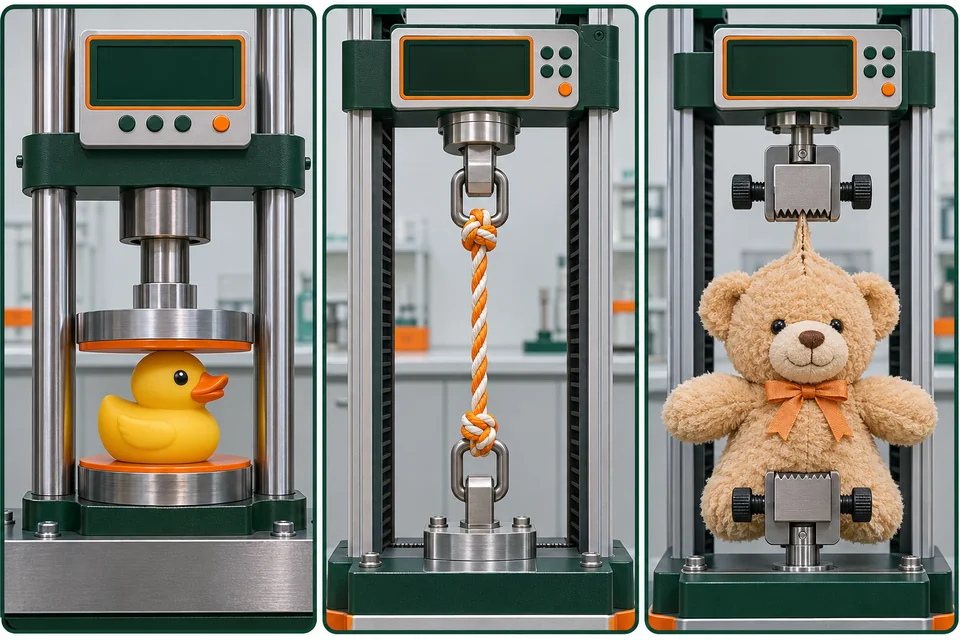
For molded toys, inspect dimensions, wall thickness where measurable, flash, voids, cracks, insert security, compression behavior, recovery, and tear initiation at holes or ribs. Material tensile or tear results can help compare compounds, while a finished-toy compression or pull test checks the actual geometry and process.
For rope, define the grip points so the fixture does not create an artificial cut. Record knot or splice movement, strand breakage, end opening, elongation, and whether any component detaches. For plush, test seams and attached components in directions that represent accessible pulling. ISO 13934-2:2014 describes a grab method for textile maximum force, and ISO 13935-2:2026 addresses maximum force to seam rupture for straight sewn seams. These laboratory methods may inform a test plan where their scope fits; curved toy seams and complete assemblies still need product-specific fixtures and criteria.
Document simulated-use checks without claiming they reproduce every dog. Record the jaw or probe geometry, force or displacement, cycle, contact location, environment, and inspection interval. Stop the test and classify the result when a crack, accessible filling, loose component, sharp feature, or other defined condition appears. State that “passed the agreed test” rather than “indestructible.”
Review packaging and warnings
Packaging should identify the product, material or care information where required, intended dog size or use, supervision instructions, inspection and replacement guidance, manufacturer or importer details required by the target market, lot traceability, and disposal information where applicable. Claims and warnings need a market-specific legal review.
A practical warning plan can tell the owner to choose an appropriate size, supervise use, inspect before and after play, and remove the toy if it becomes damaged or parts loosen. It should not promise that supervision eliminates all risk. If the product is not intended for children, assess the correct market wording rather than automatically copying a children’s-toy warning.
Request chemical documentation based on the materials, colorants, coatings, adhesives, printing, and target markets. In the EU, REACH restrictions can apply to substances in articles and apply to imports as well as domestic production. The buyer should identify the applicable restriction entries and test scope instead of asking only for a generic “REACH certificate.”
Create an RFQ test matrix
| RFQ field | Required detail |
|---|---|
| SKU and use case | Product dimensions, target dog size, intended interaction and excluded uses |
| Material and construction | Controlled material declaration, component BOM, hardness or fiber data, wall thickness, seam and attachment details |
| Test specimen | Compound plaque, fabric specimen, component, finished toy or all relevant levels |
| Test method | Fixture, direction, rate, load/displacement, hold/cycles, environment and inspection interval |
| Acceptance | Measurable limit, prohibited failure modes, sample count and defect classification |
| Evidence | Report number, date, sample/batch identity, equipment, photographs, raw result and disposition |
| Change control | Approval required before material, component, supplier, geometry, tooling or process changes |
Link the matrix to the approved sample, drawing, bill of materials, packaging artwork, and inspection plan. Classify defects and sampling in advance; Petlland’s AQL inspection guide can support that structure. Require a new risk and test review after any material, geometry, or component change.
Frequently asked questions
How should a buyer compare materials and testing when choosing a dog toy manufacturer?
Compare each material family and use case separately, then review controlled material declarations, construction details, production-equivalent samples, finished-product test methods, chemical requirements, warning language, traceability, and change control.
Does a pull test prove a dog toy is safe?
No. It shows performance under one defined setup. The result must be interpreted with material, construction, other failure modes, intended use, warnings, supervision, and market requirements.
Can a manufacturer claim a toy is indestructible?
Buyers should avoid absolute durability or safety claims. Dogs, use patterns, product sizes, and damage histories vary. Use specific, supportable performance statements and clear inspection and replacement guidance.
Sources and next step
Test-scope references: ISO 37:2024, ISO 34-1:2022, ISO 13934-2:2014, ISO 13935-2:2026, and the European Commission’s REACH restrictions overview. Confirm applicable editions and market requirements with qualified testing and compliance professionals.
Need the right material and construction options for your brief? Request a dog toy material and sample shortlist.