Quick answer: when sourcing custom pet ID tags, specify the base material and nominal thickness, finish, marking method, character layout and legibility criteria, edge condition, split-ring hardware, personalization-data workflow, packaging, and a written inspection plan. Approve physical samples before production, then record the exact test method and acceptance limit for each quality checkpoint. There is no single universal thickness, abrasion-cycle count, or pull load that fits every tag design; those values must match the intended product, market, and risk assessment.
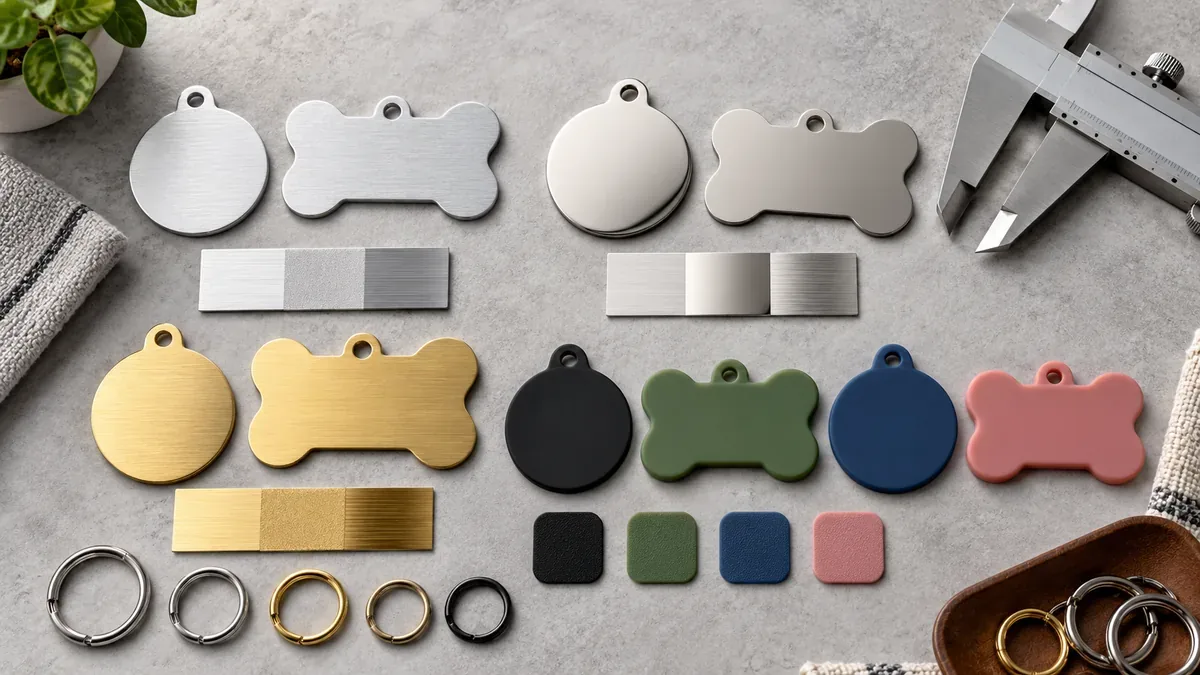
A buyer evaluating a pet ID tag manufacturer is not only choosing a shape and color. The supplier must translate artwork and variable data into a repeatable product that remains readable, feels safe at the edge, accepts the specified ring, and arrives in the correct retail or fulfillment pack. The most useful request for quotation therefore combines a bill of materials, controlled artwork, measurable workmanship requirements, approved samples, and traceable inspection records.
This guide gives importers, retailers, and private-label teams a practical specification framework. It also explains which claims should be supported by product-specific evidence instead of copied from a generic supplier sheet.
Compare tag materials
Material selection affects weight, corrosion behavior, surface appearance, marking contrast, edge finishing, cost, and the way a tag sounds against a collar. Ask the supplier to identify the exact grade or material family, nominal thickness with tolerance, temper or hardness where relevant, coating or plating system, color reference, and the material used for the ring. A sample that merely looks correct does not fully define the production item.
| Material | Typical sourcing advantage | Specification questions | Evidence to request |
|---|---|---|---|
| Aluminum | Low weight and broad color options through anodizing or coating | Alloy, thickness, finish system, color tolerance, sealing and marking contrast | Material declaration, finish sample set, thickness record and abrasion method |
| Stainless steel | Dense premium feel and strong metallic appearance | Grade, thickness, brushed or polished direction, burr control and marking method | Grade declaration, edge sample, finish master and legibility record |
| Brass | Warm premium color and classic appearance | Base alloy, protective finish, expected appearance change and packaging protection | Material declaration, finish sample, corrosion or tarnish test plan where required |
| Silicone | Soft touch, quiet contact and flexible color design | Material formulation, hardness range, molding tolerance, color reference and marking durability | Material statement, hardness/tolerance record and marking-abrasion record |
For anodized aluminum, ISO 7599:2018 provides a recognized framework for specifying decorative and protective anodic oxidation coatings on aluminum and its alloys. It does not replace the buyer’s product specification: the purchase document still needs the required appearance, thickness or class, test method, and acceptance criteria. For salt-spray testing, ISO 9227:2022 describes the apparatus, reagents, and procedure; it expressly does not set the product’s exposure duration or acceptance interpretation. Those belong in the tag specification or an agreed market requirement.
Record the material choice in a controlled bill of materials, including approved alternates. If a supplier wants to change alloy, finish chemistry, coating vendor, silicone compound, or thickness, require written change approval and a new sample review. That prevents a visually similar substitute from entering production without evaluating its effect on weight, marking, or durability.
Choose shape finish and marking method
Define the geometry with a dimensioned drawing rather than a catalog name such as “bone” or “round.” Include overall width and height, nominal thickness, hole diameter and position, corner radius, edge profile, front and back orientation, and the keep-out zone around the hole and perimeter. For a family of sizes, issue a separate drawing or a controlled dimension table for each size.
Finish requirements should cover color reference, gloss or texture, brushing direction, acceptable shade variation, masking areas, front-to-back consistency, and visible defects. Create a signed color and finish master under defined lighting. A screen photograph is not a reliable master because displays, cameras, and ambient light shift color.
Common marking choices include laser marking, mechanical engraving, rotary or diamond drag engraving, printing, embossing, and molded-in information. The correct process depends on the substrate and desired look. Specify whether the mark removes material, changes the surface color, cuts through a finish, or sits on top of it. Then define the observable result: character position, line weight or stroke, depth where applicable, contrast, fill color if used, and the treatment of very small characters.
Ask the manufacturer for a process-matched sample matrix covering each approved material, finish, and marking method. A single stainless-steel sample does not validate anodized aluminum or silicone. For custom dog tags wholesale, the matrix should also include the smallest and largest tag, the longest approved text string, and a two-sided layout if both sides are offered.
Set engraving and legibility standards
“Clear engraving” is not an inspection rule. Turn it into a measurable and repeatable control. The artwork file should define the approved font or vector paths, minimum character size, line spacing, alignment, safe area, and rules for unsupported symbols. The production file should preserve the approved artwork version and link it to the order or batch.
For appearance inspection, define the lighting, viewing distance, viewing angle, background, and whether magnification is allowed. Record character completeness, contrast, position, spelling, and front/back orientation. If mark depth or stroke width is critical, name the measurement tool, measurement location, sample quantity, and tolerance. Do not accept a vague statement such as “deep enough.”
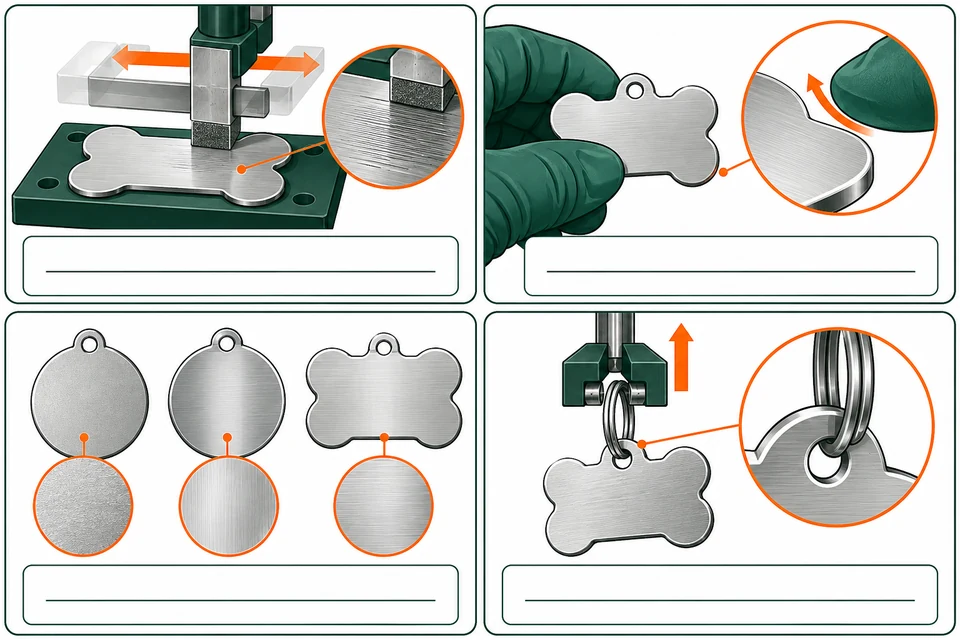
An abrasion record for characters should identify the sample and batch, material and finish, marking process, fixture, contact medium, applied load, stroke length or cycle definition, number of strokes or cycles, speed, inspection lighting and distance, before-and-after photographs, legibility result, and acceptance decision. The buyer must set the required load and cycle count for the intended use. ISO 1518-1:2023 can be relevant when a constant-load scratch test is specified for a paint or varnish coating, while ISO 2409:2020 describes a cross-cut classification for coating separation. Neither standard is a universal proof that a finished pet tag will remain readable for every use condition.
Approve the test on actual production-equivalent tags. Flat coating coupons are useful for process control, but their geometry and edge exposure may differ from the finished tag. Keep the approved sample, photographs, test record, equipment identification, date, operator, and disposition together. This evidence makes supplier comparisons more meaningful than an unsupported “wear resistant” claim from an engraved pet tag supplier.
Specify rings and edge safety
The split ring is part of the product, not an interchangeable accessory. Define its material, wire diameter, outside and inside diameter, finish, number of turns, opening behavior, and any corrosion requirement. Check that the ring fits the tag hole and intended collar hardware without excessive force, permanent opening, or finish damage.
A ring pull test record should state ring wire and diameter, material and finish, fixture, tag orientation, load direction, loading rate, target load, hold time, sample count, opening or deformation observed, failure mode, and acceptance decision. The buyer must choose the target load and sample plan based on the product design and risk assessment; do not copy an arbitrary number from another tag or market.
Inspect edges and holes for burrs, sharp points, incomplete deburring, coating buildup, cracks, and exposed substrate where the specification does not allow it. Define an agreed tactile or comparator method and, where needed, a magnified visual check. Include the hole edge because it is easy to overlook and directly contacts the ring. The approval sample should show the acceptable edge profile on every material and thickness.
Incoming and final inspections should record the sampling plan and defect classification. Petlland’s AQL inspection guide for pet products can help buyers structure critical, major, and minor defects, but the defect list and limits still need to be agreed for this specific item.
Plan personalization and packaging workflow
Personalization creates a data-control problem as well as a manufacturing step. Map the complete flow: customer order, data export, validation, production file, machine queue, inspection, packing, shipment, retention, and deletion. Use an order token or internal job ID as the primary identifier. Restrict access to the minimum staff and systems required, encrypt transfers, log changes, and agree a retention period. Never use real customer phone numbers in samples, factory test files, training images, or quality reports; use obvious dummy data such as “SAMPLE A” and a non-contact placeholder.
Define validation rules before the file reaches the machine: permitted character set, maximum characters by tag size, handling of emojis or unsupported symbols, capitalization, line breaks, blank fields, duplicate orders, and side-one/side-two mapping. A preflight report should identify rejected rows rather than silently truncating text. Require a controlled proof for new artwork or layout changes and a documented rework process for incorrect data.
For private label pet ID tags, packaging specifications should state the unit pack, backing card or pouch dimensions, material, print files and revision, barcode type and placement, country-of-origin and compliance markings where applicable, ring attachment method, protective film, assortment logic, carton quantity, carton markings, and drop or transit checks if required. Keep personalized data from being visible through the wrong pack or paired with the wrong barcode. See Petlland’s private-label pet product packaging guide for a broader packaging brief.
Before issuing a purchase order, request a production-equivalent sample set from the pet ID tag product program. Approve the material, finish, engraving, ring, packaging, and variable-data workflow as one system. Then freeze the approved documents: drawing, bill of materials, artwork, color master, data template, test methods, defect list, sampling plan, packaging specification, and change-control process.
Frequently asked questions
What should a buyer specify when sourcing custom pet ID tags?
Specify the material and nominal thickness, shape and dimensions, finish, marking process, artwork and character rules, legibility and abrasion method, edge condition, ring hardware and pull-test method, personalization-data controls, packaging, sampling plan, acceptance limits, and change approval. Approve physical samples that represent every material and process combination.
Which pet ID tag material is best?
There is no universal best material. Aluminum prioritizes low weight and color range; stainless steel offers a dense metallic feel; brass provides a warm premium look; silicone offers softness and quieter contact. The best choice depends on the product position, marking method, target weight, durability evidence, and cost.
How should engraving durability be tested?
Use production-equivalent tags and a written method that records the fixture, contact medium, load, stroke or cycle definition, count, speed, inspection conditions, before-and-after legibility, sample count, and acceptance decision. Set the values for the intended product rather than treating one cycle count as universal.
How can buyers protect personalization data?
Minimize the fields sent to the factory, use order tokens, restrict access, encrypt transfers, validate files before production, log changes, prohibit real data in samples and training, and define retention and deletion. Inspect the pairing of the tag, packaging, and barcode to prevent mix-ups.
What belongs in a pet ID tag sample approval?
Include each material, finish, size, marking method, front/back layout, edge profile, ring, longest approved text case, and final packaging configuration. Sign and date the samples, link them to controlled drawings and test records, and require approval before any material or process change.
Sources and next step
Technical references used for test-scope guidance: ISO 7599:2018, ISO 9227:2022, ISO 1518-1:2023, and ISO 2409:2020. Confirm the latest applicable edition and market requirements with your qualified compliance team.
Ready to compare a controlled sample set? Request pet ID tag material and engraving samples.