A buyer can reduce sizing and fit problems with a dog clothing manufacturer by defining the target fit, measurement points, size-grading rules, fabric behavior, care conditions and finished tolerances before bulk production. The approved fit sample should be linked to a dimensioned specification and a repeatable inspection method. A generic size label or one supplier chart is not enough because dog proportions, garment construction and material stretch vary.
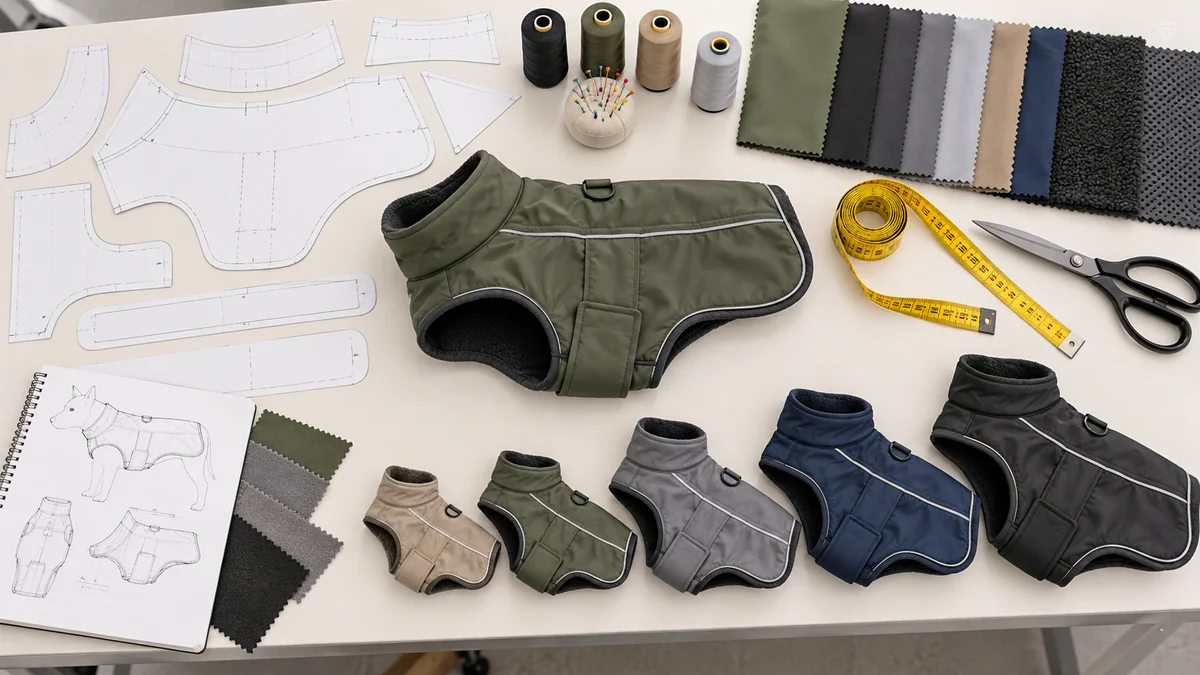
This guide is for buyers evaluating a dog clothing manufacturer, wholesale dog clothes manufacturer, custom dog apparel program or pet clothing size chart. It focuses on the records that make fit repeatable: target body profile, garment measurement method, pattern revision, material lot, graded sample results, dimensional change after care and production inspection. It does not claim that one chart can fit every breed or body shape.
Define the target fit and garment type
Start with the garment’s purpose and fit intent. A rain shell, insulated coat, recovery suit and decorative sweater do not use the same ease, coverage or closure strategy. Define whether the garment should sit close to the body, allow a base layer, protect the chest, avoid the shoulder joint or leave room for a harness. Record the expected posture during measurement and use because a dog standing square differs from a dog sitting, bending or moving.
Describe the target population without turning breed names into fixed dimensions. Breed can be a sampling aid, but dogs within the same breed may differ in chest depth, back length, neck shape, coat volume and body condition. Build the range around measured body profiles and fit objectives. If the assortment serves several shapes, consider separate blocks such as standard, broad-chest or long-back rather than forcing every dog into one linear grade.
| Fit-brief field | What the buyer should define | Approval evidence |
|---|---|---|
| Garment type | Coat, vest, sweater, recovery suit or other construction, including layers and intended season | Released sketch, bill of materials and pattern revision |
| Fit intent | Close, regular or layered fit; permitted ease at neck, chest and body; movement and coverage goals | Fit-review notes and photographs from agreed angles |
| Target body profile | Body measurements and shape characteristics used to develop each block, without treating breed as a guarantee | Anonymized measurement set and selected fit mannequins or dogs |
| Functional clearances | Leg opening, shoulder, abdomen, tail, harness access, closure overlap and male-dog belly clearance where relevant | Movement checklist and sample observation record |
| Wearing condition | Over bare coat or another layer, expected coat volume, closure setting and any accessory interaction | Approved trial condition recorded with the sample |
Define unacceptable fit conditions before the first sample: neck restriction, chest compression, gaping, twisting, backward migration, leg rubbing, closure strain, exposed seams against the skin or interference with elimination. These observations are qualitative, so pair them with garment dimensions and a consistent fit-review form. Photograph the garment from the side, top, front and underside, and record the sample size, body measurements, material and pattern version.
Decide who can approve fit and how changes are controlled. A comment such as “make it a little larger” is not executable. A revision should name the affected pattern piece or finished measurement, the change amount, the reason, the sizes affected and whether adjacent sizes must be resampled. Preserve the rejected sample data; it helps explain why the released dimensions were chosen.
Build measurement points and grading
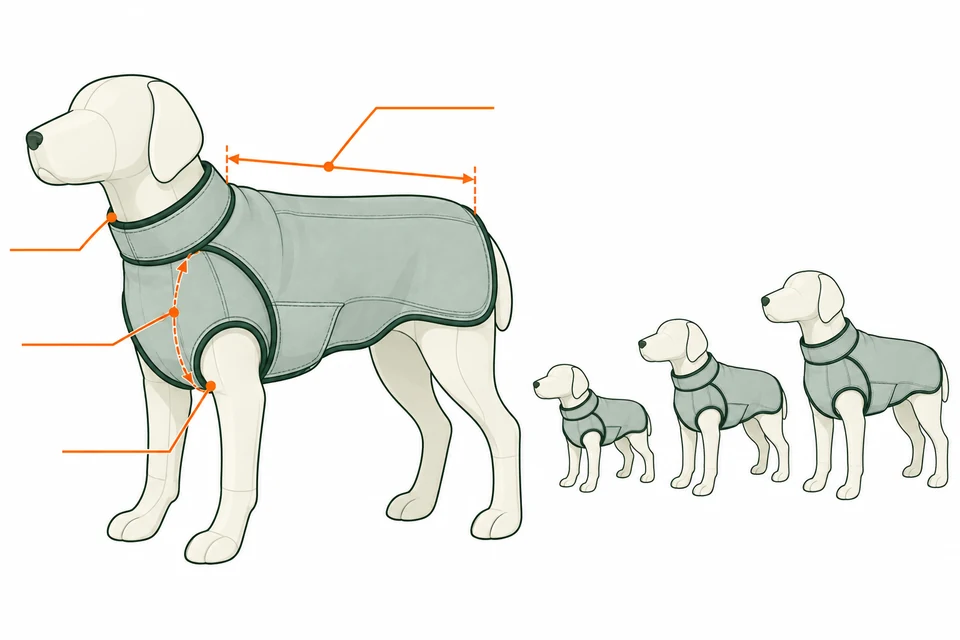
Create separate definitions for body measurements and finished-garment measurements. Back length on a dog may run from a defined neck landmark to the tail base, while back length on a coat may follow a seam or center-back edge. Chest girth on the body and half-chest width on a flat garment are not interchangeable. Every point of measure needs a diagram, start and end landmarks, garment orientation, closure state, tension and tool.
For stretch garments, state whether the item is measured relaxed, lightly smoothed or under a defined extension. For padded garments, define whether loft is compressed. For hook-and-loop closures or adjustable straps, identify the overlap or setting. Inspectors should use the same method as the development team; otherwise two accurate measurements can still disagree.
| Measurement field | Executable instruction | Record format |
|---|---|---|
| Point of measure | Code and diagram showing exact landmarks, seam line or edge path | POM code, nominal dimension and drawing revision |
| Sample state | Conditioned or as received; fastened or open; relaxed, smoothed or loaded | Conditioning, closure setting and applied tension |
| Method | Flat, circumference or on-form measurement; straight or along a curve; instrument resolution | Individual reading, unit, operator and instrument ID |
| Tolerance | Plus/minus or asymmetric limit tied to the size and construction | Lower limit, upper limit and pass/fail result |
| Location control | Distance from a seam, edge, center line or hardware reference | Measured position and any deviation |
Build grading rules from the approved base pattern and target body data. Do not scale every dimension by one percentage. Chest, neck, back, leg openings, strap length, closure overlap and hardware placement may need different increments. A grade rule should show the change from one size to the next at each pattern point or finished point of measure. If the range changes block shape, identify the break size.
Review the complete size table for internal logic. A larger chest with an unchanged leg opening may restrict movement; a longer back without moving the belly edge may create soiling or fit problems. Confirm that closure overlap and adjustment range remain usable at both tolerance limits. Grade labels should map to actual dimensions, not marketing assumptions.
Sample at least the base size and the range extremes, then add intermediate sizes where the block changes or risk is higher. When practical, fit each selected size on more than one target body profile. Record the dog or mannequin measurements in anonymized form, the garment readings and the observations. This evidence supports a size system; it does not prove universal fit.
Choose fabric and trims
Material selection affects fit before sewing begins. Record fibre content, knit or weave, mass per area, thickness, stretch direction, extension and recovery, surface finish, coating or membrane, lining, insulation and approved supplier reference. A fabric name such as “polyester stretch” is not enough because two materials with the same fibre label can drape, recover and change dimension differently.
ISO 20932-1:2018 describes strip methods for elasticity and related properties of fabrics, excluding narrow fabrics, and remains current with its amendment. If stretch and recovery affect fit, specify the method, direction, load or extension regime, conditioning and acceptance criteria. Test both principal directions when the garment relies on crosswise stretch but should resist lengthwise growth.
| Material or trim | Specification fields | Fit-related checks |
|---|---|---|
| Shell or knit | Supplier code, composition, construction, weight, thickness, stretch direction, color and finish | Extension, recovery, dimensional change, hand and shade lot |
| Lining and insulation | Composition, weight or loft, attachment and quilting spacing | Bulk, migration, seam interaction and post-care appearance |
| Elastic | Width, construction, supplier, cut length, extension setting and recovery requirement | Relaxed length, applied extension, attachment consistency and fatigue where relevant |
| Closure | Zipper, snap, hook-and-loop or buckle type; dimensions, placement and operating direction | Engagement, adjustment range, skin clearance and function after care |
| Thread and seam | Thread type/size, stitch type, density, seam allowance and reinforcement | Seam appearance, stretch compatibility, slippage or rupture method where applicable |
Match the seam construction to fabric behavior. A rigid thread or short stitch may restrict a high-stretch knit. A bulky seam at the axilla can rub even when the flat pattern is correct. ISO 13935-2:2026 covers maximum force to rupture for applicable straight sewn seams using the grab method; its scope does not automatically cover every curved dog-garment seam or every coated, knitted or nonwoven material. If the method is adapted, label it as an internal method and document the specimen, direction and deviation.
Evaluate trims as part of the finished garment. Check zipper length and end stops, snap alignment, hook-and-loop overlap, elastic setting, binding tension, reflective tape placement and harness-opening reinforcement. A trim substitution can change stiffness, weight, closure range or wash behavior, so change control should trigger a fit and dimensional review.
Color and finish approvals should be tied to bulk material lots. If the style combines shell, binding, thread and hardware, define whether they must match or coordinate and under which light they are reviewed. Avoid performance or safety claims for water resistance, insulation, reflectivity or visibility unless the claim has a defined method, acceptance limit and result for the production-intent construction.
Approve fit samples and tolerances
Approve fit in stages: development sample, corrected fit sample, graded size set and pre-production sample made with production-intent materials and processes. The golden sample and specification guide explains why a physical sample should be linked to measurable requirements and a revision-controlled record. The signed sample is a construction reference, not a substitute for the measurement table.
Set finished tolerances according to function, measurement repeatability and process capability. A small opening or closure location may need tighter control than a decorative hem. Avoid copying one tolerance across all dimensions and sizes. Check tolerance stacking: if neck opening, closure overlap and binding width all vary in the unfavorable direction, the combined result may fail even though each individual field passes.
Measure before and after the agreed care process. ISO 6330:2021 specifies domestic washing and drying procedures for textile testing and notes that machine, detergent and dryer parameters can affect results. ISO 5077:2007 provides a method for determining dimensional change after specified washing and drying. The order specification should therefore record the exact wash procedure, detergent, ballast, drying method, number of cycles, conditioning and measurement marks rather than writing only “wash test.”
| Wash and fit record | Required entry |
|---|---|
| Sample identity | Style, size, color, pattern/BOM revision, material lot and sample stage |
| Care procedure | Method reference, machine type, cycle, temperature, detergent, ballast, drying route and cycle count |
| Measurement basis | POM diagram revision, conditioning, closure state, instrument and operator |
| Before/after data | Individual dimensions, calculated change by direction and any distortion or spirality |
| Appearance/function | Puckering, delamination, pilling, color change, trim damage, closure function and seam condition |
| Decision | Acceptance limits, result, corrective action, approver and date |
After care, repeat the fit review when dimensional change, material recovery or trim distortion could affect wearing performance. A garment may meet flat dimensions yet twist on the body, or it may change at the chest more than at the back. Keep the post-care measurements with the same sample identity so the factory cannot compare unrelated fabric or size records.
Care symbols and wording must be supported by the approved care evidence and destination-market review. ISO 3758:2023 establishes a care-labelling symbol system for textile articles and describes the most severe treatments that do not cause irreversible damage. It does not replace market-specific legal review. Confirm the destination’s fibre, origin, responsible-party, language, warning and care-label requirements before printing bulk labels.
Inspect production and labeling
Production inspection should verify identity, workmanship, dimensions, function, labeling and packing. Start with the approved BOM, patterns, size chart, POM diagram, tolerance table, color standards and sealed sample. Inspect across sizes, colors, sewing lines and cartons so the result represents the order rather than one convenient batch.
Measure a planned size distribution. The highest-risk sizes may be the smallest opening, the largest panel, a break size or a size with different hardware. Record actual measurements rather than only pass/fail. If a point is outside tolerance, identify the pattern or sewing cause, quarantine affected units and determine whether adjacent sizes or lots require expanded inspection.
The planned pet product quality control checklist should cover stitch density, seam allowance, skipped stitches, puckering, raw edges, binding, elastic tension, closure alignment, sharp components, thread trimming, symmetry and contamination. Functional checks should include fastening, adjustment, harness access and movement of any zipper, snap or buckle. Destructive seam or material tests may require a separate sample plan from visual AQL inspection.
| Inspection area | Production record | Escalation trigger |
|---|---|---|
| Dimensions | Size, POM, nominal, tolerance, actual reading and result | Out-of-tolerance result, trend toward a limit or inconsistent method |
| Fit-critical construction | Pattern revision, seam location, elastic setting, closure overlap and hardware position | Unapproved change, asymmetry, restriction or loss of adjustment |
| Workmanship | Defect type, severity, location, quantity, photographs and disposition | Critical hazard, repeated major defect or concentrated process failure |
| Labels | SKU/size, fibre/origin/care content as applicable, placement, permanence and barcode verification | Wrong size, unsupported care instruction, missing required information or unreadable code |
| Packing | Folding method, protection, unit count, assortment, carton marks and carton condition | Permanent creasing, trim damage, moisture risk, mixed sizes or incorrect marks |
Control labels as components. The size label must match the garment measurements and pack assortment. The care label must match the verified material and process. Barcode, SKU, color and size need a single source of truth. Check label placement for comfort and durability, especially where a stiff edge or heat-transfer label could contact the dog.
Packaging should preserve the approved shape. Define folding lines, closure state, tissue or separator needs, bag ventilation where appropriate, hanger or insert use, and carton compression limits. Recheck the product after packed storage or transit conditioning when loft, creasing, coating or decorative parts can change.
Petlland’s planned dog clothes category can be used to discuss garment types, materials and target price points. For development, provide a target fit brief, body-profile data, size architecture, material requirements, destination market and expected quantity.
Request a dog apparel sizing and sample review. Send Petlland your garment concept, target body profiles, proposed size range, materials, care expectations and launch quantity. The team can prepare a measurement diagram, sample brief and inspection-record format for comparable supplier review.
Frequently asked questions
What should a buyer send to a dog clothing manufacturer?
Send a garment sketch, fit intent, target body profiles, body and finished-garment measurement definitions, graded size table, pattern or block reference, bill of materials, stitch and trim specifications, tolerances, care procedure, label requirements, packaging and approval workflow.
Can one pet clothing size chart fit every dog breed?
No. Breed names do not guarantee body proportions, coat volume or condition. Use measured body profiles and a stated fit objective, consider separate shape blocks where necessary, and validate selected sizes on representative targets. Present the chart as a selection aid rather than a universal fit promise.
How should dog apparel measurement points be written?
Give each point a code and diagram, define the exact landmarks or seam path, state whether the garment is flat or on-form, identify the closure setting and applied tension, and record the tool, nominal dimension and tolerance. Inspectors and developers must use the same method.
Why should a garment be measured after washing?
Fabric, seams, lining, insulation and trims can shrink, grow, twist or distort differently. Use an agreed washing and drying procedure, measure the same defined points before and after conditioning, calculate dimensional change, and repeat the fit/function review when the change could affect use.
Which sizes should be sampled before production?
Approve the base size and range extremes, then add break sizes or high-risk sizes where block shape, materials, trims or hardware change. Review more than one target body profile when practical. The sample set should challenge the grading logic rather than merely repeat similar sizes.
Sources
- ISO — ISO 20932-1:2018, Textiles: Determination of the elasticity of fabrics, Part 1: Strip tests
- ISO — ISO 6330:2021, Textiles: Domestic washing and drying procedures for textile testing
- ISO — ISO 5077:2007, Textiles: Determination of dimensional change in washing and drying
- ISO — ISO 13935-2:2026, Seam tensile properties using the grab method
- ISO — ISO 3758:2023, Textiles: Care labelling code using symbols