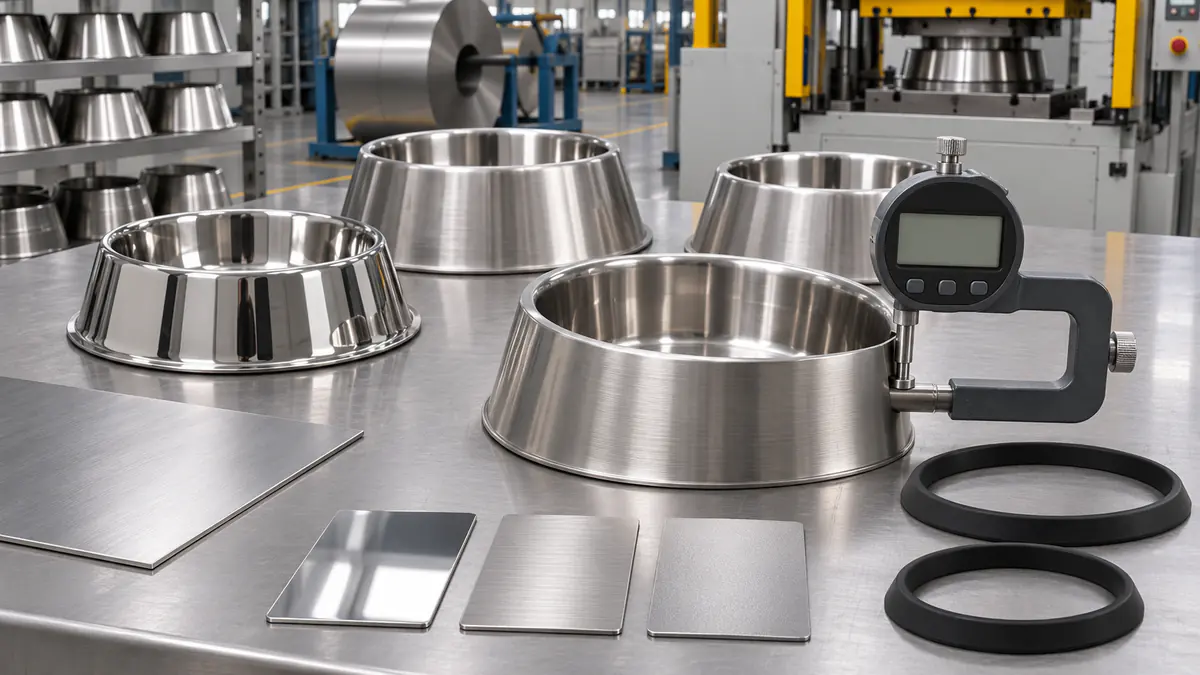
A dependable stainless steel pet bowl manufacturer can show what metal it bought, how it formed each bowl and how the finished product performs on a counter or floor. A smooth photograph cannot confirm steel chemistry, wall thickness, rim quality or the grip of a removable base. Buyers should make those details part of the approved sample and purchase specification.
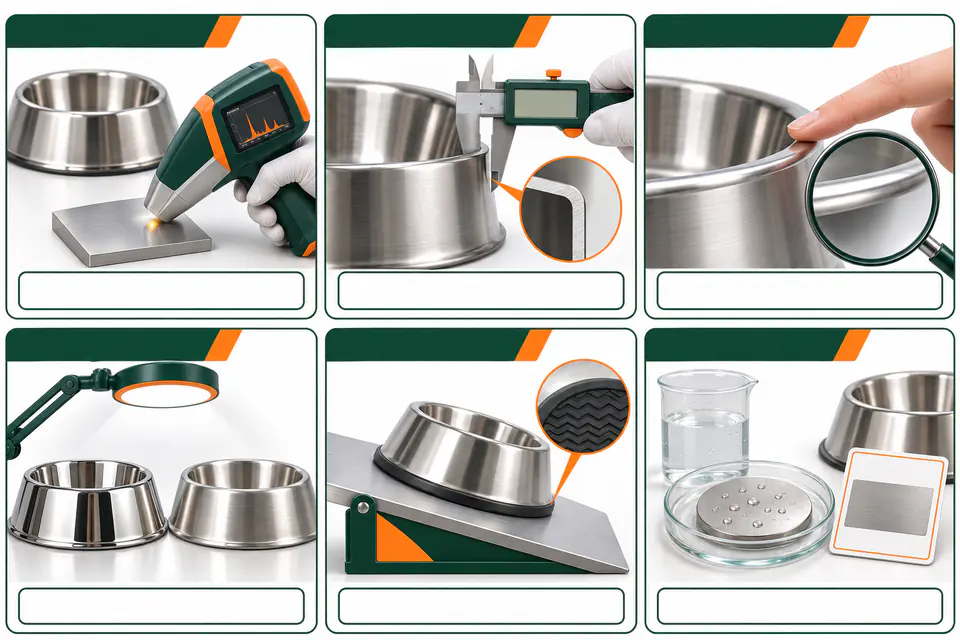
Quick answer: request a heat- or lot-linked material declaration; verify the agreed grade on incoming metal; measure thickness at agreed points; inspect drawn walls, rims and any welds; compare finish against a physical standard; and test stability, cleaning exposure, corrosion and base retention under written conditions. Then inspect packed bowls for abrasion and transit damage.
This guide is a sourcing and quality-control framework. A qualified laboratory and the buyer should confirm the test methods, limits and market requirements for the exact bowl and intended use.
Verify material grade and declarations
Write the steel designation into the specification, including the standard or equivalent system used by the mill. “Stainless” and “food grade” alone do not identify a material. The supplier should provide a mill certificate or material declaration with grade, heat number, chemistry, product form, thickness and supplier identity. Link the incoming coil or sheet, production lot and finished-bowl batch in the traceability record.
Grades such as 304 and 316 can suit food-contact applications, but grade choice depends on exposure, cleaning chemicals, chloride content, forming and cost. The stainless industry’s kitchen guidance discusses 304 and 316, while its corrosion resources explain why resistance varies by environment. Avoid treating a grade number as a blanket no-rust guarantee.
Evidence to request before approving a sample
- A material certificate or declaration tied to the lot, plus an agreed method for incoming-grade verification.
- A drawing that identifies steel grade, nominal thickness, finish, dimensions, rim construction and any joining method.
- Records for any coating, adhesive or rubber component that touches food or water, with the intended market and use conditions identified.
For U.S. claims about food-contact materials, review the FDA’s food-contact information with a qualified adviser. The exact article, component and use conditions determine the evidence needed; a general grade statement is not a finished-product approval.
Specify thickness shape and finish
Give the stainless steel pet bowl supplier a section drawing rather than capacity and diameter alone. Record top diameter, base diameter, height, usable volume, wall profile, rolled-rim geometry, drainage or stacking features and the measured wall-thickness locations. Deep drawing can leave different thicknesses at the base, shoulder and sidewall. Define tolerances for each point instead of relying on starting-sheet thickness.
Specify the finish with a signed reference sample and observable defect limits. A polished bowl may show drag lines, cloudy patches, buffing marks or embedded particles under the agreed inspection light. A brushed finish needs direction and consistency. The World Stainless surface-finishes guide links finish selection with corrosion performance and cleaning, so surface appearance and service conditions should be reviewed together.
| Specification field | Buyer records | Inspection evidence |
|---|---|---|
| Grade | Standard designation and approved equivalent | Lot-linked certificate and incoming check |
| Wall thickness | Locations, nominal values and tolerances | Calibrated gauge readings at each point |
| Geometry | Diameter, height, volume and rim profile | Drawing, gauge and approved sample |
| Finish | Reference sample and defect criteria | Inspection photos under agreed lighting |
Inspect forming edges and welds
Inspect the formed bowl before the rubber ring hides the base. Look for wrinkling, thinning, splits, deep tool marks, uneven rims and deformation. Run a controlled edge check around the entire rim and underside; record sharp edges, burrs and exposed seams. If the design includes a welded bracket, emblem or base component, document the weld location, approved appearance, cleaning access and acceptance criteria.
A rolled rim can feel smooth at one point and contain a local burr where forming ends meet. Set the inspection position and lighting in the work instruction, then photograph failures with a scale. For a welded construction, ask the factory to show how it prevents crevices, heat tint and trapped residue. Buyers comparing stainless dog bowls wholesale should inspect multiple production cavities and shifts rather than a single showroom sample.
Test stability corrosion and rubber base
Stability depends on diameter, center of gravity, fill level and the floor surface. Define a representative dry and wet surface, bowl fill, tilt or push method and pass criteria before testing. Run the same method with the approved non-slip ring fitted and after repeated removal and cleaning. Measure ring fit, retention and deformation; inspect the adhesive or mechanical joint if the base is not removable.
Corrosion checks need a defined exposure. State the medium, concentration, temperature, duration, cleaning cycle, rinse procedure and rating method. A salt-spray result alone may not predict every household washing condition. Select an applicable laboratory method for the intended environment and compare tested bowls with a retained control. Record discoloration, pitting, staining and changes at rolled edges or welds.
Set lot inspection by an agreed sampling plan. ISO 2859-1:2026 describes acceptance sampling for attributes; the buyer still has to define defects, inspection level and acceptance quality limits for this bowl. For an implementation framework, see Petlland’s AQL inspection guide for pet products.
| Test | Conditions to write down | Evidence to retain |
|---|---|---|
| Base stability | Surface, fill, load direction and limit | Video or readings and failure mode |
| Rubber retention | Fit method, cycles and cleaning exposure | Before/after dimensions and photographs |
| Corrosion | Medium, temperature, time and rating | Lab report, control sample and images |
| Rim/finish | Light, distance and defect standard | Inspection sheet and marked sample |
Protect surfaces during packing
A passed inspection can lose value in transit if polished bowls rub against one another. Define an individual sleeve or separator, stack height, carton count, orientation, cushioning and moisture control. Check that packaging materials do not leave dye, adhesive residue or scratches on the contact surface. The box label should identify the bowl SKU, lot, quantity and handling requirements.
Run a packed-sample transit trial that reflects the distribution route. Open cartons after the agreed handling sequence and inspect rims, finish, bowl shape and base fit. Keep photos of the packing method and damage, then revise dividers or carton strength before the bulk order ships. A non slip dog bowl manufacturer should also confirm that the rubber base stays attached or remains with the correct bowl through packing and unpacking.
For a broader supplier comparison, use the pet bowl manufacturer guide. Petlland’s 304 stainless slow feeder bowl illustrates a live product format; its specifications still need to be confirmed for the exact project.
FAQ
Which stainless steel grade should I specify for a pet bowl?
Choose the grade after defining the food or water contact, cleaning agents, chloride exposure, target market and cost. Ask the mill or factory for a lot-linked declaration and have a qualified laboratory confirm any required market-specific evidence.
How do I check bowl wall thickness?
Set measurement points on the drawing, including the base, shoulder and sidewall. Use a calibrated gauge on an agreed sample from production and record each reading against the tolerance.
What should a non-slip base test cover?
Test grip on specified surfaces, stability at a stated fill level, ring retention and behavior after repeated removal and cleaning. Report the conditions and failure mode instead of a pass mark alone.
Can one corrosion test guarantee that a bowl will not rust?
No single exposure covers every cleaning chemical, water chemistry and usage pattern. Agree on conditions that represent the intended use, then document results, limitations and any follow-up tests.
Request stainless pet bowl samples and evidence
Send Petlland your drawing, target grade, finish reference, size range, base design, market and target order quantity. Request stainless pet bowl samples and evidence, including the material declaration, measurement sheet, finish standard and proposed test plan.