To compare a pet bowl manufacturer, first match the material and forming process to the intended use, then control the measurable details: dimensions, usable capacity, rim finish, food-contact evidence, stability, corrosion or glaze performance, and protective packaging. Stainless steel, silicone and ceramic bowls can all be suitable, but they fail in different ways. A useful supplier comparison therefore uses one released specification and material-specific inspection records instead of a generic sample approval.
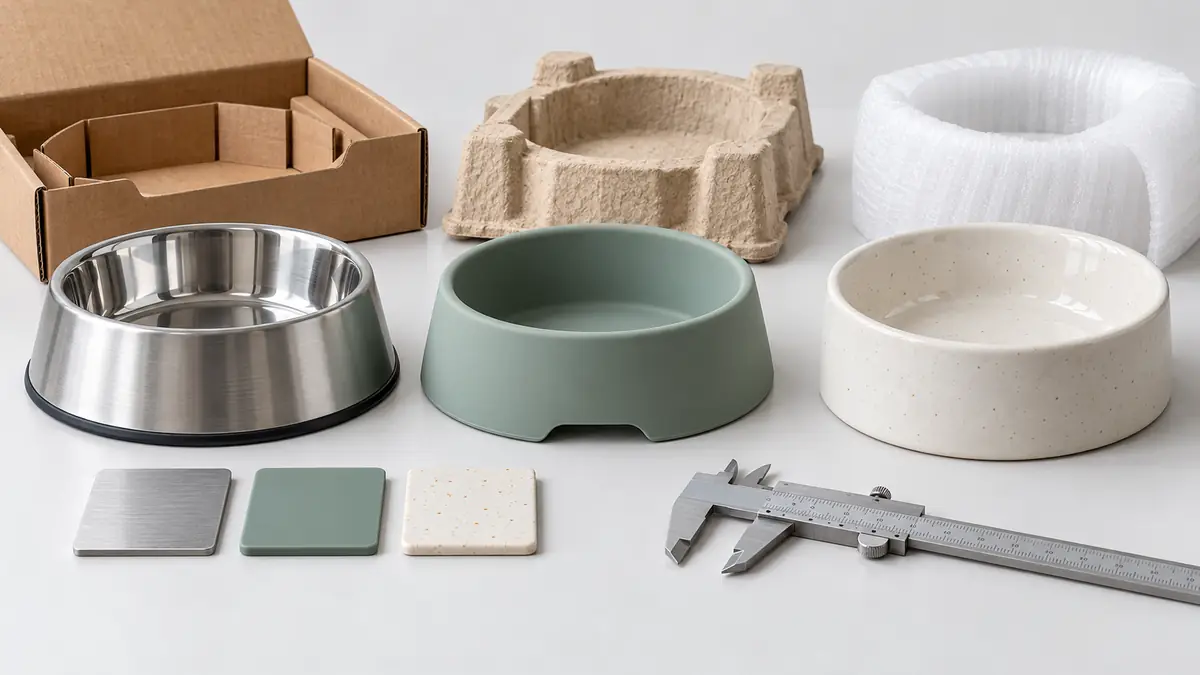
The best route depends on what the buyer needs to control. Stainless steel offers a thin, impact-tolerant body but requires grade, gauge, forming and surface-finish controls. Silicone can produce flexible, collapsible or non-slip forms, but the compound, cure and odor expectations must be specified. Ceramic offers weight, appearance and perceived quality, while firing, glaze, impact protection and extractable-element evidence deserve closer attention.
This guide gives a procurement framework for brands comparing a pet bowl manufacturer, a stainless steel pet bowl supplier, a silicone dog bowl manufacturer or a ceramic pet bowl wholesale program. It does not treat a material name, a laboratory logo or the phrase “food grade” as complete evidence. Requirements must be checked against the finished article, intended use and destination market.
Compare bowl materials and processes
Start with the process route because it determines the practical controls, tooling and likely defect modes. Two bowls described with the same material can be very different products if one is a single-wall formed shell and another is a double-wall assembly, if one silicone item is compression molded and another is liquid-injection molded, or if one ceramic body is pressure cast and another is made through a less controlled craft process.
| Material route | Processes to identify | Useful specification fields | Typical review points |
|---|---|---|---|
| Stainless steel | Deep drawing or spinning; trimming; rolling or polishing the rim; welding for double-wall designs; optional coating or bonded base | Declared alloy or grade, sheet gauge, single- or double-wall construction, finish reference, base material and adhesive or bonding method | Rim smoothness, dents, waviness, polishing consistency, weld condition, coating adhesion, flatness and corrosion marks |
| Silicone | Compression molding or liquid-injection molding; post-curing where required; trimming; bonding or overmolding of rigid inserts | Compound identification, color, hardness target, mass, odor criterion, post-cure record, temperature/use limitations and insert material | Flash, short fill, bubbles, tackiness, odor, color variation, deformation, tears around thin sections and insert separation |
| Ceramic | Slip casting or pressing; drying; bisque firing; glazing and decoration; glaze firing; base grinding and optional non-slip pad | Body and glaze references, dimensions after firing, color/gloss range, decoration location, base finish, pad material and firing controls | Cracks, crazing, pinholes, glaze skips, warpage, sharp foot rings, decoration defects, rocking and impact damage |
Ask shortlisted factories to map the process from incoming material to packed product. The map should name the operations performed in-house, those subcontracted, the checkpoints after each risk-producing stage and the records retained by batch. For ceramic products, confirm whether the factory controls body preparation, glaze preparation and firing or buys pre-mixed inputs. For steel, confirm whether polishing, coating and bottom-pad bonding are controlled by the same plant. For silicone, connect the compound batch and cure record to the finished production lot.
Material identity should be traceable. A generic statement such as “stainless,” “silicone” or “ceramic” is not enough for repeat production. The purchase specification should identify the approved grade, compound or body-and-glaze system and state whether substitutions require written approval. If the product combines materials, list every food-contact and non-food-contact component, including coatings, printing, adhesives, rubber rings and decorative elements.
Specify dimensions capacity and finish
A bowl sample can look correct while holding less than expected, rocking on a flat surface or exposing a rough edge. Convert those judgments into measurement instructions. Provide a drawing with the points to measure, the tolerance for each point, the conditioning state and the method used. Flexible silicone should not be stretched or squeezed during measurement; ceramic tolerances may need to reflect firing variation; formed metal needs defined datum points because rolled edges and tapered walls can make casual measurements inconsistent.
At minimum, control top outside diameter, opening diameter, base diameter, overall height, internal depth, wall thickness where practical, product mass and usable capacity. State whether the listed capacity means brimful volume or a working fill line. For buyer comparisons, a practical capacity record includes the dry empty bowl mass, water temperature, fill point, filled mass, calculated volume and result. Water mass can support the calculation when the agreed method defines the conversion and measurement resolution.
| Inspection field | How to define it | Record to retain |
|---|---|---|
| Capacity | Specify brimful or usable fill point, water conditions, scale resolution and tolerance | Empty and filled mass, calculated volume, sample count, result and photos of fill level |
| Rim and edge | Define acceptable radius or rolled profile, smoothness, burr prohibition and seam condition | Visual/tactile check, close-up photos and any radius or profile gauge result |
| Surface finish | Use an approved sample or measurable range for gloss, texture, polish and color | Lighting condition, defect type, defect size, location, quantity and disposition |
| Dimensions | Mark datum points and tolerances on the released drawing | Instrument, calibration status, sample size, readings and pass/fail result |
| Base contact | Define flatness, allowable rocking and pad coverage or bond line | Flat-surface check, gap or movement observation and photos |
Finish acceptance should separate functional surfaces from cosmetic zones. A scratch inside the food-contact area, a sharp point on the rim and a small mark under the base do not have the same consequence. Create a defect library using approved photographs or controlled samples. Specify inspection lighting and viewing distance for cosmetic checks, then list defects by name: dent, polishing line, glaze pinhole, glaze skip, color spot, flash, bubble, crack, chip or exposed adhesive.
For stainless steel, inspect the entire rolled or polished rim and any weld or joint. For silicone, stretch only as the intended-use test requires; uncontrolled stretching can make inspection results inconsistent. For ceramic, inspect the foot ring and base in addition to the decorated surfaces. The unglazed foot should not scratch the intended floor or tabletop, and an added pad should sit flat without exposed glue.
Review food-contact evidence
Request evidence that matches the exact finished construction and destination market. A raw-material certificate may help identify an input, but it does not automatically cover colorants, glazes, coatings, printing, adhesives, production contamination or the finished article’s actual conditions of use. The evidence file should connect the report or declaration to the supplier, material, part, color, batch or model, intended contact conditions and current specification revision.
For the United States, the FDA explains that the regulatory status of a food-contact material is determined by the status of the substances that make up the article and by their intended conditions of use. An effective Food Contact Notification is also specific to the identified manufacturer or supplier and use conditions. Buyers should therefore avoid treating an unrelated report or a supplier’s “FDA approved” marketing statement as universal coverage.
For the European Union, Regulation (EC) No 1935/2004 provides the general safety and inertness framework for food-contact materials: materials should not release constituents at harmful levels or unacceptably change food composition, taste or odor. Material-specific rules and national provisions may also apply. Because a pet bowl’s legal classification and evidence needs can depend on the product, claims and market, confirm the compliance plan with a qualified laboratory or adviser before ordering tests.
Ceramic requires particular attention to the body, glaze and decoration. The FDA notes that some ceramic foodwares have leached significant quantities of lead from food-contact surfaces and publishes compliance guidance for lead and cadmium in ceramicware. That guidance should not be copied blindly into a pet-product specification, but it shows why a buyer should identify the intended market, test the finished decorated article using an applicable method and keep results tied to the production construction.
| Evidence item | Buyer check | Common gap |
|---|---|---|
| Material declaration or formulation statement | Does it identify the exact supplier, grade/compound, color and intended use? | Generic brochure with no link to the ordered material |
| Laboratory report | Is the laboratory, method, sample description, date and result clear? | Report covers a different color, glaze, coating or factory |
| Finished-article construction | Are decorations, coatings, adhesives and pads included in the review? | Only the base resin, steel sheet or clay is documented |
| Market and use conditions | Do the evidence and test plan match the destination and expected contact conditions? | “Food grade” is accepted without a regulatory basis or use limitation |
| Lot traceability | Can production lots be linked back to approved inputs and reports? | No batch code, purchase record or change-control trail |
Use the certification pack on our ESG & Sustainability page to structure the evidence index as it becomes available. Until that page is live, include the fields above directly in the RFQ and purchase specification, and require written approval before any material, coating, glaze or decoration change.
Define stability and corrosion checks
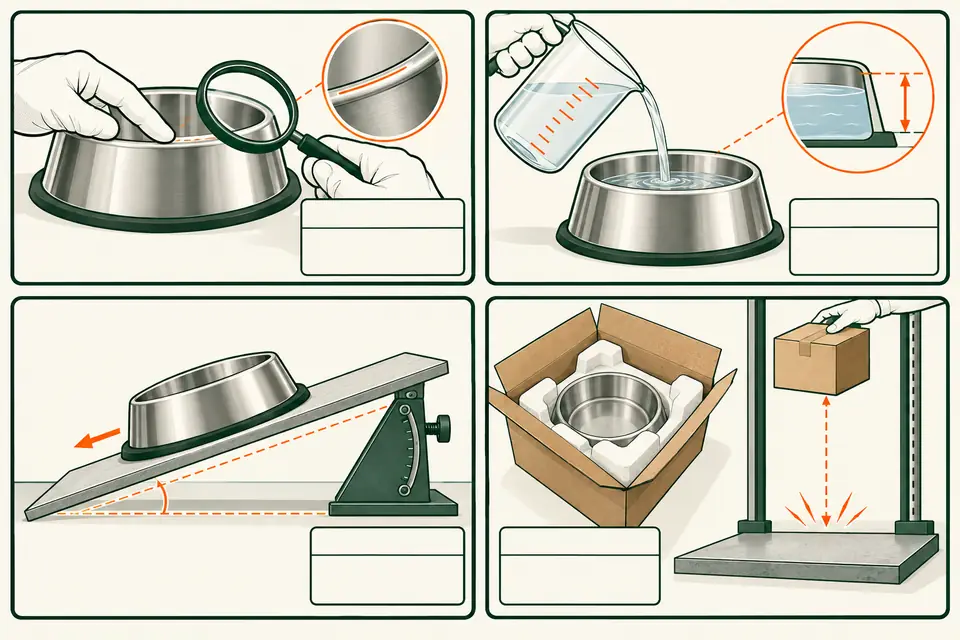
Stability combines geometry, mass, floor contact and anti-slip design. Define the test surface because a rubber ring that grips a smooth tile may behave differently on wood, laminate or a textured mat. Record the bowl condition—empty or filled—together with the fill mass, pull direction, pull speed or angle, number of repetitions and acceptance rule. For raised, angled or slow-feeder designs, add a tipping or overturn check based on the intended use.
A practical stability plan can include four checks: rocking on a reference flat surface; movement under a defined horizontal pull; separation or rolling of the anti-slip ring; and base condition after repeated washing or conditioning. Do not publish an arbitrary force threshold as a universal industry requirement. Set the criterion from the product’s use case, risk review, competitive benchmark and validated sample, then apply the same method to all compared suppliers.
Corrosion review is most relevant to stainless bowls, metal inserts, coatings and hardware. Begin with material identity and workmanship: wrong alloy, embedded contamination, poor polishing, damaged coating, trapped moisture and residue can all change performance. Then define conditioning and exposure that reflect intended use, such as repeated washing, wet-dry cycles or contact with an agreed solution. Record exposure duration, temperature, cleaning chemistry, rinse and drying conditions, number of cycles and the rating method for staining, pitting or coating failure.
ISO 9227 specifies apparatus and procedures for neutral, acetic-acid and copper-accelerated salt-spray tests, but it does not set a universal exposure period or acceptance result for a particular pet bowl. Those details belong in the product specification. Salt spray can be useful for comparing controlled metal or coating systems, but it should not replace material verification or an intended-use wash and wet-contact program.
For ceramic, replace “corrosion” with controls that match the material: glaze integrity, crazing after agreed conditioning, stain resistance where relevant, foot-ring condition and impact damage. For silicone, review discoloration, odor, tackiness, tear initiation and permanent deformation after agreed conditioning. Every test record should identify the sample revision, method, equipment, conditioning, result, photographs and disposition.
Production inspection should connect these product-specific checkpoints to an agreed sampling plan. The pet product AQL inspection guide explains how sample size and accept/reject rules fit into a broader inspection plan; critical safety or regulatory issues may still require different controls from ordinary visual defects.
Plan protective packaging
Packaging should be designed around the material route. Stainless steel may dent, scratch or deform at the rim when units contact each other. Silicone can collect dust, take a temporary set or become distorted if compressed badly. Ceramic needs separation from impact, edge loading and vibration; a retail carton that looks attractive is not automatically a protective shipping system.
Ask the supplier to build a packaging specification showing the orientation, nesting limit, separator or sleeve, inner carton, master carton, quantity, gross and net weight, carton dimensions, sealing method and pallet pattern if used. If bowls nest, define the interleaf or protective bag and the force or method used to separate them. For ceramic, keep hard surfaces apart, support the product without concentrating load on a fragile rim and avoid excessive empty space that allows movement.
| Packaging test field | What to record |
|---|---|
| Tested configuration | SKU, product revision, unit pack, inner quantity, master-carton quantity, dimensions and mass |
| Conditioning | Temperature/humidity or other agreed preconditioning, duration and starting carton condition |
| Distribution sequence | Handling, vibration, compression and drop orientation/height required by the selected protocol |
| Acceptance criteria | No functional damage; defined limits for dent, chip, crack, glaze damage, deformation, scuffing and package failure |
| Evidence | Method/procedure reference, equipment, date, operator, pre/post photos, results and corrective action |
Choose the distribution test from the actual route rather than selecting a dramatic drop height. ISTA procedures are designed for defined distribution environments; for example, its 3A overview addresses individually packaged products moving through a parcel-delivery system. The correct procedure, sequence, package category and acceptance criteria must be agreed for the shipment. A factory’s informal corner drop can be a development check, but it is not automatically equivalent to a recognized packaged-product test.
Run packaging trials on the heaviest, largest and most fragile relevant variants, not only the easiest SKU. After testing, inspect both the bowl and the package. A carton may remain closed while a steel rim dents, a ceramic bowl develops a hairline crack or a silicone part takes an unacceptable set. Record corrective actions and repeat the controlled test after a structural package change.
For current product options, see Petlland’s planned pet bowl range. If that category page is not yet live, contact Petlland with your target material, capacity, sales market, quantity and packaging channel.
Request a pet bowl material and sample shortlist. Send the intended animal size, bowl capacity, material preference, destination market, expected order quantity, branding method and packaging route. Petlland can then organize comparable supplier questions, sample checkpoints and evidence requirements before production approval.
Frequently asked questions
Which material is best for a private-label pet bowl?
There is no single best material. Stainless steel is useful when low mass, impact tolerance and repeatable forming matter. Silicone suits flexible, collapsible and integrated non-slip designs. Ceramic offers weight and finish options but needs tighter control of glaze, firing variation and protective packaging. Choose from the intended use and measurable acceptance criteria.
What should I ask a stainless steel pet bowl supplier to document?
Request the declared alloy or grade, sheet gauge, forming route, rim construction, surface finish, welding or double-wall details, bottom-ring material, coating or decoration system, traceability records and agreed corrosion/conditioning checks. Link those records to the exact model and production lot.
Is a raw-material food-contact certificate enough for a finished pet bowl?
Usually not by itself. The finished construction can include colorants, glazes, coatings, decorations, adhesives and multiple suppliers. Evidence should match the finished article, intended conditions of use, destination market, exact manufacturer or material source where relevant, and current specification revision.
How should a buyer verify pet bowl capacity?
Define whether capacity is brimful or measured to a usable fill line. Record the empty and filled mass, water conditions, fill point, calculation, instrument resolution, sample size and tolerance. Use the same method for every supplier and production inspection.
What packaging is appropriate for ceramic pet bowls?
Use a package engineered to prevent unit-to-unit contact, movement and concentrated load on the rim or foot. Specify inserts, sleeves, carton construction, orientation and quantities, then test the complete packed configuration against the expected parcel or freight environment with written damage criteria.
Sources
- U.S. Food and Drug Administration — Understanding how FDA regulates substances that come into contact with food
- U.S. Food and Drug Administration — Determining the regulatory status of components of a food-contact material
- U.S. Food and Drug Administration — CPG Sec. 545.450 Pottery (Ceramics): Lead contamination
- European Commission — Food-contact materials legislation
- ISO — ISO 9227:2022, Corrosion tests in artificial atmospheres: Salt spray tests
- International Safe Transit Association — Procedure 3A overview