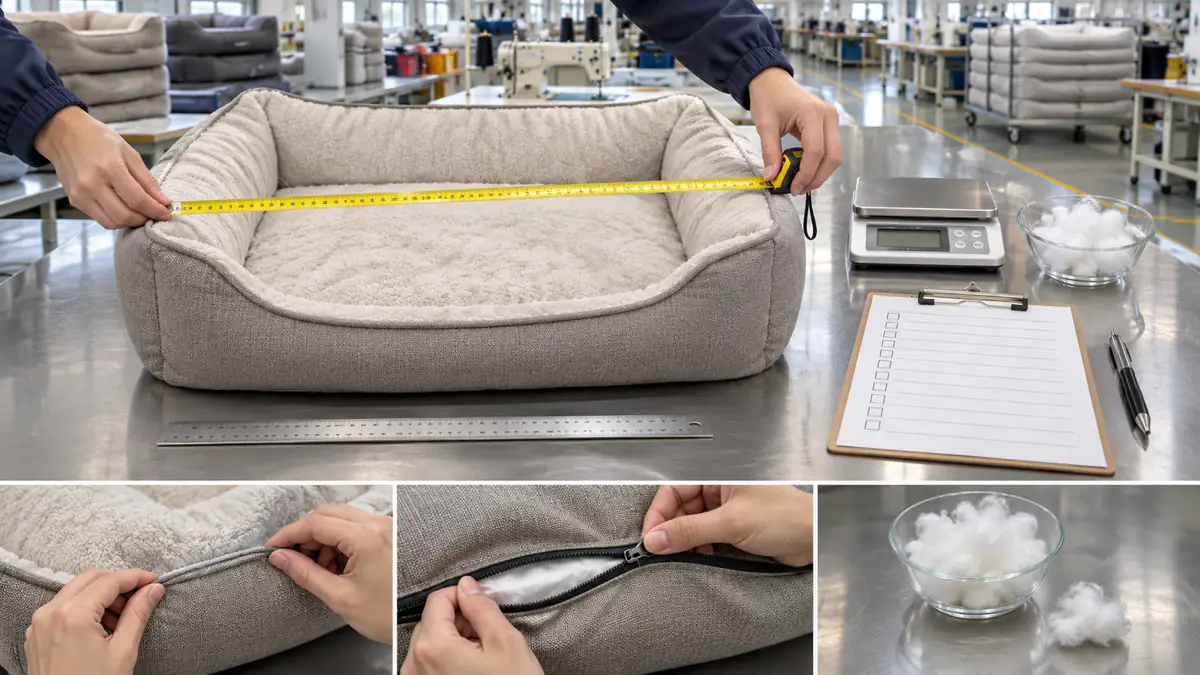
A dog bed shipment should be approved only after the inspector confirms the signed specification, measures the finished product, checks filling and construction, operates every closure, assesses odor and recovery, and verifies packaging evidence. This dog bed quality control checklist turns that decision into 18 traceable checks. It is designed for buyers, sourcing teams and factories preparing a pre-shipment inspection—not as a substitute for a product-specific specification or a qualified safety review.
Quick answer: complete all 18 checks below against one approved specification revision and golden sample. Record the method, sample size, measured result, defect class and photo evidence for each check. Use the buyer-approved sampling plan to make the lot decision; never invent a tolerance during inspection.
Confirm specifications and sample
A reliable inspection starts before anyone touches the product. The purchase order, SKU, color, size, bill of materials, signed specification revision, approved artwork, packaging specification and approved sample must all describe the same product. If they conflict, place the lot on hold and obtain written clarification. Inspecting against an old drawing can turn a conforming shipment into a false failure—or allow an unauthorized change to pass.
Checks 1–2: identity and inspection basis
- Confirm PO, SKU, color and size. Match the unit, sewn label, carton marking and inspection booking to the purchase order. Photograph the product and carton identifiers.
- Lock the specification revision and approved sample. Record both references on the report. Note any authorized deviation in writing and attach it to the inspection record.
Define the sampling plan before inspection. ISO 2859-1:2026 describes AQL-indexed sampling schemes for lot-by-lot inspection by attributes, but the buyer must approve the inspection level, sample size and acceptance/rejection numbers for this order. Our AQL inspection guide for pet products explains how that decision connects to defect counts.
Check dimensions and filling
Soft products are easy to measure inconsistently. Use one written method: condition the bed for the specified time, place it on the specified flat surface, identify the same reference points and avoid compressing bolsters with the tape. Record actual values, not only “pass.” For each dimension, compare the measurement with the signed tolerance. A nominal size without an approved tolerance is not an acceptance limit.
Checks 3–7: size, weight and filling consistency
- Measure overall length and width. Mark the defined endpoints and photograph the complete tape position so the reading can be reconstructed.
- Measure overall or bolster height. State whether the reading is taken immediately after unpacking or after a defined recovery period.
- Check net finished weight. Use a calibrated scale with adequate resolution. Tare removable packaging if the specification defines net product weight.
- Verify filling weight or density. Use the approved destructive-sample method, component record or defined density method. Do not infer filling weight from total product weight unless the specification authorizes it.
- Assess filling distribution. Compress the agreed zones and look for lumps, voids, migration and thin corners. Compare feel and appearance with the approved sample and record the affected location.
Common defects include a bolster that measures within tolerance on one side but collapses at a corner, uneven fiber distribution, foam cut undersize, hard clumps and insufficient finished weight. Classify each finding using the buyer-approved severity rules; the same cosmetic difference may be minor in one design and functionally major in another.
Inspect seams zippers and labels
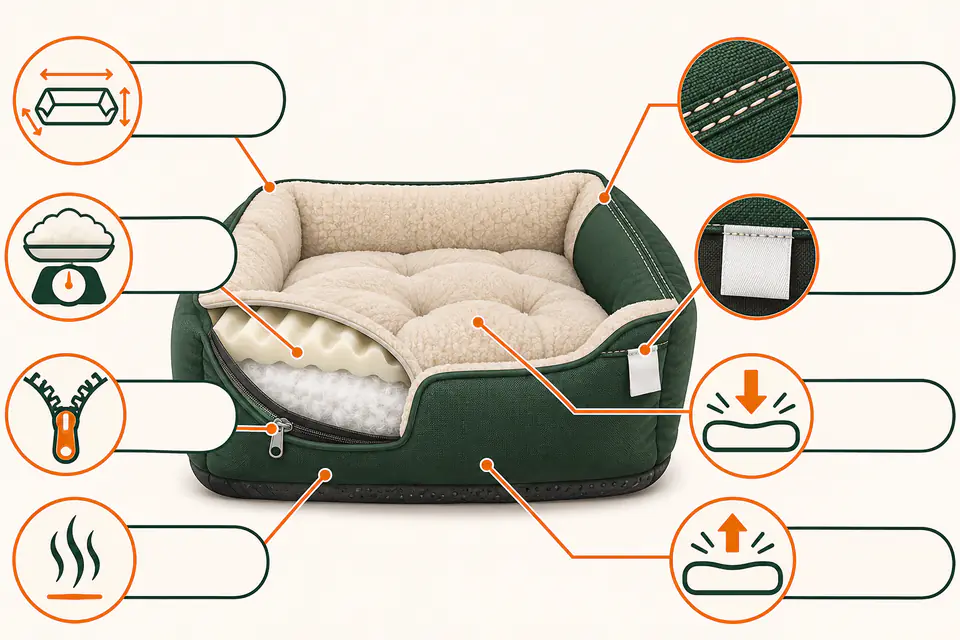
Construction defects can remain hidden until the bed is compressed, washed or used. Inspect the entire seam path rather than a single representative area. Pay special attention to corners, zipper ends, handle attachments, piping joins and any location where bulky layers meet. Open the removable cover when access is permitted and check whether seam allowances, overlock stitching and filling containment match the approved construction.
Checks 8–12: workmanship, closures and identification
- Inspect main seams and stitch security. Record openings, skipped stitches, broken thread, exposed raw edges and loose ends. Measure any opening using the approved method.
- Check piping, corners and stress points. Manipulate the junction gently and inspect for weak back-tacking, distorted corners or a seam that opens under normal handling.
- Operate the zipper or closure. Complete the approved number of full cycles. Check engagement, slider travel, stops, pull attachment, fabric catching and unintended opening.
- Remove and refit the cover. Confirm that the cover can be reassembled without excessive force and that seams, corners and zipper alignment return to the approved appearance.
- Verify sewn labels, care labels and barcode. Compare content, language, placement and scan result with approved artwork and the target-market compliance file.
Do not assume every textile rule applies to pet furniture. The US Federal Trade Commission’s textile-labeling guidance lists pet furniture among products generally excluded from fiber disclosure unless a fiber-content claim is made. Market, material and claim details still matter, so the approved artwork and compliance file—not a generic checklist—must control the label decision. The US Consumer Product Safety Commission also recommends detailed safety and compliance specifications, supply-chain controls and documentation as manufacturing best practices.
For consistent reporting, link every finding to an agreed defect class. Our pet product defect classification guide shows how to separate critical, major and minor findings without rewriting the acceptance rule during inspection.
Test function odor and recovery
Some failures appear only after unpacking or use simulation. Define the conditioning environment, waiting time, compression method, observation intervals and acceptance limit in the approved specification. Without those controls, “recovered well” and “strong odor” are subjective statements that different inspectors cannot reproduce.
Checks 13–16: sensory, appearance, recovery and safety
- Assess odor after opening. Use a ventilated area, the approved conditioning time and the buyer’s rating scale. Record the rating and identify whether the odor is associated with fabric, foam, adhesive or packaging when possible.
- Inspect color and appearance. Compare under agreed lighting. Record shade variation, staining, oil marks, contamination, fabric damage, print faults and visible asymmetry.
- Measure compression recovery. Unpack or compress according to the approved procedure, then measure at the stated intervals. Photograph the same viewpoint and reference points each time.
- Check accessible sharp or hard foreign material. Perform the approved visual and tactile inspection. Stop and escalate any needle fragment, wire, staple, sharp zipper component or unidentified hard inclusion with potential safety impact.
Typical recovery defects include permanent creasing, a bolster that remains flattened, foam that expands unevenly and a cover that becomes distorted after the insert recovers. Odor and recovery limits must be product-specific. If the specification lacks a method or limit, record the observation and hold the decision for the buyer rather than creating an improvised pass threshold.
Verify packaging and report evidence
Packaging is part of the inspected product because it determines whether a compliant bed reaches the customer in usable condition. Compare the folding sequence, compression level, polybag, desiccant if approved, carton size, quantity, protective parts, seals and shipping marks with the signed packing specification. Over-compression can cause slow recovery; under-compression can change carton loading and freight assumptions.
Checks 17–18: packing and lot decision
- Verify compression pack and carton method. Record pack dimensions, seal condition, carton markings and the appearance of a unit reopened from finished packaging.
- Reconcile evidence and make the lot decision. Total critical, major and minor defects; compare them with the approved Ac/Re plan; attach measurement photos, defect close-ups and test records; then state pass, fail or hold with the responsible reviewer.
A defensible report lets another person reconstruct what happened. Use traceable filenames that connect every image to the PO, SKU, check ID, sample and sequence. Photograph the measurement setup as well as the reading. Keep original files, record equipment used, and note any limitation such as missing approved artwork or a shortened conditioning period. The CPSC’s manufacturing best-practices guidance emphasizes documented specifications, supply-chain diligence, batch controls and compliance records; those principles are useful even when a particular pet bed requirement must be determined separately.
Frequently asked questions
Which quality checks should be completed before a dog bed shipment is approved?
Complete all 18 checks: product identity, specification revision, length and width, height, finished weight, filling weight or density, filling distribution, main seams, stress points, zipper, cover fit, labels, odor, appearance, compression recovery, accessible hazards, packaging and final evidence reconciliation.
What tolerance should be used for dog bed dimensions?
Use only the tolerance stated in the signed product specification or an authorized written deviation. A generic percentage should not replace the buyer-approved limit because designs, materials and measurement methods differ.
How should compressed dog beds be checked for recovery?
Follow the approved unpacking or compression procedure, condition the unit for the specified time, measure at defined reference points and intervals, and compare the results with the approved recovery limit. Use consistent photos to document shape and height.
Is AQL the same as a product tolerance?
No. AQL sampling helps determine the sample and lot acceptance rule for attribute inspection. Product tolerances define whether an individual measurement or characteristic conforms. Both must be approved before inspection.
Can this checklist replace laboratory or compliance testing?
No. It supports pre-shipment workmanship and specification checks. Applicable chemical, labeling, flammability or other compliance requirements depend on the product, materials, claims and target market and require a separate compliance plan.
Need a production partner that can build inspection requirements into the project from development through shipment? Review our dog bed manufacturer guide and pet bed manufacturing capabilities, then send your specification, target market and order details for a project review.