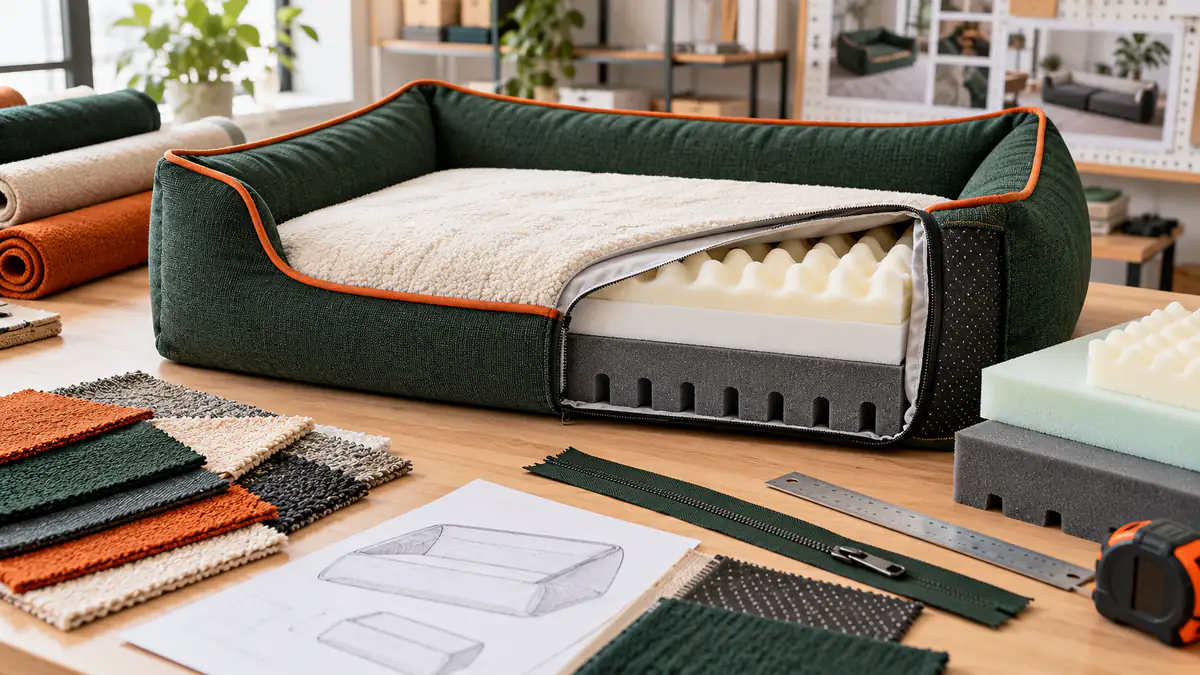
A capable dog bed manufacturer should be able to turn comfort claims into measurable specifications. Before you order, ask for the construction drawing, bill of materials, finished dimensions and tolerances, fabric composition and GSM, foam density and hardness method, filling weight, zipper specification, wash protocol, compression-packing method, and a defect list tied to inspection.
Short answer: do not choose a supplier from a catalog photo or a single soft sample. Compare the production specification, test method and acceptance criteria for the exact SKU. A good supplier can explain what is inside the bed, how the cover fits after washing, how the foam or filling recovers after packing, which dimensions vary in sewing, and what evidence will stop shipment when production misses the approved sample.
This guide gives buyers a practical framework for comparing dog bed manufacturers, planning a low-risk MOQ, and writing an RFQ that can be inspected.
1. Map common dog bed constructions
The bed shape determines the sewing operations, material consumption, packing volume and most likely defects. Start the RFQ by naming the construction—not merely “large dog bed.”
Flat mattress or crate mat
A flat mattress uses a rectangular foam core or filled insert inside a fitted cover. It is comparatively easy to measure and pack, and it gives buyers a clear way to specify length, width and finished height. A removable cover and separate waterproof liner add components but improve serviceability.
This construction fits crate, travel and floor-mat assortments. The main risks are a cover that is too tight after washing, foam cut below tolerance, zipper exposure, a slippery base, and corners that do not fill evenly.
Bolster or sofa bed
A bolster bed combines a base cushion with raised side walls. The bolsters may use PP fibre, shredded foam, shaped foam or a mixed fill. More sewing panels and curved seams increase labor and dimensional variation. The buyer must define whether the base and bolsters are removable, whether each chamber has a separate liner, and where the zipper is accessible.
Bolster construction photographs should show the internal chambers—not just the finished cover. If all loose filling shares one open cavity, it can migrate away from the sleeping area.
Donut or calming-style bed
A donut bed usually relies on long-pile plush and loose fibre fill. Fill weight, chamber layout and stitching determine loft and shape more than the outside diameter alone. Ask for the net filling weight by size and the number and position of retaining seams.
The common failures are uneven fill, a hollow center that shifts, seam opening at the base, excessive fibre migration and a packed product that never returns to the approved profile.
Layered orthopedic-style bed
A layered bed may combine a firmer support foam with a softer comfort layer, such as memory foam. The word “orthopedic” does not define a test method or guarantee a medical outcome. If you use the claim, your team must decide what evidence supports it in the destination market.
For sourcing, specify every layer separately: material type, nominal density, hardness method, thickness, adhesive method, cut profile and allowed substitutions. “High-density memory foam” is not a usable specification because density and firmness describe different properties.
Construction comparison
| Construction | Main specification fields | Frequent production risk | Packing implication |
|---|---|---|---|
| Flat mattress | Core dimensions, cover fit, liner, zipper, base fabric | Short foam, tight cover, zipper wave | Often suitable for flat or compression packing |
| Bolster/sofa | Base core, bolster chambers, fill weight, curved seams | Uneven bolsters, twisted cover, seam stress | Higher cubic volume; compression must be validated |
| Donut/fibre | Outer diameter, center diameter, fill weight, retaining seams | Fibre migration, low loft, shape variation | Compresses efficiently but may recover unevenly |
| Layered foam | Layer density, hardness, thickness, bonding, cover system | Layer substitution, poor bonding, height loss | Compression risk depends on exact foam and duration |
The construction map also reveals whether the quoted company is the actual sewing and assembly factory. Foam cutting, fabric dyeing, quilting, zipper supply and printed packaging may come from separate upstream suppliers. Ask the dog bed manufacturer to identify which operations are in-house and which are subcontracted.
2. Compare foam and filling options
Separate density, firmness and thickness
Foam density is mass per unit volume. It can help verify that the purchased material matches the approved grade, but density alone does not tell you how firm the bed feels. Firmness is measured by a defined indentation method, and finished support also depends on thickness, layer arrangement and the load area.
ISO 2439 covers indentation-hardness methods for flexible cellular materials and notes that the results relate to the stated test conditions. ASTM D3574 provides standardized methods for flexible polyurethane foams used for research, quality control, and acceptance or rejection under specifications. Your RFQ should name the method, specimen conditioning, target result and tolerance instead of requesting “medium firm foam.”
Common material routes
| Material route | Advantages | Risks to control | Evidence to request |
|---|---|---|---|
| Solid support foam | Stable geometry; easy to cut and measure | Density or thickness substitution; bottoming out if underspecified | Foam TDS, lot record, density and hardness results, cut-size record |
| Memory-foam layer | Pressure-responsive comfort feel and premium story | Slow recovery, heat response, odor, layer delamination | Layer-specific density, hardness method, thickness, conditioning and recovery record |
| Layered solid foam | Separates comfort and support functions | Wrong layer order, adhesive failure, total-height shortfall | Cross-section photo, BOM, bond inspection, layer measurements |
| Shredded foam | Adjustable loft and efficient use of fill | Migration, lumping, inconsistent chip mix | Net fill weight, chip specification, chamber map, recovered profile |
| PP fibre fill | Soft hand, compressible, common in bolsters and donut beds | Clumping, low fill weight, migration after use or washing | Fibre specification, net fill weight by chamber, distribution check |
Do not allow an unapproved change between solid foam, shredded foam and fibre. They can produce a similar catalog silhouette while behaving differently in shipping, use and returns.
Specify the cover as a system
Fabric weight in grams per square metre is useful, but GSM is not a durability score. A high-GSM plush and a lower-GSM woven Oxford fabric can serve different functions. Record:
- fibre composition and construction;
- nominal GSM and tolerance;
- pile height or yarn count where relevant;
- coating or membrane specification;
- color standard and approved swatch;
- abrasion or rubbing requirement where relevant;
- backing, non-slip print and waterproof-liner construction;
- shrinkage and appearance after the agreed wash and dry procedure.
ISO 3801 provides methods for mass per unit area of woven fabrics. ISO 105-X12 addresses dry and wet rubbing color fastness, while ISO 6330 defines controlled domestic washing and drying procedures for textile testing. These standards provide test methods; the buyer still sets the acceptance threshold appropriate to the product and market.
Removable cover, liner and zipper
A removable cover only works if it can be removed, washed and refitted without excessive force. Specify the zipper chain type, slider, puller, tape color, opening length, end stops and whether the pull is hidden from the dog. Ask for a replacement-cover fit check on the approved core.
For a foam bed, consider a separate inner liner so routine cover washing does not expose the core. If the liner is described as waterproof, name the material or test requirement behind that claim. “Waterproof fabric” without a method, result and seam treatment leaves too much room for substitution.
3. Explain MOQ and customization levers
MOQ is not one number for every dog bed. It is the highest practical minimum created by the fabric lot, foam cutting plan, color, printed component, sewing setup and packaging order.
Petlland currently publishes a reference MOQ of 100 pieces for its pet-bed range, while stating that the final minimum depends on the model, material, color, logo and packaging specification. Mixed sizes, colors and models require confirmation. Use that as a planning reference—not as a guarantee for an unquoted specification.
What usually keeps MOQ lower
- an existing bed pattern and size ladder;
- stock fabric or an existing color;
- embroidery, woven label or heat-transfer branding on a standard cover;
- plain polybag or a stock-size carton with a printed insert;
- one construction with a limited color split;
- a standard foam grade already purchased by the factory.
What can increase MOQ
- custom-dyed fabric or a new printed pattern;
- a unique foam profile, molded component or nonstandard thickness;
- many colors split across several sizes;
- custom zipper color or hardware;
- printed retail boxes with a supplier minimum;
- a new quilting pattern, shaped bolster or complex chamber construction;
- destination-specific labeling that prevents shared packaging.
Ask for an MOQ breakdown
| RFQ line | Ask the supplier to state |
|---|---|
| Finished SKU MOQ | Minimum per construction, size and color |
| Fabric MOQ | Metres or kilograms per color; whether stock is available |
| Foam MOQ | Minimum sheet/block purchase and cutting yield |
| Branding MOQ | Minimum for label, embroidery, print or patch |
| Packaging MOQ | Minimum and overrun policy for bags, inserts and cartons |
| Mixed-order rule | Which sizes or colors may be combined, and at what surcharge |
| Leftover ownership | Who owns unused branded packaging or custom material |
If you are testing wholesale dog beds, reduce variation before reducing quality. One construction in two or three sizes is usually easier to control than many colors, fills and packaging formats in the same first order. Review Petlland’s low-MOQ private-label starting framework before building the size and color split.
4. Define inspection and durability tests
An inspection plan needs a method, sample, acceptance rule and evidence. “Check quality” is not an instruction.
Use a signed specification and golden sample
Keep a revision-controlled specification sheet and one approved production sample. The document should identify every measurement point and its condition—for example, whether finished height is measured immediately after unpacking or after a defined recovery period.
The following tolerance fields are an illustrative buyer template, not an industry standard:
| Field | Nominal value | Illustrative tolerance | Measurement condition |
|---|---|---|---|
| Finished length | Buyer sets by size | ±2% | Bed relaxed on a flat surface |
| Finished width | Buyer sets by size | ±2% | Bed relaxed on a flat surface |
| Foam-core length and width | Buyer sets | ±5 mm | Uncovered core after conditioning |
| Foam or filled height | Buyer sets | −5% / +10% | After the agreed unpacking recovery time |
| Cover GSM | Buyer sets by fabric | Buyer and mill agree | Conditioned specimen using the named method |
| Net fill weight | Buyer sets by size | ±3% | Filling only, excluding cover and liner |
Replace these examples with values proven by your sample, sewing process and channel requirements. A tolerance that is too wide creates fit and listing problems; one tighter than the process can hold increases rework and cost.
Test the attributes that drive returns
- Dimension and weight check. Record finished length, width, height, total weight and fill weight against the size table.
- Foam identity and hardness. Confirm layer thickness, density and the agreed indentation method. Use ISO 2439 or relevant ASTM D3574 methods where applicable.
- Seam strength. Identify load-bearing seams and use a defined pull or tensile method. ISO 13935-2:2026 describes a grab method for maximum force to seam rupture on applicable sewn articles.
- Stitching review. Record stitch type, seam allowance, stitch density and reinforcement. Photograph skipped stitches, broken thread, open seams, puckering and exposed raw edges.
- Zipper function. Set a buyer-defined opening-and-closing cycle count, inspect end stops, check slider movement and confirm that the cover can be refitted.
- Wash and dry test. Use the labeled care method or an agreed ISO 6330 procedure. Recheck shrinkage, color, surface appearance, zipper wave and cover fit.
- Color rubbing test. Where transfer is a concern, specify dry and wet evaluation under ISO 105-X12.
- Compression-pack recovery. Pack the exact production construction at the agreed compression ratio and duration. After unpacking, record height recovery at agreed intervals, permanent creases, foam cracks, fill migration, odor and whether the cover refits.
- Packaging check. Confirm barcode, labels, care instructions, country-of-origin information, packed dimensions, gross weight and carton strength against the approved pack.
Compression recovery deserves its own approval sample. There is no universal “24-hour rebound” rule suitable for every foam and filling. Define the packed duration, storage temperature, recovery intervals and pass criteria for the exact SKU. Do not approve vacuum packing from a different foam sample.
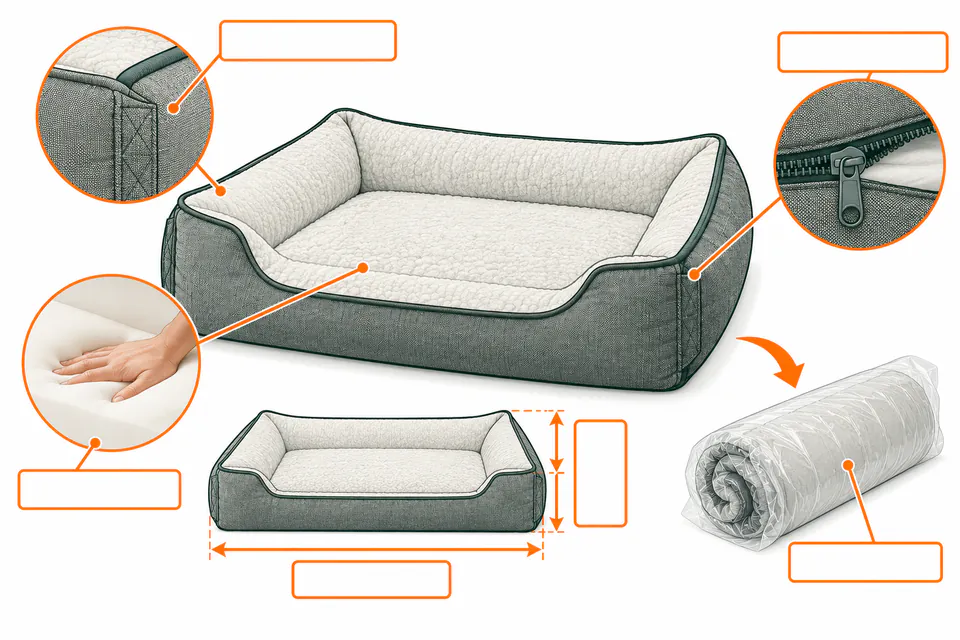
Defect photo and diagram library
The inspection file should show or diagram acceptable and unacceptable examples:
- Critical: exposed needle or sharp component; destination-market material or labeling nonconformity; detachable hazardous component where applicable.
- Major: open or broken load-bearing seam; zipper cannot operate; cover cannot refit; wrong foam or fill; dimensions outside tolerance; permanent compression damage; wrong SKU or barcode.
- Minor: loose thread that does not open the seam; slight surface mark; small piping or label alignment variation within the signed limit.
The classification must be agreed before inspection. Petlland’s AQL guide for pet products explains why AQL is a sampling decision rule rather than a promise that a fixed percentage of the shipment is defect-free.
5. Build a supplier RFQ checklist
Send every shortlisted dog bed manufacturer the same RFQ. Comparable inputs produce comparable quotations.
Product and construction
- What is the exact bed type, size ladder and target market?
- Provide a cross-section drawing and chamber map.
- Is the cover removable, and is there a separate liner?
- Which processes are in-house, and which are subcontracted?
Foam and filling
- List every layer or chamber with material, thickness and net weight.
- State foam density, hardness method, result and tolerance.
- State permitted material substitutions; write “none without buyer approval” if that is the rule.
- Provide supplier TDS or test evidence linked to the proposed material lot.
Fabric, zipper and sewing
- State fibre composition, construction, GSM, color reference and finish.
- State zipper type, opening length, slider and puller details.
- State seam type, seam allowance, stitch density and reinforcement points.
- Confirm the wash method, shrinkage criterion and cover-refit check.
MOQ, sample and production
- Break down MOQ by SKU, size, color, fabric, logo and packaging.
- Quote prototype, corrected sample and pre-production sample separately.
- State sample timing, production timing and the point when bulk materials are committed.
- Confirm ownership of patterns, artwork, branded packaging and unused custom material.
Quality and packaging
- Provide the inspection checklist, defect classification and sampling plan.
- Define dimension, weight, seam, zipper, wash and compression-recovery criteria.
- State when inline and pre-shipment inspections occur and who can hold shipment.
- Provide packed dimensions and gross weight by size for both unit and export carton.
- Confirm barcode scan, care label, market labeling and carton-mark checks.
Specification-sheet field sample
| Section | Required field |
|---|---|
| Identification | SKU, revision, model, color, size, destination market |
| Finished dimensions | Measurement diagram, nominal values, tolerances, conditioning |
| Cover | Fibre, weave/knit, GSM, pile, coating, color standard, wash method |
| Liner | Composition, membrane/coating, seam treatment, claimed function |
| Foam/fill | Material, supplier grade, density, hardness method, thickness, net weight |
| Components | Zipper, slider, piping, labels, non-slip base, thread |
| Sewing | Seam type, seam allowance, stitch density, reinforcements |
| Performance | Seam, zipper, wash, rubbing, foam and compression tests |
| Packaging | Fold/compression method, recovery rule, unit pack, carton, barcode |
| QC | Golden sample ID, defect classes, AQL plan, report evidence |
For a current product-family reference, review Petlland’s private-label and wholesale pet beds and the memory foam orthopedic sofa bed. Published specifications are starting points; the quotation and approved sample control the actual order.
FAQ
What should I check before choosing a dog bed manufacturer?
Check the legal supplier and production site, exact construction, bill of materials, fabric GSM, foam density and hardness method, filling weight, dimensions and tolerances, cover wash performance, zipper specification, inspection plan, compression recovery and packed dimensions.
What is a realistic MOQ for private-label dog beds?
It depends on the pattern, fabric, color split, foam, branding and packaging. Petlland publishes a 100-piece reference MOQ for its current pet-bed range, subject to specification and quotation. Ask for the minimum behind each component rather than relying on one headline number.
Is higher-density foam always firmer?
No. Density and firmness are different properties. Request both the density and a hardness result produced under a named test method. Also specify layer thickness because finished support depends on the whole construction.
Which fabric GSM is best for a wholesale dog bed?
There is no universal best GSM. Choose the fabric construction for the use case, then set a nominal GSM and tolerance. Confirm abrasion, color rubbing, wash appearance, shrinkage and hand feel on the actual approved swatch.
How should I test a vacuum-packed dog bed?
Use the exact production foam, cover and packing method. Define compression ratio, packed duration and storage conditions; then record recovered dimensions at agreed intervals, creases, cracks, fill distribution, odor and cover fit. Approve the protocol before bulk packing.
Does AQL inspection replace laboratory testing?
No. AQL determines whether a sampled production lot is accepted under agreed defect rules. Laboratory or controlled performance testing verifies materials and claims. Both must refer to the same approved specification.
Conclusion
The best dog bed manufacturer is the one that makes the product measurable. Select the construction first, define every foam, filling and fabric field, identify the MOQ driver, and turn washability, durability and compression recovery into testable acceptance criteria. That process lets buyers compare quotations on the same basis and gives inspectors evidence they can enforce before shipment.
Request a dog bed shortlist and sample plan.
Contact Petlland with your target market, construction, size range, quantity, branding, packaging and delivery destination.
Sources and review notes
- Petlland Pet Beds for Private Label and Wholesale — current product family, construction examples and reference MOQ.
- Petlland AQL Inspection for Pet Products — sampling method and dog-bed defect classification.
- ASTM D3574-25 — test methods for flexible polyurethane foams.
- ISO 2439:2008 — indentation hardness of flexible cellular materials; confirmed current in 2026.
- ISO 3801:1977 — mass per unit area of woven fabrics.
- ISO 6330:2021 — domestic washing and drying procedures for textile testing.
- ISO 13935-2:2026 — maximum force to seam rupture using the grab method.
- ISO 105-X12:2016 — color fastness to rubbing.
The numerical tolerances in this guide are clearly labeled as an illustrative buyer template, not universal standards. Final specifications, compliance duties and claim evidence depend on the SKU, destination market, sales channel and approved contract.