Quick answer: a pet brand can manage packaging minimums by treating every component as a separate inventory item, calculating its real consumption by SKU, and postponing SKU-specific printing until the latest practical stage. A shared carton or pouch combined with short-run labels, inserts, or sleeves often lets the product order proceed without buying the same quantity of fully printed packaging. The right plan balances unit cost against excess stock, storage, rework, and artwork-change risk.
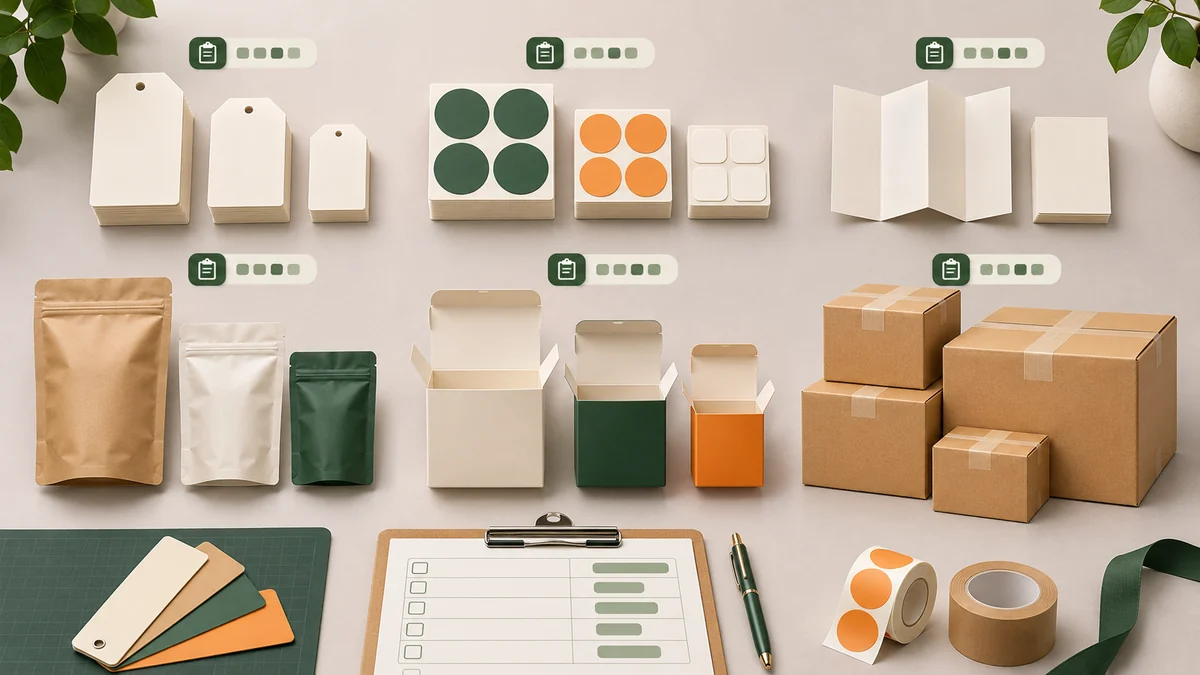
A pet product packaging MOQ problem usually appears when the product factory can make a small run but the printer, converter, or carton supplier requires a larger quantity. The gap becomes more expensive when one structure is printed separately for every color, size, language, or sales channel. This guide shows how to build a component-level plan instead of accepting one blended packaging number.
Separate product and packaging MOQs
The product MOQ is the smallest production quantity for the item itself. Packaging may involve several independent suppliers and minimums: the hangtag printer, label converter, pouch maker, folding-carton printer, instruction-leaflet printer, and master-carton plant. Ask for the MOQ, price break, tooling requirement, lead time, packing multiple, and expected waste for each component. Do not assume the lowest product quantity automatically applies to every pack.
Build the forecast at SKU level. A “SKU” should distinguish every variant that changes the package, including size, color, barcode, language, market warning, and channel-specific artwork. Then separate fixed components that every SKU can share from variable components that carry SKU data.
| Planning field | What to record | Why it matters |
|---|---|---|
| Product quantity | Sellable units plus approved replacements or samples | Creates the base packaging demand |
| Pack conversion | Units per pouch, carton, insert, tag and master carton | Prevents one-to-one assumptions where they do not apply |
| Component MOQ | Minimum quantity and order multiple for each supplier | Shows where excess inventory will arise |
| Waste allowance | Approved percentage or unit count by process | Covers setup, print, packing and inspection loss |
| Artwork life | Expected period before design, barcode or compliance text changes | Measures obsolescence exposure |
A supplier quotation is a dated commercial input, not a permanent industry standard. Record the supplier, date, currency, validity, specification, and included or excluded tooling. Reconfirm it before placing the purchase order.
Compare packaging components
Different components create different minimum-order and obsolescence risks. A generic master carton is normally easier to reuse than a fully printed retail carton. A blank pouch with a variable label can support more SKUs than a preprinted pouch. A product insert may have a higher risk if legal text, care instructions, or language changes.
| Component | Typical customization | Inventory risk | Low-volume option to evaluate |
|---|---|---|---|
| Hangtag | Logo, barcode, size, color and claims | SKU-specific tags can become obsolete | Shared tag plus a variable barcode or size label |
| Sticker or label | Short variable data and branding | Lower storage volume but adhesive and print life matter | Short-run digital labels applied late |
| Insert or leaflet | Instructions, warnings, language and warranty text | Text changes can strand stock | One shared structure with market-specific inserts |
| Pouch | Material, zipper, window and print | Custom film and printing can require larger runs | Stock pouch plus label, band or card |
| Folding carton | Dieline, board, finish and full artwork | Tooling and printed stock can lock in a design | Shared carton with modular insert and sleeve |
| Master carton | Dimensions, strength and shipping marks | Usually lower artwork risk if marks remain variable | Plain carton with compliant shipping labels |
Ask whether the quoted custom packaging minimum order applies per artwork, per size, per color, per material, or across a combined production run. The answer changes the economics. Also confirm whether a printer can gang several versions on one sheet or production run, and how it allocates setup waste among them.
Use shared structures and late-stage labels
A scalable system separates the expensive structure from the information that changes frequently. One shared box can use different molded-pulp or paperboard inserts. One pouch can receive different labels. One base hangtag can carry a small barcode and size sticker. This is the core of a low MOQ pet packaging strategy.
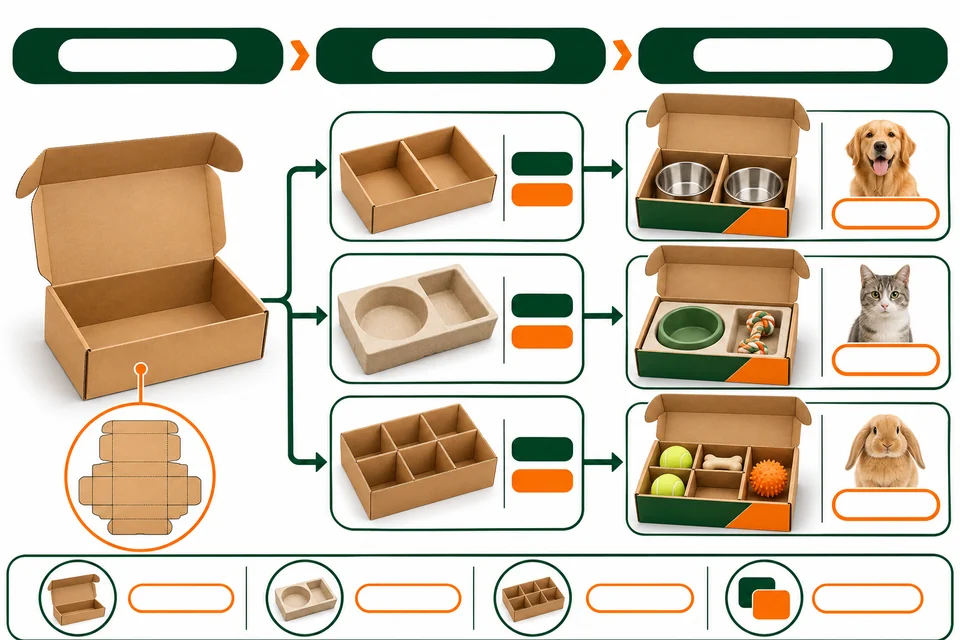
Late-stage customization should still be controlled. Define the label material, adhesive, placement tolerance, barcode verification, color reference, application sequence, and line-clearance check. For a private label hangtag MOQ, define which data belongs on the common tag and which data is added by sticker, overprint, or variable digital print.
Use version-controlled artwork and a packaging bill of materials. Every SKU should link to the correct carton, insert, label, barcode, and market text. At packing, scan or verify the variable component against the product to prevent mix-ups. Petlland’s private-label pet product packaging guide provides the broader artwork and packaging brief.
Calculate excess inventory risk
Start with the expected packaging consumption, then round up to the supplier’s MOQ and order multiple. A simple planning model is:
Required packs = planned sellable units + approved samples/replacements + expected packing loss.
Purchased packs = required packs rounded up to the next supplier MOQ or order multiple.
Expected excess = purchased packs – required packs.
For illustration only, if a launch needs 600 sellable units, 12 samples, and a 3% packing-loss allowance, the plan requires 631 packs after rounding up the loss calculation. If the component MOQ is 1,000, expected excess is 369. This is a planning example, not a supplier standard or recommended waste rate.
Convert excess into money and time. Include the component purchase cost, inbound freight, storage, counting and handling, rework, relabeling, and possible write-off if the artwork, barcode, claim, or regulation changes. Compare that total with the higher per-unit cost of a short-run alternative. The cheapest printed unit can create the highest launch cost when most of the order remains unused.
Run best-case, base-case, and slow-sales scenarios. The quantity plan should show expected monthly sell-through, reorder lead time, remaining shelf life where relevant, and the date when the package could become obsolete. Use the same assumptions when negotiating the pet product MOQ.
Approve a scalable packaging system
Approve the system as a group of controlled components, not as one attractive mockup. The approval set should include the structure sample, material specification, dieline, artwork version, color master, variable-data template, barcode result, label placement, insert fit, packed product, master-carton configuration, and shipping marks.
Before release, complete a quantity balance showing ordered, issued, consumed, rejected, reworked, returned, and remaining quantities for every component. Agree how the supplier stores surplus, who owns it, how long it will be retained, how it is counted, and what happens after an artwork change. Require written approval before using remaining stock on a new order.
For very small launches, review whether the packaging system can support the first 100 private-label pet-product units without creating a large stranded balance. The answer may be a plainer shared pack at launch and a fully printed format after demand is proven.
Frequently asked questions
How can a pet brand manage packaging MOQs when the product MOQ is lower?
Separate each packaging component, share structures across SKUs, postpone variable information to labels or inserts, combine artwork versions where the supplier permits it, and compare total excess-inventory cost with short-run unit cost.
Should packaging waste be added to the MOQ?
Use a documented process-specific allowance agreed with the supplier. Do not use one permanent percentage for every component. Record planned, consumed, rejected, and remaining quantities so future allowances are based on evidence.
When is fully printed packaging justified?
It is easier to justify when demand is proven, artwork is stable, the quantity will be consumed within its useful life, and the cost saving exceeds storage and obsolescence risk.
Need a component-level quantity balance? Send your SKU and quantity plan for a packaging MOQ review.