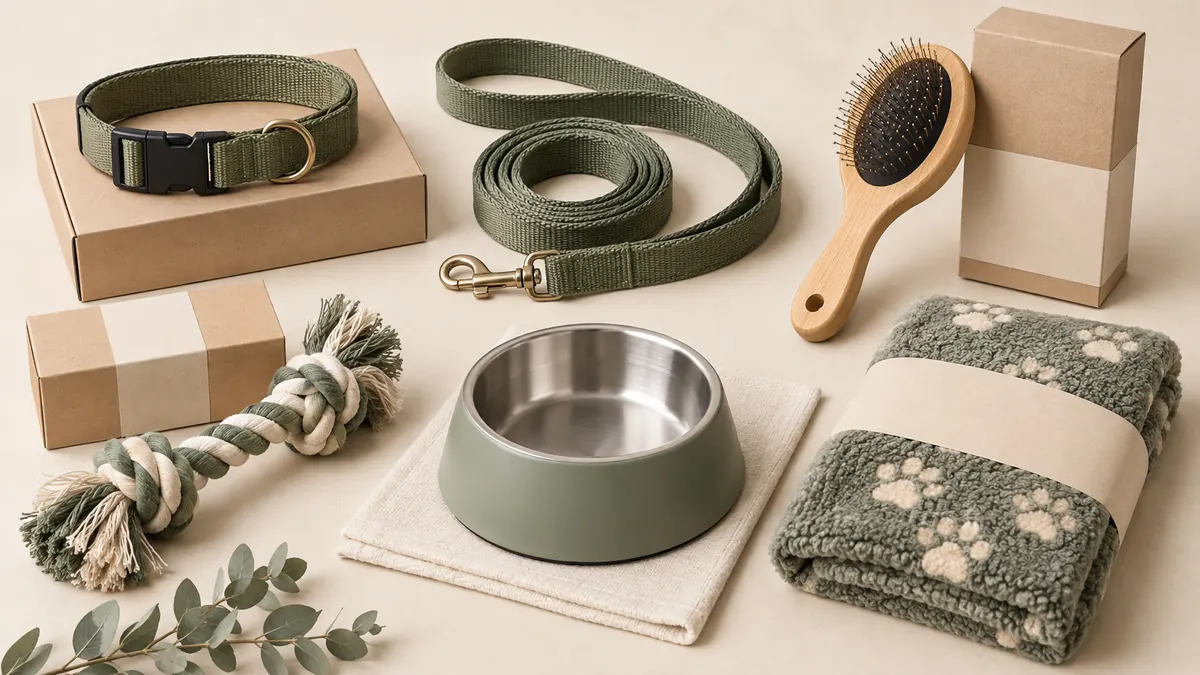
The most realistic private label dog products for a first low-MOQ collection are standardized, non-ingestible items that already have proven tooling and can be differentiated through color, logo, label, insert and retail packaging. Collars, slip leads, grooming brushes, rope toys and blankets usually give a new brand more control than a new mould, an electronic product, a chemical formula or a bulky bed.
Petlland’s current public catalogue uses a reference MOQ of 100 pieces for the categories discussed below. That is a planning reference, not a universal promise: the final MOQ depends on the model, material, colour, logo, packaging and the number of variants. MOQ normally applies per product and per colourway, not across an entire mixed order. Every number in this guide should therefore be replaced by the written quotation for the approved specification.
Key takeaways
- Start with existing product bodies and change brand touchpoints before changing structure or tooling.
- Score every category on first-order difficulty, packaging, shipping volume, return risk and repeat-purchase potential.
- Count sizes, colours and artworks as separate SKUs before accepting a “100-piece” offer.
- Put one simple traffic product, one attach product and one repeatable or giftable product in the first mix.
- Treat food-contact, electrical, chemical, therapeutic-claim and bulky products as higher-evidence choices.
1. Define a first-collection score
A first collection should test demand without hiding cash in tooling, cartons or slow-moving variants. Score each candidate from 1 to 5 on the five factors below, where 5 is most favourable for a first order. The total is a comparison tool, not a supplier guarantee.
| Factor | A score of 5 means | Questions to put in the RFQ |
|---|---|---|
| First-order difficulty | Existing tooling, few components and a short approval path | Is the exact body already in regular production? Which change triggers a new sample or MOQ? |
| Packaging threshold | A standard polybag, hangtag, header card or simple carton can carry the brand | What is the minimum per artwork? Are print plates, inserts and barcodes quoted separately? |
| Shipping efficiency | Low unit volume and little dead air | What are packed dimensions, units per carton, gross weight and chargeable volume? |
| Return risk | No fit, fragile finish, electronics or ambiguous performance claim | Which measurements and customer expectations cause returns? How will they be verified? |
| Reorder potential | The item wears, is replaced, is gifted or supports bundles | What reorder signal can be measured within 30, 60 or 90 days? |
Use the score after the landed-cost model, not instead of it. A compact item can still be a weak launch if print setup, testing, inspection and freight make the retail price unrealistic. As of 7 October 2026, Petlland does not publish generic unit-price ranges because material, construction, size, decoration, packaging and quantity change the quote. Use a re-calculable model instead:
Landed cost per sellable unit = (goods + artwork or tooling + samples + inspection + freight + duty or tax + marketplace preparation + contingency) ÷ expected sellable units.
Record the currency, Incoterm, destination, quote date, quantity, carton data and assumed reject allowance beside the result. That lets the team update one input without turning an old estimate into a false current price.
2. Rank 12 categories
The ranking below uses the five-factor score for a small online brand using existing tooling and one restrained colour or artwork. The packaging column shows a practical starting format, but the exact pack and MOQ must be confirmed in the quotation. Petlland’s private-label launch guide explains the same progression from brand-only changes to material, pattern and mould changes.
| Rank | Category | Score / 25 | Petlland planning MOQ | Practical first pack | Why it ranks here |
|---|---|---|---|---|---|
| 1 | Rope or slip lead | 23 | 100 pcs reference | Polybag plus header card or hangtag | One main dimension set, low shipping volume and easy colour coordination; confirm rope diameter, length, stopper and hardware. |
| 2 | Grooming brush | 22 | 100 pcs reference | Printed card, sleeve or compact retail box | No apparel sizing; handle colour, logo and box can differentiate an existing body. Pin type and mechanism still need sample approval. |
| 3 | Cotton rope toy | 22 | 100 pcs reference | Hangtag or header card | Compact, giftable and visually clear. Fibre, knot construction, loose ends and any safety claim require inspection. |
| 4 | Nylon dog collar | 21 | 100 pcs reference | Hangtag or card-backed polybag | Strong private-label surface and natural pairing with a leash. Size and colour splits can multiply the true MOQ. |
| 5 | Fleece pet blanket | 20 | 100 pcs reference | Folded polybag, belly band or gift box | Low fit risk and useful for bundles; custom prints and sizes may carry per-design minimums and add carton volume. |
| 6 | Pet ID tag | 20 | 100 pcs reference | Small card or pouch | Very compact and easy to bundle. Engraving workflow, character limits and fulfilment model must be decided before launch. |
| 7 | Plush squeaky toy | 19 | 100 pcs reference | Hangtag or card-backed polybag | Good gifting and repeat potential, but seams, squeaker retention, fibre shedding and claim language need clear tests. |
| 8 | Step-in or mesh harness | 17 | 100 pcs reference per style | Hangtag or card-backed polybag | High perceived value, but fit, size grading, hardware, stitching and pull-test evidence increase return and approval risk. |
| 9 | Stainless or silicone bowl | 16 | 100 pcs reference | Sleeve or retail carton | Clear everyday use and bundle potential. Food-contact material documentation, coating, odour, stability and dimensional volume matter. |
| 10 | Dog bed | 14 | 100 pcs reference | Compression bag or export carton | Strong retail value, but foam or fill, recovery, washability and chargeable volume make a first shipment harder. |
| 11 | Soft carrier | 13 | 100 pcs reference | Folded polybag or retail carton | Higher selling price, but fit, ventilation, structure, zips, load claims and returns make approval more involved. |
| 12 | Unmedicated grooming mist | 11 | 100 pcs reference | Sealed bottle, label and carton | Repeat potential is attractive, but formula, claims, leak testing, shelf life, labels and destination-market review raise the evidence burden. |
This is a launch ranking, not a quality ranking. A lower-ranked category may be commercially better for a team that already has test reports, packaging drawings, retailer approval or reliable historical sales. A high-ranked product can also move down immediately if the brand needs several colours, custom hardware or a new mould.
The recommended internal starting points are Petlland’s current dog collars, dog toys and pet grooming brushes catalogues. Each publishes the same 100-piece reference with a clear qualification that the model, material, colour, logo and packaging determine the final minimum.
3. Show MOQ and branding options
“Low MOQ” only has meaning when the customization level is named. A logo on a stock body and a new product structure are different manufacturing projects even when the catalogue image looks similar.
| Customization level | Petlland planning band | Typical brand changes | Main MOQ driver |
|---|---|---|---|
| Existing product body | From 100 units | Logo, label, insert, barcode, stocked colour and retail packaging | Print setup, artwork version, pack minimum and one-SKU economics |
| Colour or material change | Commonly from 300 units | Pantone colour, alternative webbing, fabric, handle or finish | Material dye lot, component purchasing and line setup |
| New printed pattern | Around 500 units | Exclusive textile or printed surface using an existing pattern | Print run, artwork repeat and per-design minimum |
| New silicone or TPR mould | Around 1,000 units | New shape, texture, dimensions or moulded logo | Tooling, trial shots, material run and validation |
These are current planning bands published by Petlland, not industry-wide rules. They must be reconfirmed against the exact product and quote date. A supplier may accept 100 total pieces but require 100 of each colour, size, artwork or packaging version. Ask for the MOQ matrix in writing:
- MOQ per model.
- MOQ per colour or material.
- MOQ per size.
- MOQ per logo method and artwork.
- MOQ per retail packaging version.
- Whether different variants can share an export carton.
Keep the first packaging system simple
Use one packaging architecture across the collection where practical. A kraft hangtag or header card can carry the logo, barcode, material statement, country-of-origin information, warnings and channel-specific labels without forcing a bespoke box for every product. Blank neutral packaging plus a printed label or insert is usually easier to revise after the first sales data arrives.
For soft or irregular products, confirm the polybag specification, suffocation warning where applicable, barcode placement and carton protection. For bowls or brushes, ask whether a sleeve or compact carton protects the product without shipping empty air. For blankets, request folded dimensions and units per carton, not only the unfolded size.
Do not approve packaging from a flat artwork alone. Retain a physical or production-equivalent pack showing the product fit, barcode scan, label position, closure and carton count. Petlland’s terms state that tooling, mould, print-plate and artwork setup charges are itemised separately; keep those costs visible in the landed-cost sheet.

4. Flag bulky or regulated choices
Some low-MOQ pet products are technically available at 100 pieces but still make poor first orders because the evidence or freight burden is high.
Bulky products
Beds, thick blankets, carriers and elevated feeders can be dominated by chargeable volume rather than factory price. Request the packed dimensions, compression method, recovery test, units per carton, gross weight and destination quote before comparing suppliers. A sample shipped alone does not predict the economics of a master carton.
Food-contact products
For bowls and feeders, identify every food-contact surface, coating, adhesive and colourant. In the United States, the FDA maintains inventories and authorizations for food-contact substances by intended use and conditions of use. A generic claim such as “food grade” is not a substitute for material identity, supplier documentation and destination-market review for the exact construction.
Electrical products
LED collars, trackers, heated items and electronic toys add component traceability, charging, ingress, battery and transport questions. The UN Manual of Tests and Criteria includes subsection 38.3 for lithium cells and batteries used in transport. Ask for the applicable test summary and shipping documents for the exact battery and assembled product; do not inherit evidence from a visually similar component.
Chemical formulas and therapeutic claims
An unmedicated grooming aid and a product promoted to treat disease are not the same regulatory proposition. FDA guidance states that products intended solely to cleanse or beautify animals are generally treated differently from products intended to cure, mitigate, treat or prevent disease, which may be animal drugs. Flea and tick products can also fall under EPA or FDA oversight in the United States. Freeze the formula, claims, label, market and responsible importer before ordering.
Toys and load-bearing products
Rope and plush toys need material, seam, small-part and durability checks appropriate to the design and market. Harnesses, collars, leashes and carriers need a written load path, component specification, size rule and finished-assembly test. Do not turn one passing sample into a universal “indestructible,” “escape-proof” or “safe for all dogs” claim.
The buyer remains responsible for identifying legal and retailer requirements in the destination market. Supplier catalog availability is not proof of compliance, and an existing report is useful only when its product, material, construction, model and market scope match the order.
5. Build a three-SKU launch mix
For a first order with the fewest variant traps, use a walk, care and play mix:
| SKU | First specification | Brand treatment | What the launch tests |
|---|---|---|---|
| 1. Rope slip lead | One rope diameter, one length, one hardware finish, one colour | Woven label or tag plus a shared header card | Can the brand acquire a customer with a practical walking product? |
| 2. Self-cleaning grooming brush | One existing body, one handle colour, approved pin type | Pad print or laser mark plus a compact shared-design box | Will buyers add a care product with no size choice? |
| 3. Cotton rope tug toy | One size, specified cotton construction and knot pattern | Hangtag using the same visual system | Can a giftable attach product raise average order value and reorder interest? |
This mix stays compact, avoids apparel size ladders and uses three distinct use moments. Keep one colour family and one packaging system so the products read as a collection without creating extra artwork minimums.
Before issuing a purchase order:
- Name one customer, sales channel, destination and target retail price.
- Lock one specification and one colour per product.
- Request the final MOQ per product, colour, logo and packaging version.
- Approve production-equivalent samples and packaging.
- Build the landed-cost model from carton data and a dated freight quote.
- Define inspection points, defect classes and pass rules.
- Set a reorder decision: sell-through, return rate, review quality and margin after 30, 60 and 90 days.
If the brand’s core promise requires matching walking gear, substitute an adjustable collar for the toy only after counting every collar size as a separate SKU and confirming the size split. If the channel is gifting or subscription, substitute a blanket only after confirming folded dimensions and per-design print minimums.
Request a low-MOQ first-collection shortlist. Send Petlland the destination market, channel, target retail price, quantity, preferred product types, logo method and packaging requirement. The shortlist should return the feasible model, final MOQ, customization level, packaging options, sample path, carton data, evidence available and a dated quotation for each candidate.
Frequently asked questions
Which private label dog products are realistic for a first low-MOQ collection?
Existing-tooling collars, slip leads, grooming brushes, rope toys and blankets are usually the most realistic. They can often be differentiated through color, logo, labels and packaging without a new mould. The exact choice still depends on the model, variants, destination rules and landed cost.
Does a 100-piece MOQ cover several colours and sizes?
Not automatically. Petlland states that MOQ is normally confirmed per product and per colourway, while mixed sizes, colours and models are subject to confirmation. Ask for a written MOQ matrix before treating 100 pieces as the total collection quantity.
What is the difference between white label pet products and private label pet products?
White label usually means an existing product sold to multiple buyers with limited branding changes. Private label can still use an existing body, but the buyer controls a defined combination of logo, colour, specification, packaging and quality criteria. OEM or new-tooling work changes the product more deeply and normally raises cost, lead time and MOQ.
Should a first collection include a dog bed or carrier?
Only when the expected retail margin can absorb volumetric freight and the team can validate dimensions, materials, recovery, load or ventilation requirements and return risk. A 100-piece reference MOQ does not make a bulky item inexpensive to land or easy to support.
How should a buyer compare low-MOQ quotations?
Compare the same specification, quantity, Incoterm, destination, packaging and evidence package. Add samples, setup, inspection, freight, duty or tax, channel preparation and contingency, then divide by expected sellable units. Record the date and assumptions so the comparison can be recalculated.
What evidence should be approved before production?
Keep the signed specification, bill of materials, artwork, packaging sample, colour reference, physical golden sample, applicable test records, carton data, defect list and inspection plan. The required evidence changes with the product and market; do not reuse an unrelated report because the catalogue photos look similar.
Evidence sources used
- Petlland, How to Start a Private Label Pet Product Brand with Just 100 Units — current customization planning bands and MOQ qualifications.
- Petlland, Terms of Supply — MOQ per product/colourway, setup charges, pricing and importer-responsibility statements.
- Petlland product pages for dog collars, dog toys and pet grooming brushes — current category reference MOQ and customization statements.
- U.S. FDA, Inventory of Food Contact Substances Listed in 21 CFR.
- U.S. FDA, Animal Grooming Aids.
- U.S. EPA, EPA’s Regulation of Flea and Tick Products.
- UNECE, UN Manual of Tests and Criteria Rev.8.