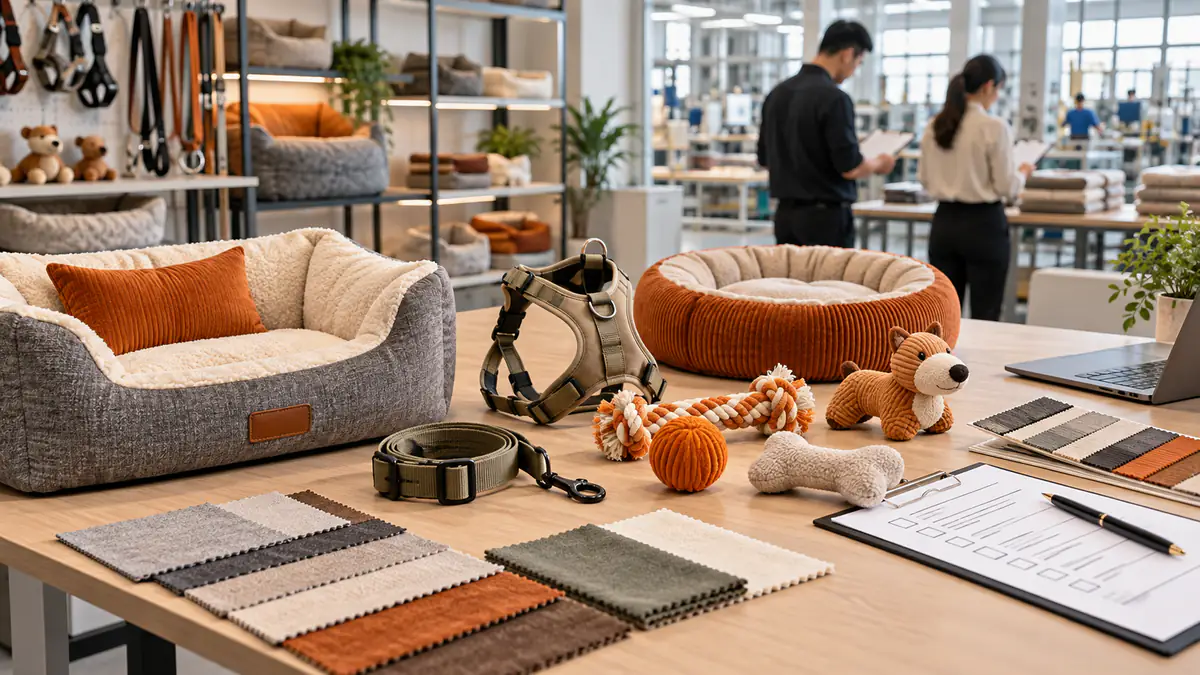
The right pet product manufacturer is not always the company with the lowest unit quote—or even the company that owns the most equipment. The best sourcing model depends on how many product categories you need, how much control your team can maintain, and who will be accountable for quality, consolidation, and delivery.
Short answer: choose a direct factory when your order is concentrated in one manufacturing process and your team can manage specifications, inspections, and freight. Consider a trading company when you need catalog breadth and convenient communication but can independently verify the actual manufacturers. Use a sourcing partner when a multi-category order needs supplier coordination, AQL-based quality control, consolidation, and landed-cost management under one project owner. In every case, verify the legal entity, production location, quality responsibility, and full landed cost before paying a deposit.
This guide compares the three common models and gives growing pet brands a practical decision framework for China pet product sourcing.
1. Define the three supplier models
Direct factory
A factory is the manufacturing entity that controls the core production process for the quoted product. A pet bed factory may cut, sew, fill, and pack textile products, while molded bowls, silicone lick mats, or metal crates require different equipment and supply chains.
Buying direct can give you close access to production engineers, clearer control of product changes, and potentially lower markups. It does not automatically guarantee the lowest total cost or the best quality. Factories may outsource printing, hardware, foam, packaging, or even overflow production. Your team still needs to verify which processes are performed on-site and which are subcontracted.
Direct factory sourcing is usually strongest when:
- most order value sits within one product category or production process;
- volume is high enough to meet the factory’s SKU and color MOQs;
- your team can maintain technical files and approve samples;
- you can arrange inspections, freight, customs, and issue resolution.
Trading company
A trading company purchases from one or more manufacturers and resells products to the buyer. It may offer a broad catalog, English-language sales support, smaller mixed orders, and faster quotation across categories.
The trade-off is an additional commercial layer between the buyer and the production site. That layer can be useful, but the buyer needs visibility: Who makes each SKU? Who approves a material substitution? Who pays for rework? Can the buyer or an inspector visit the actual production site?
A trading company can fit when:
- you are testing standard products from an existing catalog;
- speed and assortment matter more than deep customization;
- your team has a separate inspection and freight process;
- supplier identity and responsibilities are documented in the purchase agreement.
Sourcing partner
A sourcing partner coordinates suppliers on the buyer’s behalf. Depending on the agreement, the scope may include RFQs, supplier verification, sampling, product development, AQL-based inspection, consolidation, export documentation, and DDP delivery.
This model can reduce the number of handoffs for a brand buying pet beds, harnesses, toys, bowls, and packaging from different specialist factories. It does not remove the underlying factory MOQs, and it should not reduce transparency. Ask how the partner is paid, whether supplier identities are disclosed, who owns molds and technical files, and how defects or delays are escalated.
A sourcing partner is generally most relevant when:
- the launch spans multiple production processes or suppliers;
- the buyer needs one project owner across development, QC, and logistics;
- shipments need consolidation before export;
- the team wants itemized landed-cost and risk reporting.
2. Compare MOQ, category breadth, QC ownership, communication and landed cost
Supplier labels are less useful than a responsibility map. Use the following matrix as a starting point, then replace every assumption with a written answer in the quotation and purchase order.
| Decision factor | Direct factory | Trading company | Sourcing partner |
|---|---|---|---|
| MOQ | Set by one factory, often per SKU, material, color, or production run | May combine catalog items, but the real factory’s minimum still exists | Can coordinate multiple suppliers; underlying process and material minimums still apply |
| Category breadth | Usually strongest within one process or closely related category | Often broad catalog coverage | Broad coverage through disclosed specialist factories |
| QC ownership | Buyer must define standards and arrange inspection unless factory scope is explicit | Often coordinated by the seller; independence and evidence must be verified | Can centralize buyer-approved QC, inspection reports, and corrective action |
| Communication | Direct access to sales and sometimes production staff | One commercial contact, with possible distance from the factory floor | One project owner across suppliers, samples, QC, and logistics |
| Landed cost | Unit price may be lower; buyer adds inspection, consolidation, freight, duty, and internal coordination | Margin is embedded; compare what services are included | Service cost should be transparent; compare the total delivered outcome |
| Best fit | Concentrated, repeatable orders with capable in-house sourcing | Standard catalog buying or early assortment tests | Multi-category, customized, or consolidated programs |
Compare landed cost, not only EXW or FOB price
The lowest unit quote can become the more expensive option after sample rounds, separate inspections, domestic transfers, consolidation, documentation, duty, and delay risk are added.
Request a comparable cost view that identifies:
- product price and Incoterm;
- tooling, labels, packaging, and testing;
- inspection and rework responsibility;
- China-side transport and consolidation;
- international freight, insurance, import clearance, duty, and final delivery;
- costs triggered by split shipments, storage, or missed booking windows.
If a quote uses DDP, confirm the named destination and exactly who is responsible for import formalities. Under the ICC Incoterms framework, DDP places the maximum delivery obligation on the seller: delivery is at the named destination, cleared for import and ready for unloading. That makes the term convenient, but it does not replace the need for correct product classification, compliant documentation, and a written scope.
Treat AQL as a sampling plan, not a quality promise
AQL-based inspection helps determine how many units are sampled and which acceptance criteria apply to a lot. ISO 2859-1 specifies acceptance sampling plans indexed by acceptance quality limit for lot-by-lot inspection. The buyer still needs a defect classification, inspection level, approved sample, measurement tolerances, packaging checks, and clear rules for critical, major, and minor defects.
For a pet harness, for example, the checklist might cover strap width, seam construction, buckle function, pull-test method, color, labeling, metal finish, packaging, and carton marks. “AQL inspection” without a product-specific checklist is incomplete.
3. Show warning signs and verification steps
Warning signs
Pause the order if the supplier:
- will not provide a matching legal company name, business license, and receiving bank account;
- shows production photos but refuses a live or third-party audit of the claimed site;
- quotes unrelated product categories as if they all come from one factory;
- cannot explain which processes are subcontracted;
- changes materials, dimensions, packaging, or component brands without written approval;
- offers an unusually low price without a complete specification;
- rejects independent pre-shipment inspection;
- cannot identify who authorizes rework, replacement, or shipment release;
- uses a vague DDP promise without a named destination or import-responsibility detail.
Verification sequence
Use a consistent sequence before deposit:
- Entity check: match the quotation, contract, business license, bank beneficiary, and export documents.
- Capability check: map each SKU to required equipment, processes, materials, test methods, and subcontractors.
- Factory check: conduct a live walkthrough or independent audit that shows the production line, incoming-material area, in-process controls, final-inspection area, warehouse, and recent production records.
- Sample check: approve a signed or sealed reference sample and a revision-controlled specification.
- Quality check: agree defect classes, AQL parameters, inspection timing, evidence, and corrective-action ownership.
- Commercial check: document Incoterm, payment milestones, lead-time assumptions, tooling ownership, IP terms, and remedy for nonconforming goods.
- Logistics check: confirm carton data, dangerous-goods status where relevant, consolidation plan, export documents, and destination responsibilities.
Factory-audit field sample
The following is an audit field sample, not proof that any supplier is qualified. Record objective evidence for every item:
| Audit field | Evidence to capture | Decision question |
|---|---|---|
| Legal identity | License, site address, bank beneficiary | Is the contracting party the entity being audited? |
| Production scope | Equipment list, line photos, capacity records | Can this site perform the core quoted process? |
| Subcontracting | Approved supplier list, outsourced-process records | Which steps happen elsewhere, and who controls them? |
| Incoming control | Material specifications, receiving logs, quarantine area | Are nonconforming inputs separated and traced? |
| In-process control | Work instructions, check records, calibrated tools | Are critical dimensions and functions checked during production? |
| Final inspection | Checklist, defect samples, release authority | Who can stop shipment, and what evidence is retained? |
| Traceability | Lot codes, production dates, component records | Can a defect be traced to a lot and corrective action? |
| Social and safety basics | Emergency exits, PPE, legally required records | Are material compliance and operating risks being managed? |
Do not accept partner-office photographs as factory evidence. Identify every image by legal entity, location, date, and process shown.
An anonymized RFQ process example
Consider an illustrative RFQ for four SKUs: a textile pet bed, nylon harness, rubber enrichment toy, and printed retail box.
- A direct textile factory may quote the bed competitively but source the harness, toy, and box through other companies.
- A trading company may provide one bundled quote quickly, but the buyer still needs the legal manufacturer and quality plan for each SKU.
- A sourcing partner may issue separate RFQs to specialist factories, align shared colors and packaging, coordinate inspections, and consolidate the approved lots.
The correct decision is not based on which label sounds most direct. It comes from comparing the disclosed maker for each SKU, MOQ assumptions, sample and testing plan, QC ownership, consolidation steps, and landed cost. This illustrative process should be adapted to the actual product, market, and compliance requirements.
4. Provide a five-question decision tree
Ask these questions in order:
- Does at least 80% of the order value use one core manufacturing process?
If yes, shortlist direct factories first. If no, continue to question two. - Can your internal team create specifications, manage samples, verify factories, and control inspections?
If yes, a direct multi-supplier approach may work. If no, continue to question three. - Are the products standard catalog items with low customization risk?
If yes, a verified trading company may be efficient. If no, continue to question four. - Do several supplier lots need shared colors, packaging, quality criteria, or one export shipment?
If yes, a sourcing partner with multi-factory integration and consolidation is usually the stronger fit. If no, buy from the best verified source per category. - Can the chosen provider disclose factories, define QC ownership, and show an itemized landed-cost scope?
If no, do not proceed. If yes, compare the verified offers on risk-adjusted total cost.

Responsibility matrix to complete before purchase
| Task | Buyer | Factory | Trading company | Sourcing partner |
|---|---|---|---|---|
| Final product specification | Approves | Confirms manufacturability | Communicates and confirms | Coordinates and confirms |
| Manufacturer disclosure | Requires | Provides own entity and subcontractors | Provides maker for each SKU | Provides maker for each SKU |
| Sample approval | Approves | Produces | Coordinates | Coordinates across suppliers |
| Inspection checklist | Approves | Supports | Scope must be stated | Develops/coordinates if contracted |
| Shipment release | Retains final authority | Holds goods until release | Holds or instructs factory | Coordinates hold/release |
| Defect correction | Accepts agreed remedy | Performs manufacturing correction | Owns remedy as seller | Coordinates accountable supplier per contract |
| Consolidation | Arranges or outsources | Ships its lot | May arrange | Coordinates if contracted |
| Import and delivery | Depends on Incoterm | Depends on Incoterm | Depends on Incoterm | Depends on Incoterm and service scope |
Names in the columns do not replace contractual accountability. For every row, assign one owner, one approver, and the evidence required for release.
5. Recommend the best fit by order complexity
Choose a direct factory for a focused repeat program
Direct factory sourcing is often best for a stable product family with meaningful repeat volume—for example, several sizes of one sewn bed construction. Your team can build a deeper technical relationship and remove unnecessary coordination layers. Budget for independent verification, inspection, and logistics if those functions are not included.
Choose a trading company for a controlled catalog test
A trading company can be practical when you need standard products from several categories, low development input, and one commercial conversation. Protect the test with factory disclosure, approved samples, inspection rights, and a clear remedy. If the product moves into a high-volume or highly customized phase, reassess whether direct factory access or a sourcing partner would provide better control.
Choose a sourcing partner for multi-category execution
A sourcing partner is most useful when complexity, not just purchase price, is the primary challenge. A program involving textiles, molded parts, hardware, packaging, and one delivery date requires several specialist factories to work from aligned specifications.
In that situation, a partner such as Petlland may be considered where the scope calls for multi-factory integration, product-specific AQL-based quality control, consolidation, and DDP coordination. These services should be confirmed in the quotation and purchase agreement for the actual SKUs and destination. A partner should make the supply chain more visible and accountable—not hide it.
For more detail, review Petlland’s sourcing and quality-control services and OEM/ODM process. Before onboarding any supplier, use the pet product supplier audit guide. If your team is still choosing a customization model, compare white label, private label, and OEM pet products.
The final selection should follow the structure of the order:
- One process, repeat volume, strong internal sourcing: direct factory.
- Standard catalog, limited customization, independent QC available: verified trading company.
- Multiple categories, shared launch date, consolidated QC and shipping: transparent sourcing partner.
FAQ
Is buying from a pet products factory always cheaper?
No. A factory may offer a lower unit price, but your total cost can include inspection, separate domestic freight, consolidation, export handling, duty, and internal coordination. Compare the same specification and the full landed-cost scope.
How can I confirm that a supplier is a real factory?
Match its legal entity and bank beneficiary, inspect the claimed site, verify equipment against the quoted process, review production and quality records, and confirm subcontracted steps. Use an independent auditor when your team cannot visit.
Can one pet product manufacturer make beds, toys, bowls, and harnesses?
It is uncommon for one site to own every specialized process at competitive quality and scale. A supplier may coordinate several factories. That can be valid if the actual manufacturers, responsibilities, and quality controls are disclosed.
What should be included in an AQL inspection for pet products?
The plan should state the applicable sampling parameters, defect classes, approved sample, measurements, functional checks, visual criteria, labeling, packaging, carton marks, and the evidence needed for release. Product-specific safety or compliance tests may require separate laboratory work.
When does a sourcing partner make sense?
It makes sense when the order spans multiple factories, the products require customization, the buyer needs coordinated inspections, or approved lots must be consolidated and delivered under one project plan.
Does DDP mean the buyer has no import responsibilities?
DDP assigns extensive delivery and import obligations to the seller under the agreed Incoterm, but the buyer should still verify the named destination, importer arrangements, classification, compliance documents, duty assumptions, and what happens if customs requests additional information.
Conclusion
Choose a supplier model only after mapping each SKU to its real manufacturing process and each risk to an accountable owner. A direct factory provides focus and production access, a trading company provides commercial convenience, and a sourcing partner provides cross-supplier coordination. The right choice is the one that makes the manufacturer, specification, inspection evidence, cost, and delivery responsibility verifiable.
Send your SKU list for a supplier-model recommendation.
Contact Petlland with your product categories, target market, estimated quantities, customization needs, and delivery destination.