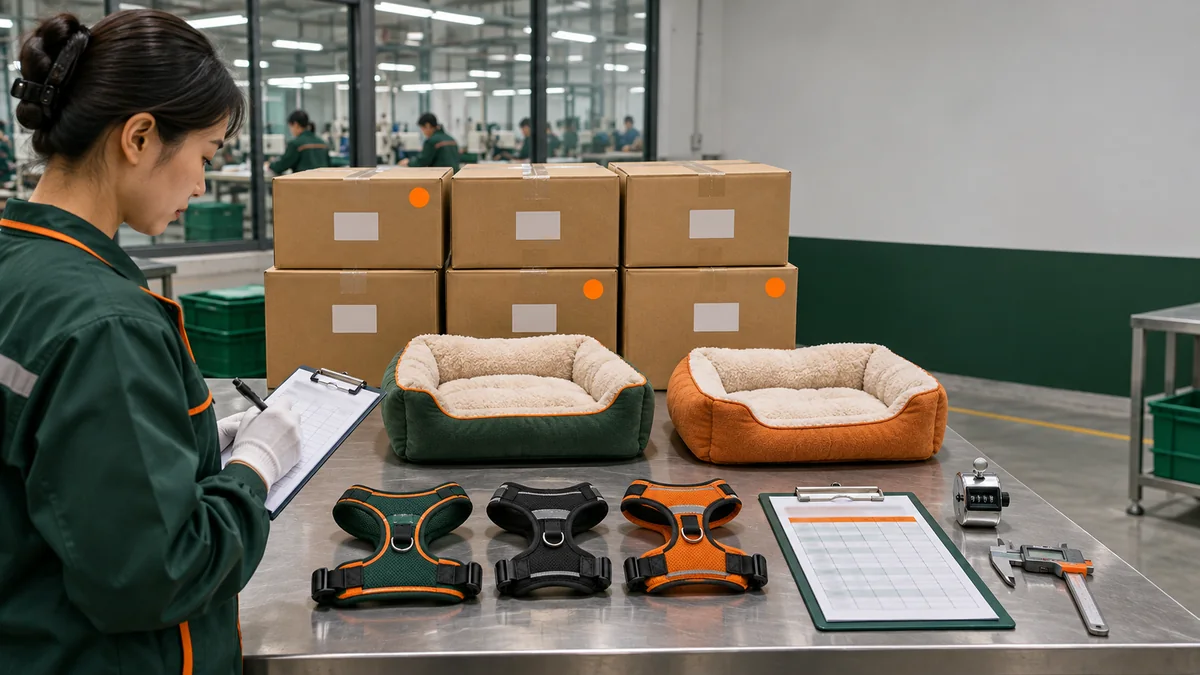
An AQL sampling plan turns a shipment lot into a practical inspection decision. Start with the lot size, choose the inspection level required by the contract, use the table to find a code letter, and then read the matching sample size and acceptance/rejection limits. The inspector draws that number of units across the shipment and compares the defects found with the Ac and Re numbers.
The short answer to “How do you use an AQL sampling table to choose the correct inspection sample size?” is: lot size → inspection level → code letter → sample size → Ac/Re limits. Each step depends on the one before it. Choosing 80 units because it feels sufficient, or applying “2.5%” directly to a shipment, is not the same as using an acceptance-sampling plan.
This guide focuses only on reading the table and selecting the sample. Petlland’s parent guide to AQL inspection for pet products covers defect classification and the broader use of major and minor AQL levels. Keeping those topics separate avoids mixing the table lookup with the commercial decision about which defects belong in each class.
Start with lot size
The lot is the defined quantity presented for inspection under one decision. It is not automatically every unit on a purchase order. A shipment may need to be divided when products differ by SKU, factory, material, color, production line, production period, specification revision or packing status. Combining unlike goods can hide a localized problem and produce a sample that does not represent any one group well.
Before the inspector opens cartons, the purchase order or inspection booking should identify the product, total quantity, lot boundaries, completed quantity and packed quantity. If 10,000 units were ordered but only 7,800 finished units form the lot available on inspection day, the plan should use the actual defined lot under the agreed contract rule. A partially completed lot can also limit random access, so the buyer should decide whether inspection can proceed.
Lot size affects the code letter, but sample size does not rise in direct proportion forever. Acceptance sampling is designed to obtain information from a manageable random sample, not inspect a fixed percentage of every shipment. That is why doubling the lot does not necessarily double the sample.
Choose inspection level
The inspection level controls the relative sample size. Under the ISO 2859-1 framework, general inspection levels I, II and III are used for ordinary lot-by-lot inspection, with General II commonly specified as the default starting point. Level I produces a smaller sample and Level III a larger one for the same lot range. Special levels S-1 through S-4 are intended for situations where smaller samples are necessary and larger sampling risks can be accepted, often because a test is destructive, slow or expensive.
Do not let the factory or inspector change the level after seeing the goods. The purchase specification should name the standard edition, inspection type, level, switching status and AQL values before production. Normal, tightened and reduced inspection are not interchangeable labels; switching rules depend on the history of a continuing series of lots and the applicable standard.
For a first order, a buyer might specify normal inspection, General II, single sampling, with separate limits for critical, major and minor defects. A higher or lower level should have a documented reason. Petlland’s sourcing and quality-control services can help turn the product risk, contract and inspection method into one consistent booking instruction.
Find the code letter
Find the lot-size row in the first table, then move across to the chosen inspection-level column. The intersection gives a sample-size code letter. The code is an index that connects the lot-size table to the sampling-plan table; it is not a quality grade and it is not an AQL value.
For example, a commonly used normal-inspection, General II plan maps a lot of 800 units to code letter J, a lot of 1,500 units to K, and a lot of 12,000 units to M. These examples are included to demonstrate the workflow, not replace the current licensed table. Always verify the row, column and any arrow or note in the edition required by the contract.
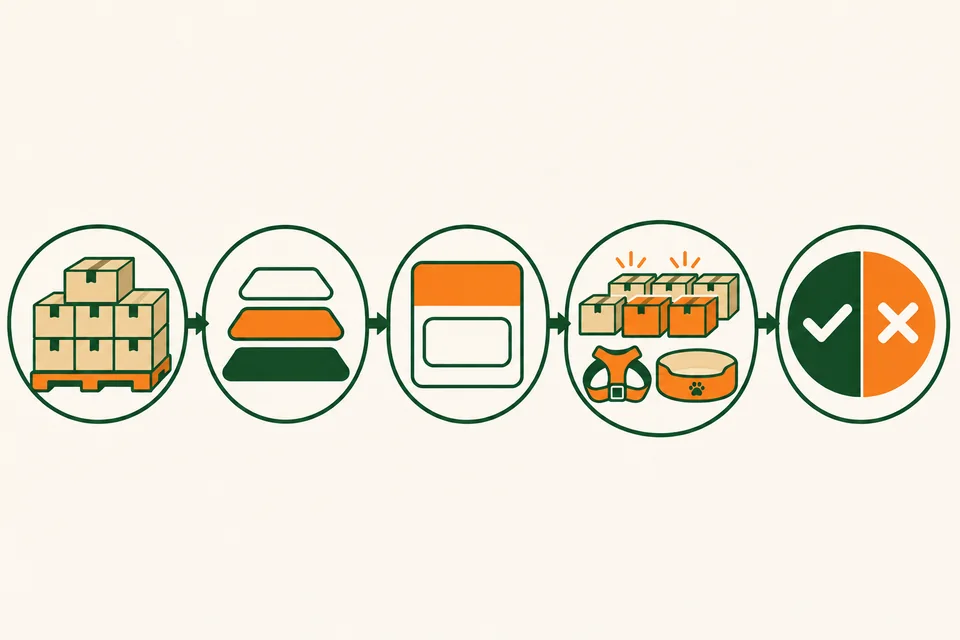
After finding the code, record it on the inspection sheet. This small step makes the decision auditable: another reviewer can confirm the lot size and level led to the chosen sample. If the code cannot be traced, the sample-size claim is incomplete.
Select sample size and Ac Re numbers
Use the code-letter row in the selected single- or multiple-sampling table. The row provides the sample size. Move across to the specified AQL column to find the acceptance number (Ac) and rejection number (Re). Accept the lot for that defect class when the count is at or below Ac; reject it when the count reaches Re. In a single-sampling plan, Re is usually the next whole number after Ac.
AQL is not the percentage of defective units a buyer promises to accept in this particular shipment. ISO describes AQL as the quality level used as the indexing value for the sampling scheme and, for a continuing series of lots, the worst tolerable process average. A sample can pass even though uninspected units contain defects, and a sample can fail even though the lot’s true defect rate is lower than the sample result. Acceptance sampling manages producer and consumer risks; it does not remove them.
Critical defects need special wording. Many buyer specifications use Ac 0 / Re 1 for hazards or regulatory failures, meaning one observed critical defect rejects the lot. That contractual rule should not be described as “AQL 0.” Record it separately from the major and minor AQL columns.
| Illustrative lot | Level | Code | Sample | Major 2.5 Ac/Re | Minor 4.0 Ac/Re |
|---|---|---|---|---|---|
| 800 | General II | J | 80 | 5 / 6 | 7 / 8 |
| 1,500 | General II | K | 125 | 7 / 8 | 10 / 11 |
| 12,000 | General II | M | 315 | 14 / 15 | 21 / 22 |
The table above is a small teaching aid, not a reproduction of the complete standard. ISO 2859-1:2026 includes the framework, tables and switching rules needed to select a plan for a defined inspection situation. Obtain the licensed edition and use the version named in the purchase agreement.
Work through three pet product examples
Example 1: 800 dog harnesses
A shipment contains one defined lot of 800 matching dog harnesses. The contract calls for normal inspection, General II, single sampling, with critical Ac 0/Re 1, major AQL 2.5 and minor AQL 4.0. The lot-size lookup gives code J, and the plan row gives a sample of 80 units. The illustrative Ac/Re limits are 5/6 for major defects and 7/8 for minor defects.
The inspector selects 80 harnesses across cartons, sizes, colors and accessible production sections. If the result is 0 critical, 5 major and 7 minor defects, each class is at or below Ac and the lot passes the sampling decision. If major defects reach 6, minor defects reach 8, or one critical defect is found, the lot fails under these rules.
Example 2: 1,500 pet beds
A lot of 1,500 matching pet beds is inspected under the same normal General II plan. The lot maps to code K and a sample of 125. The illustrative major 2.5 limits are Ac 7/Re 8, while minor 4.0 uses Ac 10/Re 11.
Sampling should cover cartons from different pallet positions and, where traceable, more than one sewing or filling period. Suppose the inspector finds no critical defects, 7 major defects and 8 minor defects. The lot remains within both acceptance numbers. Eight major defects would reject it. The decision counts defective units or defects exactly as the inspection specification defines; do not change the counting rule after inspection begins.
Example 3: 12,000 pet bowls
A homogeneous lot of 12,000 pet bowls maps to code M under the illustrative normal General II lookup, producing a sample of 315. At major AQL 2.5 the example limits are Ac 14/Re 15; at minor AQL 4.0 they are Ac 21/Re 22. Inspectors should distribute 315 selections across the lot rather than taking the nearest open cartons.
If the sample contains 10 major and 12 minor defects but one critical sharp-edge defect, the lot rejects because the critical rule is Ac 0/Re 1. Passing the major and minor columns cannot cancel a failure in another defect class. The inspection report should show the sample source, photographs, defect tally and decision for each class.
Use the worksheet below to record lot size, inspection level, code letter, sample size, Ac/Re limits and defects found. It includes the three educational examples and blank rows for new inspections. Verify the code and limits against your licensed table before relying on the calculated decision.
FAQ
How do you use an AQL sampling table to choose a sample size?
Identify the defined lot size, select the contractually required inspection level, find the code letter at their intersection, and then use that code in the chosen sampling-plan table. The code row gives the sample size; the AQL column gives the Ac and Re limits.
Does AQL 2.5 mean 2.5% of the shipment may be defective?
No. AQL is an indexing value used to select an acceptance-sampling plan and, for a continuing series of lots, represents the worst tolerable process average. The decision comes from the sample size and Ac/Re limits, not by multiplying the lot quantity by 2.5%.
What do Ac and Re mean in an AQL inspection chart?
Ac is the maximum observed count that accepts the lot for a defect class. Re is the count that rejects it. In a single-sampling plan, if Ac is 5 and Re is 6, a count of five passes that class and a count of six fails it.
Can the same sample be used for critical, major and minor defects?
Often the same randomly selected units are examined for all three classes, but each class has its own decision rule. The contract may specify Ac 0/Re 1 for critical defects and separate AQL columns for major and minor defects.
Which edition of ISO 2859-1 should buyers use?
ISO published ISO 2859-1:2026 as the third edition. The purchase contract should identify the required edition and any buyer-specific rules. Do not silently change standards or table versions during an order.
Sources
- ISO 2859-1:2026 — Sampling procedures for inspection by attributes — Part 1
- ASQ Quality Glossary — acceptance sampling, random sampling and sample size definitions
Need a product-specific sampling plan, defect list and inspection checklist? Review Petlland’s quality-control services and send the product specification before production begins.