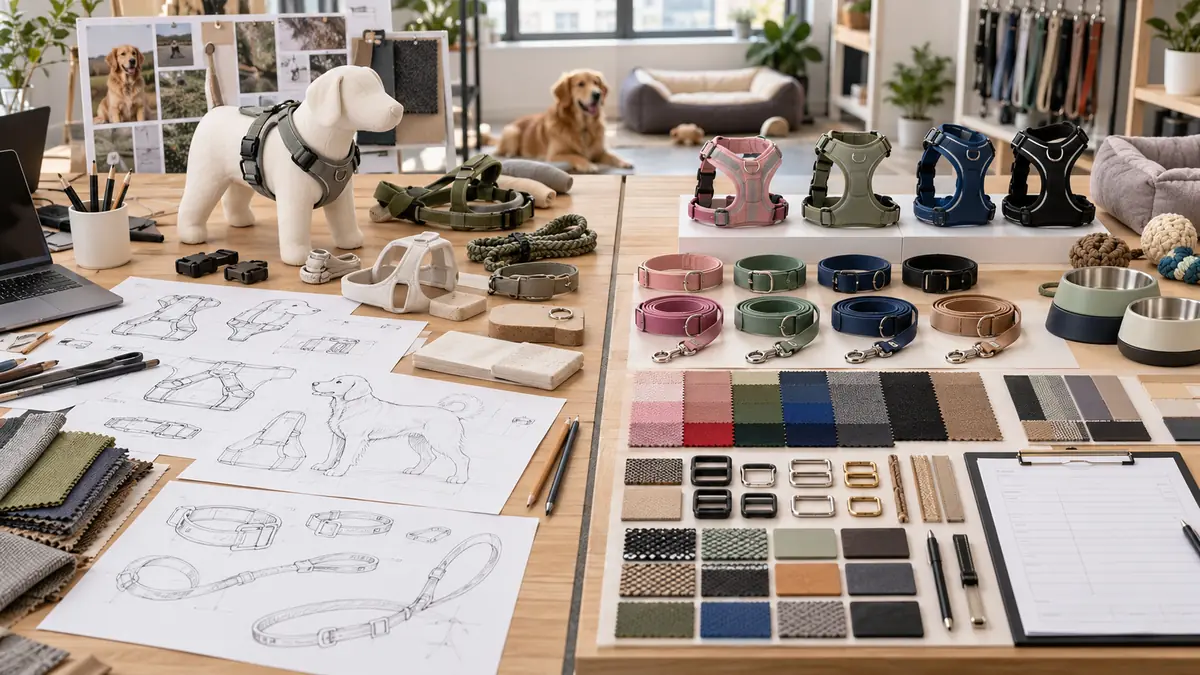
The practical choice between OEM vs ODM pet products is not about which acronym sounds more advanced. It is about who contributes the product design, who controls the released specification, how much development work is required, and what commercial commitment the brand can support before launch.
Direct answer: choose an OEM route when your brand can supply and approve the product requirements that the factory must manufacture. Choose an ODM route when the supplier contributes a proven platform or helps develop the structure, tooling or engineering. Choose private label when an existing product is already suitable and only the branding, selected colorway or packaging needs to change. Put those responsibilities in writing, because there is no single industry-wide use of OEM and ODM terminology.
This guide turns the model names into a buying decision. It compares design ownership, development time, tooling, MOQ, specification control and differentiation, then applies the trade-offs to common pet-product categories. Petlland's published figures are included as planning examples for its current factory base, not as universal market rules or a quotation.
Define private label OEM and ODM
Private label: keep the product body and change the market-facing layer
A private label manufacturing model normally starts with a product the supplier already makes. The buyer selects an available construction, then controls the brand assets around it: logo application, label, insert, retail packaging, barcode and sometimes a stocked color or material option.
Private label is useful when the commercial question is still "Will our audience buy this category?" It minimizes product-development work and avoids new tooling. Its limitation is equally clear: if the underlying body remains a catalogue item, competitors may be able to buy a similar product. Exclusivity must therefore be defined for the artwork, packaging, selected configuration and listings rather than assumed from the phrase "private label."
OEM: manufacture to the buyer's controlled requirements
For this guide, OEM pet products are products manufactured to buyer-controlled requirements. The buyer may provide a complete design package or a precise functional brief that becomes a released specification after development and sample approval. The factory contributes manufacturing know-how, process design and production feasibility, but the buyer controls what the finished product must be.
OEM work can be modest or extensive. A specified webbing grade, revised harness geometry, custom foam density, graded size pattern or defined hardware upgrade may all move a project beyond surface-level private label. A completely new product can also be OEM when the buyer owns the drawings, performance requirements and revision-controlled specification.
The key OEM question is not "Did the factory make it?" Every route uses a factory. The useful question is "Could another qualified factory manufacture the same released specification without relying on undocumented knowledge held by the first supplier?" If not, the brand may have less practical control than the contract suggests.
ODM: adapt or develop a supplier-contributed platform
For this guide, ODM pet products use a supplier-contributed design, platform or development capability. The supplier may offer an existing structure that can be configured, or it may turn a buyer's concept into manufacturable geometry, tooling and process documentation. The buyer then selects, modifies and approves the market version.
ODM can shorten the path from idea to manufacturable product because the supplier is not starting from zero. It can also create dependency if the underlying design files, tooling or engineering records remain with the supplier. The contract should separate three layers:
- Background IP: designs, know-how and platforms that existed before the project.
- Project IP: drawings, molds, patterns, artwork, test methods and improvements created for the project.
- Brand assets: trademarks, packaging, copy and artwork supplied by the buyer.
WIPO's 2026 guidance on supplier IP agreements warns that ownership can blur when suppliers participate in design, development or manufacturing. Clear confidentiality, use, assignment or licensing terms matter more than the model label. Industrial-design protection is also territorial and generally concerns the ornamental appearance of a product, while technical or functional improvements may involve other rights. This is a commercial planning guide, not legal advice.
Why the same project can receive different labels
One supplier may call a modified catalogue item OEM; another may call it ODM; a third may call any branded order OEM. Petlland's published working convention places logo and packaging changes in private label, product modifications in OEM, and new-structure or new-tooling development in ODM. Buyers should use those definitions only as a starting point and write the actual responsibility split into the quotation, development agreement and purchase specification.
Compare design ownership and development effort
The model changes who must create, validate and maintain the information that production depends on. A logo file is not a product specification, and a physical sample alone does not capture every material, tolerance, test method or approved exception.
| Decision area | Private label | OEM | ODM |
|---|---|---|---|
| Starting point | Supplier's existing product | Buyer-controlled design or requirements | Supplier platform or supplier-assisted concept development |
| Buyer input | Brand assets, selected options and packaging | Drawings, functional targets, dimensions, materials and acceptance rules | Market brief, must-have functions, target cost and approval decisions |
| Supplier input | Catalogue product and decoration process | Manufacturing feasibility, process design and production execution | Platform, engineering, structure, tooling path and production execution |
| Specification control | Buyer controls brand layer; product body may remain supplier-controlled | Buyer should control the released product specification | Control is negotiated; supplier background IP may remain licensed rather than assigned |
| Development effort | Low | Medium to high, depending on completeness of the buyer's design | Medium to high, depending on novelty and validation |
| Differentiation | Mostly visible brand and packaging | Product-level, if the requirement is meaningful and exclusive | Product-level, but exclusivity depends on platform and contract boundaries |
| Portability to another factory | Often easy but not exclusive | Possible when files, tolerances and tooling rights are complete | May be limited by supplier-owned platform, tooling or know-how |
An anonymized development workflow
The following workflow is a sanitized operating model, not a customer case or a claimed project outcome.
- Route screen: the buyer supplies target user, product category, intended market, target retail price, launch date and reference products. The team decides whether an existing body can work, whether the buyer's requirements are complete enough for OEM, or whether supplier-led ODM development is needed.
- Responsibility release: both sides sign the responsibility matrix before detailed files or tooling are commissioned. Background IP, project deliverables, confidentiality, exclusivity and reuse rights are listed explicitly.
- Feasibility review: the supplier checks materials, construction, tooling, tolerances, test access, packaging and cost. Open assumptions become written questions, not silent factory decisions.
- Prototype cycles: each sample has a stage, revision and change list. A concept sample proves direction; a functional sample proves construction; a pre-production sample must match the intended material and process.
- Specification freeze: the approved physical sample is paired with a controlled bill of materials, dimensions, tolerances, artwork, packing instructions, test methods and revision number.
- Tooling and production release: ownership records, mold or pattern number, maintenance responsibility, storage location and transfer conditions are confirmed before bulk production.
- Change control: no material, construction, artwork or process change is accepted through chat alone. The specification revision and sample status are updated together.
Responsibility matrix to settle before development
| Deliverable or decision | Buyer responsibility | Supplier responsibility | Written proof to retain |
|---|---|---|---|
| Product brief and intended use | Define user, animal size, market, use conditions and must-have outcomes | Challenge ambiguity and identify manufacturing constraints | Approved product brief and open-issue log |
| Background design | Declare buyer-owned inputs and third-party references | Declare supplier platform, prior tooling and reusable know-how | IP schedule attached to the agreement |
| Engineering files | Approve required performance and interfaces | Create or manufacture from the agreed drawings, as contracted | Native and export files, revision log and access rights |
| Material specification | Approve composition, grade, color and restricted-substance requirements | Source approved material and disclose substitutions before use | BOM, supplier records, swatches and approval evidence |
| Tooling and patterns | Approve budget and ownership terms | Quote, build, label, maintain and store as agreed | Tool number, photos, payment record and transfer terms |
| Verification and testing | Define destination-market and brand requirements with qualified advice | Supply samples and production evidence; arrange agreed tests | Test plan, report identifiers and disposition |
| Golden sample | Approve the final construction and appearance | Produce, seal and retain matched reference as agreed | Signed sample label and matching specification revision |
| Production changes | Approve or reject deviations | Request written approval before changing controlled inputs | Engineering-change or deviation record |
WIPO notes that industrial design rights can protect ornamental aspects such as shape, pattern, lines or color, generally through registration in the relevant jurisdiction. That legal protection is separate from factory paperwork. A tooling receipt, NDA or specification can support contractual control, but it does not automatically create registered design rights.
Map cost MOQ and lead-time differences
Cost is not only the unit quote. The development model changes the amount of cash and calendar time committed before revenue exists.
The cost stack
Private label usually has the smallest non-recurring cost because the body and process already exist. The buyer may still pay for samples, artwork setup, packaging plates or courier charges.
OEM adds specification and validation work. Depending on the change, costs can include patterns, graded sizes, fixtures, material minimums, more sample rounds and targeted testing. A buyer with incomplete drawings may also pay indirectly through repeated prototypes and delayed decisions.
ODM may use an existing supplier platform and avoid some engineering cost, but structural changes or exclusive variants can require design work, tooling and validation. If the platform remains supplier-owned, the lower initial development burden may be exchanged for less portability or narrower exclusivity.
Petlland planning figures, not universal thresholds
Petlland currently publishes the following starting points for its factory base. Final MOQ applies to the agreed model, color, material and packaging; timing starts from written sample approval unless otherwise stated and excludes transit. Product-specific quotations take precedence.
| Development route | Published MOQ per SKU | Published sample window | Published production window | Tooling position |
|---|---|---|---|---|
| Private label, logo on stock product | From 100 pcs | 7 days | 20-25 days | None |
| Private label, retail packaging | From 100 pcs | 15 days | 25-30 days | None |
| OEM, custom color or material | From 300 pcs | 15-18 days | 30-35 days | Existing tooling |
| OEM, new size pattern | From 500 pcs | 20 days | 32-38 days | Pattern fee |
| ODM, new silicone or TPR mold | From 1,000 pcs | 30 days | 35-45 days | Quoted per tool |
| ODM, full structure development | From 2,000 pcs | 30-40 days | 40-50 days | Quoted per project |
These ranges explain direction, not certainty. MOQ often rises when a project needs a custom material run, a new component, a new mold or dedicated setup. Lead time expands when decisions, test results or sample revisions remain open. Conversely, a well-defined OEM package can move faster than a poorly defined ODM concept even if the OEM product is more differentiated.
Compare total commitment before comparing unit price
Ask for five numbers on the same basis:
- sample and engineering charges;
- tooling, fixture or pattern charges;
- MOQ per SKU, color and size;
- estimated unit price at the launch quantity and expected reorder quantity;
- calendar from brief to approved sample, then from approval to production completion.
Then add the cost of validation, packaging, freight, duty, inspection and rework allowance. A low unit quote can be the expensive route if it requires a higher MOQ, more variants or a mold that cannot be transferred.
Show category-specific examples
Dog harnesses
Private label: choose an existing harness construction, stocked webbing and hardware, then add woven labels, a selected color and retail packaging.
OEM: provide a controlled size chart, strap geometry, webbing specification, hardware performance requirements, stitching pattern and fit criteria. The factory manufactures to that released package and documents approved changes.
ODM: begin with a handling problem or use case, then adapt a supplier platform or co-develop a new structure. The supplier may create patterns and construction solutions; the agreement must define access to files, exclusivity and pattern ownership.
The route should be based on the physical difference the customer can perceive. A new color alone rarely justifies structural development. A genuinely improved fit or control feature might.
Pet beds and mats
Private label: brand an existing shape and choose from standard covers, fills or sizes.
OEM: specify panel dimensions, foam density, fill weight, cover construction, zipper, seam details, care label and packaging compression limits.
ODM: ask the supplier to develop a modular or convertible structure around a user need, target landed cost and shipping constraint. Because compressed packing can affect product recovery, the validation plan should be agreed before the design is frozen.
Plush and fabric toys
Private label: apply branding and packaging to a catalogue toy whose construction remains unchanged.
OEM: provide the character artwork, pattern or construction package, materials, component rules, seam requirements and labeling specification.
ODM: commission the supplier to translate a concept into patterns, prototype construction and a production-ready specification. The contract should say whether the supplier may reuse the underlying pattern or sell similar bodies to other buyers.
Bowls and feeders
Private label: decorate or package an existing bowl or feeder.
OEM: specify material, capacity, dimensions, surface finish, base construction, tolerances and packaging protection, using existing tooling where possible.
ODM: develop a new shape, mechanism or assembly that needs supplier engineering and tooling. Confirm who owns the CAD, mold, cavities and later design changes. Also separate appearance rights from functional claims and obtain qualified market-specific advice where needed.
Across categories, the same rule holds: choose the lightest development model that still creates the product difference your customer will notice and your business can defend.
Choose a model with a decision checklist
Use the checklist before requesting quotations. If an answer is unknown, mark it as an open decision rather than allowing the supplier to fill the gap silently.
Choose private label when
- an existing product already meets the intended use and quality level;
- your current advantage comes from audience, brand, assortment or packaging;
- speed and demand validation matter more than structural exclusivity;
- you want the lowest development burden and no new tooling;
- you accept that similar product bodies may remain available to other buyers.
Choose OEM when
- your brand can define the product requirements and approval criteria;
- the physical specification, not only the packaging, must change;
- you need control of drawings, materials, dimensions, tolerances and revisions;
- the launch volume supports the relevant material, setup or pattern minimums;
- portability to another qualified factory matters and the documentation can support it.
Choose ODM when
- you have a validated market problem but not a complete manufacturable design;
- the supplier has a relevant platform, engineering team or tooling capability;
- speed to a differentiated structure matters more than owning every background element;
- you can negotiate clear use, exclusivity, licensing, tooling and file-access terms;
- the business can support additional prototypes, tooling and validation before launch.
Ten questions to put in the RFQ
- What exactly does the supplier mean by private label, OEM and ODM for this quotation?
- Which design, tooling, files and know-how existed before this project?
- Which project deliverables will the buyer own, license or receive after payment?
- Can the supplier sell the same body, structure or appearance to another buyer?
- What change drives the MOQ: decoration, material, component, pattern, mold or process setup?
- How many sample rounds are included, and what starts the production clock?
- Which tests and approvals must be complete before tooling and bulk production?
- How will the golden sample and specification revision be linked?
- Who can approve a material or process deviation, and how is it recorded?
- What happens to tooling, files, samples and confidential information when the relationship ends?
If the answers are clear, the acronym matters less. If they are vague, calling the project OEM or ODM will not reduce the risk.
Petlland's OEM and ODM capability page explains its current customization ladder and published planning minimums. The broader white label vs private label vs OEM guide helps brands choose the first commercial model, while the golden sample and specification guide covers the approval record needed after the route is chosen.
Frequently asked questions
What is the practical difference between OEM and ODM pet products for a growing brand?
OEM is the better fit when the brand controls what must be made and can release a complete specification. ODM is the better fit when the supplier contributes the platform, engineering or structural development. The commercial difference appears in file ownership, tooling, exclusivity, validation work, MOQ and the brand's ability to move the product elsewhere.
Is OEM always more expensive than ODM?
No. A complete OEM design using familiar processes may require less development than an ambitious ODM concept. ODM can reduce the buyer's engineering burden when a supplier platform already exists, but exclusive changes, new tooling and unclear approvals can add cost. Compare the total launch commitment, not the label or unit price alone.
Who owns an ODM pet product design?
Ownership depends on the agreement and applicable law. The supplier may retain background IP while the buyer owns brand assets and receives ownership or a license for project-specific deliverables. State the position for CAD files, patterns, molds, artwork, improvements and reuse rights before paying for development. Obtain qualified legal advice for the relevant jurisdictions.
Does paying for a mold mean the buyer owns it?
Not automatically. The purchase and development documents should identify the tool, ownership, storage, maintenance, permitted use, refund or amortization terms and transfer conditions. Petlland states that client-funded tooling is recorded to the client account by mold number, but the exact terms still need to appear in the project quotation.
Can a first-time brand start with OEM or ODM?
Yes, but it should have evidence that the product difference justifies the additional cash, time and validation. If demand is still uncertain and an existing body can solve the customer's problem, private label usually preserves more learning budget. Move into OEM or ODM when the product-level difference is central to why customers will buy.
Can an OEM or ODM label guarantee exclusivity?
No. Exclusivity comes from defined contractual rights and, where appropriate, registered intellectual-property protection. Confirm the exact product scope, territory, duration, exceptions, supplier background IP and remedies. Do not assume that a custom color, paid sample or model name creates exclusivity.
Sources and review notes
- Petlland – OEM and ODM customization capability, current published minimums, sample windows, tooling terms and approval workflow, reviewed 17 October 2026.
- Petlland – White Label vs Private Label vs OEM Pet Products, operational definitions and customization ladder, reviewed 17 October 2026.
- Petlland – Pet Product Sample Approval and Golden Sample Guide, specification, revision and sample-control workflow, reviewed 17 October 2026.
- WIPO – IP Agreements with Suppliers: What Ventures Need to Know, published 14 July 2026.
- WIPO – Industrial Designs, definition, scope and registration overview, reviewed 17 October 2026.
Review note: OEM, ODM and private-label terminology is not used consistently across suppliers. MOQ, costs and lead times vary by product, material, tooling, color, packaging, factory capacity and season. Petlland's published figures are planning references for its current factory base and must be reconfirmed for the exact SKU. IP ownership, exclusivity and registration are legal questions; use qualified counsel for the relevant markets.
Send your concept for an OEM or ODM route recommendation. Include the product category, intended user, target market, must-have physical difference, target quantity, target landed cost and launch date through Petlland's contact page.