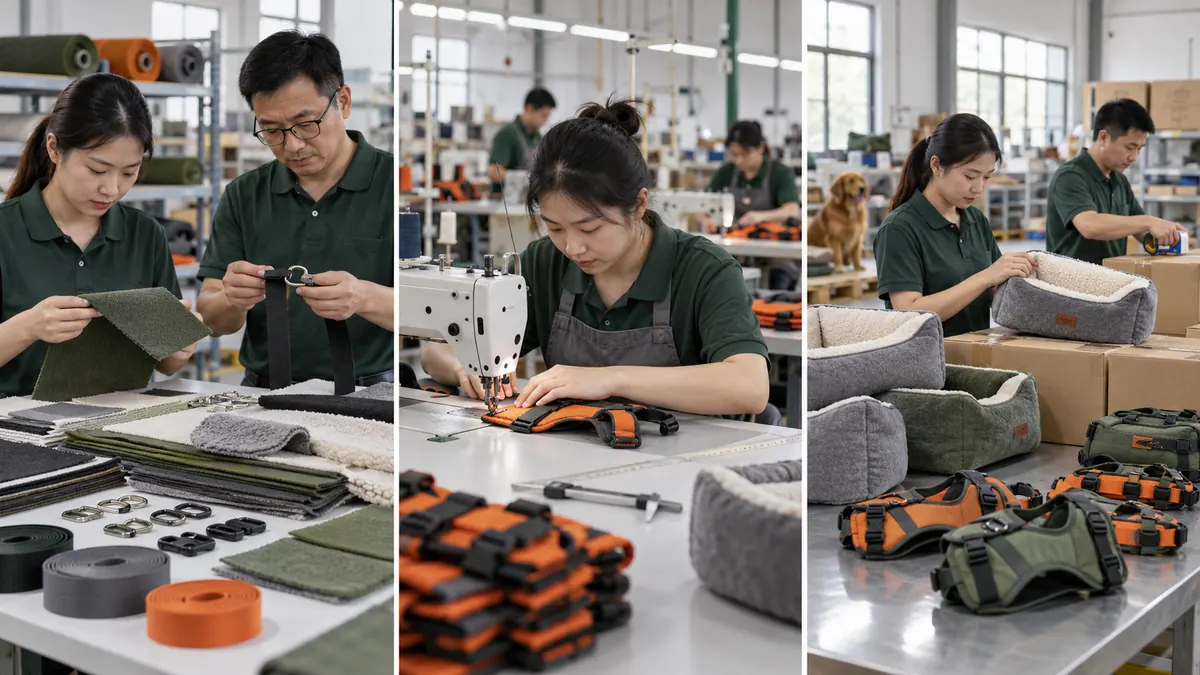
A pre shipment inspection in China is useful, but it is not a complete pet product quality plan. By the time finished goods are packed, an inspector can still identify workmanship, quantity, packaging and labeling problems, yet the factory may already have repeated the same material or process error across the whole order.
Direct answer: the stage that prevents the most risk depends on when the risk is created. Use pre-production inspection for materials, components, approved samples and line readiness; use during-production inspection for process drift and corrective action; use pre-shipment inspection for a statistically supported decision on the completed lot. For a new supplier, a new construction or a safety-sensitive category, the strongest plan normally combines all three.
This guide explains what each stage can prove, what it cannot prove, and how to build a practical inspection plan without treating AQL or PSI as a universal guarantee. It also includes an anonymized record structure and a defect escalation path. The record structure is a redacted planning model based on Petlland's published reporting fields; it is not presented as a customer result, certification or laboratory report.
1. Define each inspection stage
Pre-production inspection
A pre production inspection takes place before bulk production, or during the earliest first-article work. The purpose is to verify that production is starting with the correct inputs and an understood specification.
Typical checks include:
- approved material swatches, webbing, foam, filling, hardware or resin;
- the current bill of materials and specification revision;
- the sealed golden sample or signed reference sample;
- dimensions, tolerances, color references, labels and packaging artwork;
- incoming material quantity, storage and segregation;
- production fixtures, patterns, molds, gauges and test methods;
- first articles before the line is allowed to continue.
QIMA describes an initial production check as an on-site inspection from pre-production through the first 20% of production, including raw materials and the first items produced. SGS lists pre-production and initial production checks among its consumer-product inspection services. The percentage is a service convention, not a universal rule; the purchase order should define the gate for the specific project.
Pre-production inspection is strongest at preventing a wrong-input problem from becoming a full-run problem. It cannot show whether a process will stay controlled over thousands of repeated operations.
During-production inspection
A during production inspection, often called DUPRO, checks completed and work-in-progress units after the line is running but before the order is finished. QIMA places DUPRO in the middle of production, while SGS and Intertek describe it as a way to identify nonconformities and corrective actions before completion.
Typical checks include:
- production progress and whether the correct SKU mix is being made;
- first-off and in-process measurements;
- sewing, welding, molding, gluing, printing or assembly consistency;
- machine settings, work instructions and operator control points;
- traceability between raw materials, work-in-progress and finished cartons;
- the effectiveness of corrective action raised at the first-article stage;
- targeted sampling from different shifts, lines or batches.
DUPRO is strongest when a defect can drift over time: skipped stitches, changing dimensions, inconsistent fill weight, weak adhesive coverage, incomplete molding or artwork registration. It does not provide a final decision on the complete shipment because some units do not yet exist.
Pre-shipment inspection
A pre shipment inspection China program checks finished goods before release. Service providers often require production to be complete and most units to be packed. SGS describes final random inspection at 100% produced and at least 80% packed; QIMA states that PSI is conducted when at least 80% of the order is complete. The buyer's contract should state its own readiness threshold.
Typical PSI checks include:
- finished quantity and packed quantity;
- random sample selection across cartons and SKU variants;
- workmanship, dimensions, weight, function and appearance;
- barcode, label, warning, insert and retail-pack checks;
- carton assortment, shipping marks, carton dimensions and weight;
- comparison against the approved sample and specification;
- defect counts against the agreed acceptance plan;
- a documented release, hold or corrective-action recommendation.
ISO 2859-1:2026 defines AQL-indexed acceptance sampling schemes for inspection by attributes. ASQ explains that an acceptance sampling plan specifies the sample size and the acceptance or non-acceptance criteria. For many buyer programs, that makes AQL most visible at PSI, where a finished lot can be randomly sampled. AQL is not a substitute for first-article approval, process control, laboratory testing or a complete inspection checklist.
2. Match risks to stages
Inspection timing should follow the moment a failure can first be detected. Waiting for PSI is reasonable only when the risk truly appears in finished goods and can still be corrected before shipment.
| Risk | Earliest useful stage | Why |
|---|---|---|
| Wrong fabric, webbing, foam, resin or hardware | Pre-production | The input can be quarantined before it enters bulk production. |
| Wrong pattern, mold, specification revision or label artwork | Pre-production | One controlled first article can stop systematic replication. |
| Stitch density, seam alignment or adhesive coverage drifts by shift | During production | The line can be corrected while most units remain unfinished. |
| Color or dimension changes between material batches | During production | Sampling across batches reveals variation that one first article cannot. |
| Finished quantity, mixed SKU ratio or carton assortment | Pre-shipment | The complete packing result must exist before it can be verified. |
| Random finished-lot workmanship defects | Pre-shipment | A random sample supports a documented accept-or-hold decision. |
| Market compliance or safety validation | Before production plus qualified testing | Visual inspection cannot create compliance or replace laboratory work. |
The key distinction is prevention versus detection. Pre-production and during-production controls can prevent continued replication after a problem is found. PSI mainly detects whether the finished lot meets the agreed release criteria.
An anonymized inspection-record structure
The following structure shows how a usable record can connect a finding to a decision without exposing a buyer, supplier or order. It is a field-level example, not a claimed project outcome.
| Record field | Redacted example |
|---|---|
| Project and SKU | Buyer, supplier and SKU identifiers removed |
| Stage | During-production inspection |
| Production status | Completed and work-in-progress quantities recorded by line and shift |
| Controlled reference | Approved sample, specification revision and inspection checklist ID |
| Finding | Load-bearing seam construction differs from the approved reference |
| Evidence | Location, quantity checked, photographs, measurements and affected batch/shift |
| Initial classification | Major pending buyer confirmation; critical if the agreed risk assessment identifies an injury hazard |
| Containment | Pause the affected operation; segregate work-in-progress and finished units from the traceable range |
| Correction | Reset the process, produce corrected first articles and document operator/instruction changes |
| Verification | Recheck corrected first articles, expand targeted sampling and schedule final random inspection |
| Release authority | Named buyer representative or agreed quality owner |
This record avoids the weak instruction “factory will improve.” It identifies the affected range, the controlled reference, the owner, the evidence required and the gate that must pass before work continues.
Defect escalation path
- Record the finding. Tie it to an SKU, location, batch, shift, sample and specification clause.
- Classify the consequence. Use the project-specific critical, major and minor definitions rather than a generic internet list.
- Contain the exposure. Stop or isolate the affected process and prevent mixed good/bad stock.
- Notify the decision owner. Escalate critical findings immediately; time-box major-defect decisions.
- Correct the process, not only the sample. Require evidence of the changed setting, instruction, material or method.
- Verify the correction. Approve corrected first articles, run targeted checks and retain objective records.
- Reassess the lot. Use the agreed final sampling and release rules once production is complete.
- Close the action. Record root cause, affected quantity, disposition, owner and prevention step for the next order.
3. Compare timing and cost
The later a systematic defect is found, the larger the commercial exposure usually becomes. This is a planning principle, not a universal cost formula.
| Stage | What exists when the check happens | Typical correction scope | Main schedule risk |
|---|---|---|---|
| Pre-production | Materials, components, artwork, setup and first articles | Replace or reapprove inputs; correct patterns, settings or documents | Material replacement or approval delay |
| During production | Work-in-progress plus some finished units | Segregate an affected range, rework units, correct the line and verify | Lost production time and a targeted rework cycle |
| Pre-shipment | Completed and mostly packed goods | Sort, unpack, rework, replace, repack and re-inspect | Shipment delay, freight rebooking or launch disruption |
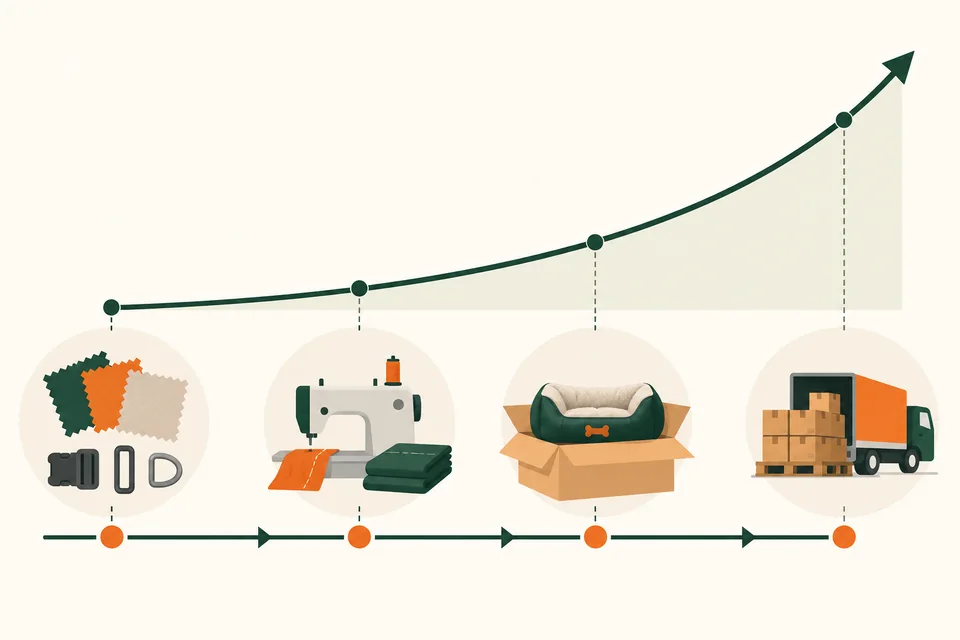
The illustration above shows a conceptual rise in correction effort from material approval to shipment. It does not represent Petlland project data, a quoted rework price or a guaranteed cost curve.
Pre-production inspection is often the lowest-exposure point because a wrong input or first article can be stopped before volume work. DUPRO usually has more direct value on long runs, new lines and process-sensitive construction because it catches replication while corrective action is still possible. PSI remains essential because it gives the buyer evidence about the finished lot, but a failed PSI can be commercially expensive even when the inspection itself is inexpensive.
Do not compare inspection stages only by the inspector's day rate. Compare the decision value:
- How many units could be affected before the next checkpoint?
- Can the factory trace the affected range by shift, batch or line?
- How long would containment, rework and re-inspection take?
- Would the shipping booking or launch date move?
- Is the defect visible in-process, or only after assembly and packing?
- Who pays for a repeat inspection under the purchase agreement?
4. Show category examples
Dog harnesses, collars and leads
Before production, confirm webbing, hardware finish, buckle and D-ring specifications, pattern revision, size chart, bar-tack construction and the approved pull-test method. During production, check load-bearing stitch placement, webbing sealing, adjuster orientation and size measurements across shifts. At PSI, sample finished sizes and colors, check function and workmanship, confirm labels and carton assortments, and apply the agreed finished-lot sampling plan.
Do not invent one universal pull force. The acceptance criterion should come from the product design, intended animal size, risk assessment, destination market and validated test method.
Pet beds and mats
Before production, verify fabric, foam or fill specification, zipper, care label, color reference and pattern dimensions. During production, check seam construction, fill weight, panel dimensions, zipper installation and cover fit. At PSI, sample finished beds across cartons, compare measurements and appearance with the approved reference, and verify packaging, compression and carton data.
Plush and fabric pet toys
Before production, confirm fabric, filling, components, artwork and the approved construction. During production, monitor seam allowance, stitch consistency, component attachment and filling variation. At PSI, inspect finished workmanship, labels, quantity and packing, and perform only the agreed on-site functional checks. Product safety or chemical compliance still requires the appropriate design review and qualified testing.
Pet bowls and feeders
Before production, verify the material specification, approved supplier documentation, color, mold/cavity reference and food-contact requirements for the destination. During production, monitor molding or forming consistency, rim condition, base fit, coating or glaze appearance and capacity measurements. At PSI, sample finished units for appearance, dimensions, function, quantity, retail packaging and shipping protection.
Packaging and mixed-SKU orders
Packaging errors often appear late, so the control should be split. Approve artwork, barcodes, warnings and inserts before printing. Check line-side SKU control and packing instructions during production. At PSI, scan codes and verify SKU/quantity/carton combinations against the purchase order.
5. Build an inspection plan by order risk
A three-stage program is not automatically necessary for every reorder. Allocate inspection effort according to what changed and what failure would cost.
Use all three stages when:
- the supplier, factory, product construction or material is new;
- the order uses safety-relevant hardware, load-bearing seams or controlled materials;
- the product has many size, color, label or packaging variants;
- the specification changed after sampling;
- the production run is long enough for process drift to matter;
- the launch date or freight booking leaves little room for failure;
- previous orders had repeat defects or weak corrective-action evidence.
Consider a reduced plan when:
- the same factory has stable evidence across repeated comparable lots;
- the specification, material source and production line are unchanged;
- the supplier has demonstrated traceability and closed prior actions;
- the buyer has agreed how reduced or tightened inspection is triggered;
- the residual risk and cost of failure are genuinely low.
ISO 2859-1 includes normal, tightened and reduced inspection concepts for continuing series of lots. A buyer should not interpret that as permission to skip process controls whenever one shipment passes. The transition rules, records and supplier history should be defined.
A practical stage-selection worksheet
For every high-impact requirement, complete this sentence:
We will verify [requirement] at [stage] using [method and sample] against [controlled reference]. If it fails, [owner] will [containment and correction] before [release gate].
Examples:
- Verify approved harness webbing and hardware before cutting against the signed BOM and reference set. If either is wrong, purchasing quarantines the lot before production release.
- Verify bar-tack construction during production against the approved sample and stitch specification. If it drifts, the factory isolates the traceable range and requalifies the operation.
- Verify finished carton assortment at PSI against the purchase order and packing list. If the sample fails, shipment remains on hold until corrective action and re-inspection are complete.
Petlland's AQL inspection guide owns the detailed finished-lot sampling explanation. The supplier audit guide covers factory due diligence before deposit. This article owns the decision of when to inspect. Buyers can review Petlland's quality-control services and factory workflow for the operating context.
Frequently asked questions
Which inspection stage prevents the most risk?
No single stage does. Pre-production inspection best prevents wrong inputs and setup errors from spreading. During-production inspection best limits process drift while correction is still practical. Pre-shipment inspection best supports a release or hold decision on the finished lot. High-risk orders usually need all three.
Is pre-shipment inspection enough for a first order?
Usually not. PSI can reveal finished-lot defects, but it may discover a systematic material or construction error only after the whole order is complete. Add pre-production and during-production gates when the supplier, material, design, line or specification is new.
At what production percentage should DUPRO occur?
There is no universal percentage. QIMA describes DUPRO in the 20%-80% range, while SGS examples often place it around 30%-50%. Choose a point that exposes the risk but still leaves enough unmade quantity for corrective action to matter.
When should a pre-shipment inspection be booked?
Book it after production is complete and most goods are packed, while leaving enough time before shipment for containment, correction and re-inspection. SGS describes final random inspection at 100% produced and at least 80% packed. The purchase order should state the readiness threshold.
Does AQL apply to every production-stage check?
No. ISO 2859-1 can be applied to attributes across products, processes and records, but many buyer programs use AQL primarily for finished-lot acceptance sampling. Pre-production and DUPRO often use targeted checks, first-article approval, measurements, traceability and process evidence rather than treating every finding as a final AQL lot decision.
What should happen after an inspection finds a major defect?
Document the finding, confirm its project-specific classification, isolate the affected range, identify root cause, correct the process, verify corrected first articles and expand targeted checks. When the lot is complete, apply the agreed final release or re-inspection plan. Do not close the issue with an unverified promise to “improve.”
Sources and review notes
- ISO 2859-1:2026 – Sampling procedures for inspection by attributes, Edition 3, published January 2026.
- ASQ – Attribute and variable sampling plans, explaining sample sizes and acceptance/non-acceptance criteria.
- SGS – Product inspection services, listing initial, during-production and final random inspection.
- SGS – Final random inspection, describing readiness and typical finished-goods checks.
- QIMA – Initial production check, describing pre-production through early production checks.
- QIMA – During-production inspection, describing mid-production checks and timing.
- QIMA – Pre-shipment inspection, describing finished-order PSI.
- Intertek – Consumer-goods inspection services, describing during-production and final random inspections.
Review note: stage percentages are provider conventions, not universal legal thresholds. The conceptual correction-cost curve is not actual project data. Defect classifications, inspection methods and release criteria must be agreed for the product, order and destination market. This article is educational and is not legal, compliance or product-safety advice.
Ask Petlland to map the right inspection stages. Send the product category, order quantity, supplier status, specification revision and destination market so the team can propose pre-production, during-production and pre-shipment gates for your sourcing brief.