
A pet product sample becomes the production standard only after the buyer and supplier approve the same physical construction, controlled specification, measurable tolerances, visual references, packaging details and revision number in writing. The approved unit is then sealed as the golden sample, while its matching pet product spec sheet becomes the measurement and inspection record. A photograph or a message saying “sample approved” is not enough.
For practical product sample approval, use a two-part master: the physical sample shows details that are hard to reduce to numbers, while the specification records everything that must be repeatable. If the two disagree, production should stop until the discrepancy is resolved and a new revision is signed.
Key takeaways
- Name each sample stage so a visual prototype is never mistaken for a production-ready reference.
- Approve the product, packaging and evidence set—not only the appearance of one unit.
- Give every measurable or visual requirement a pass rule, method and responsible approver.
- Issue a new revision when an approved requirement changes; never overwrite the old record.
- Retain matched golden samples with the buyer, supplier and inspector when the risk justifies it.
1. Define sample stages
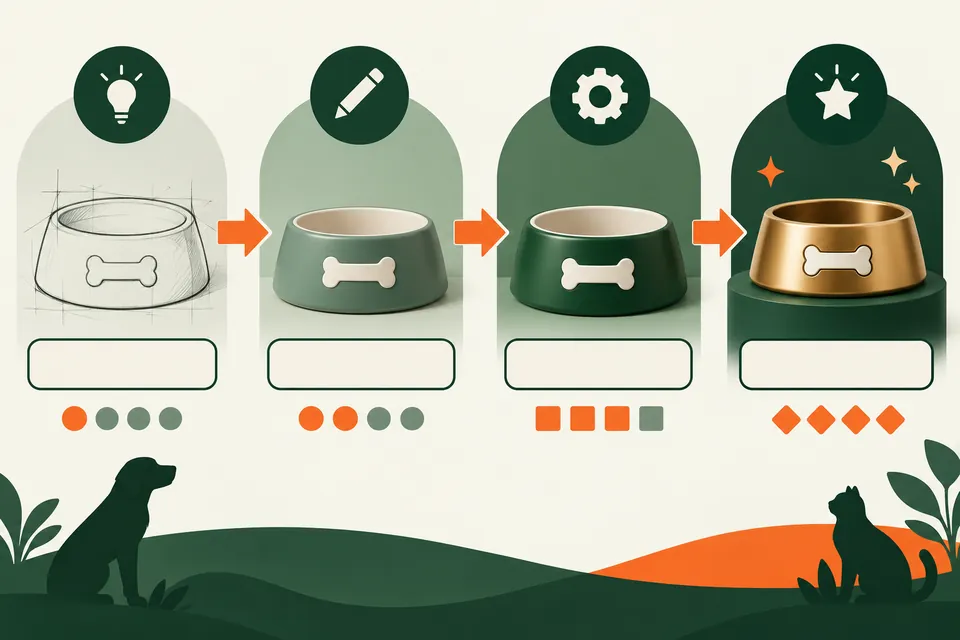
The word “sample” is too broad to control production. A concept sample may prove shape, a functional sample may prove construction, and a pre-production sample may prove the final materials and process. Buyers should name the stage on every sample label, approval email and courier record.
| Stage | Main decision | What may still be provisional | Approval result |
|---|---|---|---|
| Concept or appearance sample | Is the form, scale and brand direction worth developing? | Production materials, internal construction, colour, packaging and tests | Approve the direction only |
| Functional or engineering sample | Does the product perform as intended and can the construction be made repeatedly? | Final colour, decoration, packaging and production-line settings | Approve or revise the construction |
| Revised sample | Were the recorded defects and requested changes corrected? | Only the fields explicitly left open in the change list | Close each revision item or return it |
| Pre-production sample | Does the intended factory, process, material, artwork and packaging match the purchase specification? | Nothing that affects conformity unless marked as an approved open item | Authorise production if all required evidence passes |
| Golden sample | What physical unit will production and inspection be compared with? | Nothing; it must match the released specification revision | Seal, sign, date and retain |
| Top-of-production sample | Did the first units from the actual line reproduce the approved standard? | Normal production variation inside the agreed tolerances | Continue, correct the line or hold production |
The approval gate is not the same at every stage. A concept sample can be approved for the next development round without being approved for bulk production. Use a full sentence such as:
Approved as the pre-production sample for specification PL-COL-01, revision R03, subject to the listed packaging barcode scan result. This approval does not authorise any unrecorded material, colour, construction or artwork change.
Petlland’s OEM and ODM process describes the same principle: each round is documented with photos, measurements and a change list, and production is held against the signed reference rather than the first attempt. Its published example moves from an off-centre logo, colour mismatch and weak seam to a signed sample with controlled registration, colour assessment and seam strength.
Before approving the final stage, confirm five things:
- The sample was made by the intended supplier using the intended production method.
- Materials and components match the approved bill of materials, not temporary substitutes.
- Artwork, labels, pack-out and carton configuration are final or separately controlled.
- Required tests have a named method, acceptance criterion and result linked to this revision.
- Every open issue has an owner, due date and written disposition.
2. List required spec fields
A useful specification lets a new operator, inspector or replacement buyer reach the same conclusion without relying on memory. Keep the document concise enough to use on the factory floor, but detailed enough to decide whether a unit conforms.
An anonymised pet product spec sheet
The example below is intentionally generic. Values are illustrative and must be replaced with the approved requirements for the actual product, market and use case.
| Section | Controlled field | Anonymised example | Approval evidence |
|---|---|---|---|
| Document identity | Project, SKU, product name, revision, issue date | PL-COL-01 / adjustable collar / R03 / 2026-10-09 | Signed release page |
| Scope | Factory, production site, destination market, sales channel | Approved Site A / US ecommerce | Purchase order and supplier record |
| Bill of materials | Material, grade, supplier or approved equivalent, colour, weight or thickness | Nylon webbing; specified width and thickness; approved olive swatch | Material declaration, swatch and receiving check |
| Components | Buckle, D-ring, slider, thread, label and fastener identity | Component codes tied to drawings or retained references | Component samples and supplier records |
| Dimensions | Measurement points, nominal values, tolerances and sample condition | Finished length measured flat; webbing width; logo centre position | Drawing and measurement record |
| Workmanship | Stitch pattern, seam allowance, edge finish and defect rules | Bar-tack location and minimum complete stitch pattern | Marked photograph and defect catalogue |
| Appearance | Colour reference, viewing conditions, texture, gloss and acceptable variation | Physical swatch approved under agreed light source | Dated swatch or master component |
| Branding | Artwork file, size, placement, colour and application method | Outlined vector file with placement from fixed datum | Print proof and decorated sample |
| Performance | Test method, conditioning, load or cycle, pass criterion | Agreed pull or buckle test for the exact assembly | Test record linked to revision |
| Packaging | Unit pack, insert, barcode, warnings, retail pack and seal | Approved dieline revision and scannable barcode | Physical pack and scan record |
| Carton | Units per carton, arrangement, dimensions, weight and marks | Defined pack-out and carton tolerance | Pack-out photo and carton record |
| Inspection | Critical, major and minor defects; sampling plan; measurement frequency | Product-specific defect list linked to inspection plan | Signed inspection specification |
| Approval | Buyer, supplier and quality approvers with dates | Names, roles, signature or traceable electronic approval | Approval log |
Do not hide requirements inside email threads. Link drawings, artwork, colour standards, material declarations, test reports and packaging files from one revision-controlled index. The filename alone should not be the only identifier; repeat the revision and release date inside the document.
The specification should also say what happens when a field is missing. “As sample” is acceptable only when the retained physical reference makes the characteristic unambiguous and durable. It is weak for dimensions, material identity, performance, warnings or artwork because those requirements can be measured or documented directly.
A supplier capability check belongs before the approval gate. Use the pet product supplier audit to confirm that the named site can control incoming materials, equipment, subcontracting, testing and records. A perfect sample made outside the intended production system is not evidence that the bulk order will be repeatable.
3. Set tolerances and visual standards
“Same as sample,” “good quality” and “close to Pantone” cannot settle a production dispute. Every characteristic that can vary needs a target and an agreed boundary. The buyer should choose tolerances from function, fit, customer expectations, process capability and destination requirements—not copy generic numbers from another product.
Dimensional tolerance examples
The following values show how a requirement can be written; they are not universal recommendations.
| Weak instruction | Controlled example | How to inspect |
|---|---|---|
| Collar length about 50 cm | Finished length 500 mm ± 5 mm, measured flat from the named datum with the adjuster in the stated position | Measure on a flat surface with the specified tool and condition |
| Logo centred | Logo centre within ± 2 mm of the product centreline and parallel within the agreed visual limit | Use the drawing datum and placement template |
| Webbing 25 mm | Nominal width 25 mm with buyer-defined tolerance; record thickness and conditioning as separate fields | Measure at three defined points, avoiding compressed edges |
| Toy weight approximately 120 g | Finished unit mass target and tolerance after the stated conditioning period | Calibrated scale; defined sample frequency |
Some measurements are safety- or function-critical and deserve tighter controls or 100% checks. Others are cosmetic and can be judged on a sample. The specification should identify the characteristic class, not apply one tolerance philosophy to every field.
Colour and appearance standards
Approve colour using a reproducible reference and viewing condition. A digital screen, a printed email attachment and a physical textile swatch are not interchangeable. Record:
- the master reference, such as a retained physical swatch or agreed colour system reference;
- the material, finish and texture, because they change perceived colour;
- the light source or light booth condition used for visual approval;
- whether instrumental measurement is required, including the exact instrument setup and buyer-defined acceptance limit;
- the permitted relationship between panels, components and production lots;
- whether metamerism, gloss, pile direction or translucency needs separate review.
A colour-difference value is meaningful only when the measurement method, instrument geometry, illuminant, observer, sample preparation and formula are controlled. Do not write a bare “Delta E” limit and assume every supplier will measure it the same way.
For workmanship, build a small visual standard set:
- Acceptable: the boundary condition that should pass.
- Limit sample: the worst appearance the buyer will still accept.
- Reject: a clear example of a defect outside the approved limit.
Photograph each example with a scale, neutral lighting and a close view plus context view. Record whether the defect is critical, major or minor in the inspection plan. Petlland’s AQL inspection guide explains why the classification and acceptance plan must be agreed before inspection. AQL is a lot-sampling decision rule; it does not define the product requirement and it does not replace the golden sample.
4. Control revisions
The approved sample and spec sheet must always point to the same released revision. If a material, dimension, colour, artwork, packaging file, test method or supplier changes, the team should be able to see what changed, who approved it and which orders use it.
ISO’s quality-management guidance treats documented information as something that must be available, protected and controlled through its lifecycle. Practical controls include review and approval, access, storage, preservation, retrieval, version control, retention and disposition. A small brand does not need complicated software to apply those principles; it needs a consistent rule that nobody can bypass through a chat message.
Use a revision identifier such as:
PL-COL-01-PPS-R03-20261009
Where PL-COL-01 is the controlled product or project, PPS identifies the pre-production sample, R03 is the revision and the final field is the issue date. The code is only useful if the same identifier appears on the spec sheet, change log, sample label, photographs, approval record and purchase order.
Minimum version-control rules
- Keep one controlled master location and assign an owner.
- Mark drafts clearly; only a released revision may authorise production.
- Never overwrite or silently replace an approved file.
- Record every changed field, the reason, the requester and the approvers.
- Re-approve affected evidence, including tests and packaging, when the change could invalidate it.
- Send the new revision to every point of use and confirm receipt.
- Mark superseded documents and physical samples “obsolete” and remove them from production areas.
- Link each purchase order and inspection booking to one exact revision.
| Revision | Change | Reason | Evidence affected | Required decision |
|---|---|---|---|---|
| R01 | Initial construction sample | First development round | Dimensions, BOM and appearance | Revise |
| R02 | Buckle changed; logo moved | Function and placement correction | Component record, pull test, artwork | Conditional approval |
| R03 | Final material, colour and retail pack locked | Production release | Full spec, physical sample, test and packaging record | Released |
Classify changes by impact. A spelling correction in an internal note may not require a new physical sample. A new webbing supplier, coating, mould, load-bearing component, formula, colour recipe, package warning or barcode can. When in doubt, ask whether the change could affect fit, function, safety, compliance, appearance, durability, inspection or customer expectation. If yes, document the assessment and re-approve what is affected.
Email approval should quote the exact revision and list any exceptions. Messages such as “looks good” or “go ahead” are not safe release records because they rarely identify the sample, file set or unresolved conditions.
5. Store and use the golden sample
A golden sample is a controlled reference, not a display item. Seal it after final approval and give it an identity that remains readable for the life of the product. The sample label should include product code, revision, approval date, factory, approvers, related purchase order or project, and seal number where used.
For higher-risk or long-running programmes, retain matched references in three places:
- Buyer master: protects the buyer’s independent record.
- Factory master: remains available to production and factory quality control.
- Inspector reference: travels to or is retained by the inspection party when physical comparison is essential.
Where sending three physical units is impractical, define which sample is controlling and support it with high-resolution photographs, a measurement record and a secure document repository. A photograph alone remains a weaker substitute for texture, flexibility, construction, colour and workmanship.
Storage controls
- Use a tamper-evident bag, seal or signed label without damaging the product.
- Store away from sunlight, heat, moisture, dust, crushing and chemical exposure.
- Keep colour and material swatches in conditions appropriate to the material.
- Distinguish the sealed master from working samples used for line setup.
- Photograph the sealed condition, identifier and key features with a scale.
- Log check-out, return and any damage or ageing.
- Set a review or retirement trigger for material degradation, design change, supplier change or long storage.
How production and inspection use it
Before line start, the factory compares incoming materials, first-piece construction, artwork and packaging with the released spec and the working reference. During production, operators use measurable checkpoints rather than repeatedly handling the sealed master. At inspection, the inspector verifies the document revision first, then compares measurements, function, workmanship, colour and packaging against the same release.
The golden sample does not override legal requirements, laboratory test methods or written tolerances. It fills the gap where physical characteristics are difficult to communicate. If the sample conflicts with the specification, stop and issue a written disposition; do not let the factory select whichever reference is easier to meet.
Before every repeat order, confirm that the approved revision is still current and ask whether any material source, component, process, subcontractor, tooling, artwork or regulation has changed. Re-orders can drift when teams assume a two-year-old sample still represents the present supply chain.
Petlland’s product catalogue can be used to identify the starting product family, but the approved sample package must describe the exact SKU being ordered. Catalogue photographs and generic descriptions are never a substitute for the released specification.
Download the pet product sample approval checklist. Use it to record the sample stage, specification revision, evidence reviewed, open items, approvers, seal details and production-release decision before placing the order.
Frequently asked questions
What must be approved before a pet product sample becomes the production standard?
Approve the final construction, materials and components, dimensions and tolerances, colour and visual standards, branding, performance criteria, packaging and pack-out, required evidence, defect rules and exact document revision. Then seal and identify a matching physical golden sample. Production should not begin while any requirement that affects conformity remains vague or unrecorded.
Who should approve the golden sample?
At minimum, the buyer’s authorised product or quality owner and the supplier’s responsible production or quality representative should approve it. Add engineering, compliance, packaging or third-party inspection approval when those functions own a material risk. The record should show names, roles, dates, revision and any conditions.
Is photo approval enough for a pre-production sample?
Usually not for a new or materially changed pet product. Photos can document appearance and speed minor decisions, but they cannot reliably prove dimensions, material identity, colour under controlled light, hand feel, construction, function, odour or durability. If remote approval is unavoidable, define which characteristics remain unverified and how they will be closed before production.
How many golden samples should be retained?
Retain enough matched samples to give the buyer, factory and inspector access to the same reference when the product risk and order value justify it. Three is a practical model, not a universal rule. For expensive or unique items, one sealed controlling sample plus controlled records may be appropriate; the ownership and location must be explicit.
Can a supplier change a material after sample approval?
Only through the agreed change-control process. The supplier should disclose the proposed change before use, explain the reason and impact, provide updated documents and samples where required, and obtain written approval for a new revision. “Equivalent” should be defined by measurable requirements, not asserted after production.
What happens if bulk production differs from the golden sample?
Apply the written specification, tolerance and defect classification. Hold affected production or shipment, identify the scope, record the nonconformity and agree rework, sorting, replacement, concession or rejection. Do not treat the golden sample as a guarantee that replaces a production inspection plan.
Does a golden sample replace AQL inspection or laboratory testing?
No. The golden sample provides a physical comparison standard. Laboratory testing evaluates specified safety, material or performance requirements, while AQL inspection applies a sampling decision rule to a production lot. The three controls answer different questions and should point to the same approved revision.
Evidence sources used
- Petlland, OEM & ODM Pet Products Manufacturing — current sample-round documentation, signed-sample retention and customisation workflow.
- Petlland, How to Audit a Pet Product Supplier in China — supplier-system checks before deposit and production.
- Petlland, AQL Inspection for Pet Products — measurement against the signed sample, defect classification and inspection-record requirements.
- ISO, ISO 9001:2026 overview — current quality-management framework, documented information and controlled operations.
- ISO/TC 46, Guidance for implementing documented information controls — review, approval, access, storage, version control, retention and disposition concepts.
Editorial note: The sample codes, tolerances and records above are operational examples, not universal standards, product-safety claims or legal advice. Define them for the exact product, production process, destination market and sales channel.