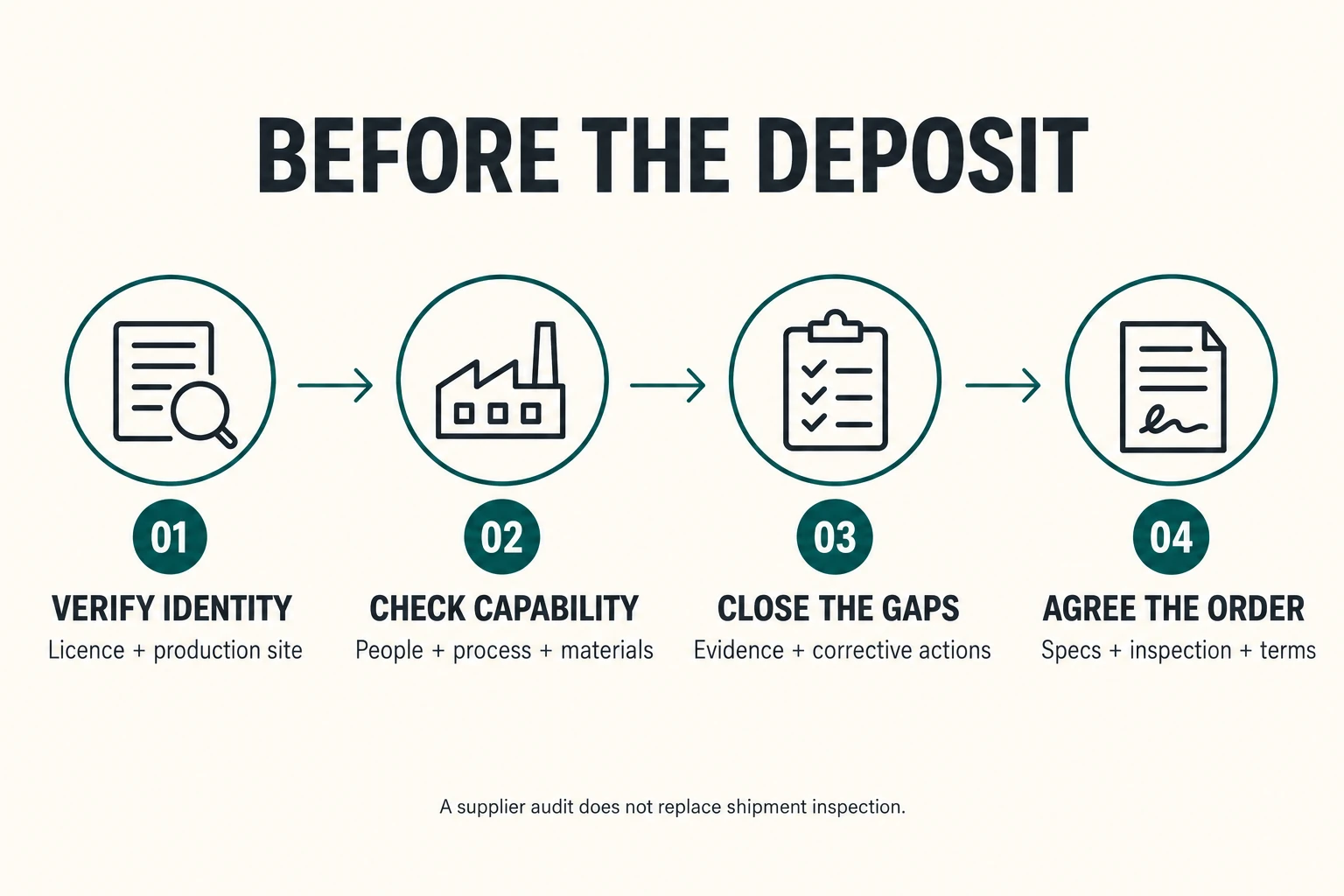
Before paying a deposit, verify the supplier’s legal identity, inspect the actual production site, check product-specific capacity and quality controls, and agree written specifications and inspection rights. A pet product supplier audit in China should produce dated evidence, an action list and a payment decision, rather than a collection of factory photographs.

Key takeaways
- Verify the seller, manufacturing site and payment recipient as separate entities, then document how they are connected.
- Audit the processes required for your product. A sewing workshop does not establish capability to manufacture moulded bowls.
- Social audit reports, quality certificates and laboratory reports answer different questions. None substitutes for the others.
- Score verified evidence, record unresolved findings and keep serious identity or safety concerns outside the numerical score.
- Agree sample approval, third-party inspection access and corrective-action responsibilities before the deposit.
What a supplier audit actually checks
A supplier audit evaluates whether a business and its production site can fulfil a defined order consistently. It covers identity, people, equipment, materials, quality records and the controls behind production. A pre-shipment inspection evaluates an actual batch of goods. A laboratory test addresses particular properties of the samples submitted. Plan all three where the product and order risk require them.
Petlland’s published factory audit process groups supplier evaluation into legal and capacity checks, social compliance, quality systems, material traceability and sample discipline. The checklist below turns those published areas into a practical evidence record. It is a newly prepared buyer worksheet, not a completed factory report or a claim about a particular supplier.
15 checks before paying a deposit
1. Verify the Chinese legal entity
Request the Chinese business licence, full registered Chinese name and Unified Social Credit Code. Cross-check the entity in China’s National Enterprise Credit Information Publicity System, and record the lookup date and any discrepancy requiring explanation. Keep a copy of the registration evidence with the quotation. An English trading name alone is insufficient to identify the contracting business.
Evidence to retain: licence copy, dated registry record and a note connecting the trading name to the legal entity. Registration establishes identity; it does not establish production capability.
2. Identify the seller and payment recipient
Compare the contracting entity, invoice issuer and beneficiary name. A trading company or export agent may legitimately sit between you and the factory, but its role should be explicit. Ask for the relationship and responsibilities in writing. Verify changed bank instructions through an independently established contact channel before payment.
Hold point: an unexplained beneficiary mismatch or request to pay an individual account. Do not resolve that uncertainty by relying only on another message from the person who sent the payment request.
3. Confirm the actual manufacturing site
Obtain the production address, then inspect that location in person or appoint an independent auditor. Follow the product route from incoming materials to packing. A live video walkthrough can help shortlist suppliers, but it provides a narrower view than an on-site assessment. Record which stages you observed and which remained inaccessible.
Evidence to retain: dated site observations, permitted photographs, the site contact and a process map. Clarify any difference between the registered office and the manufacturing address.
4. Inspect the processes your SKU needs
Match the process map to the bill of materials. For a harness, inspect cutting, sewing, reinforcement stitching, hardware assembly and load-testing arrangements. For a pet bed, examine filling controls and cover assembly. For moulded products, identify where moulding and finishing happen. A showroom sample does not prove that those operations run at the site you were shown.
Evidence to retain: process list, equipment observations and named in-house or external process owners.
5. Test the capacity claim against the production schedule
Ask for output records from comparable products, staffing by shift, downtime and current order commitments. Identify the bottleneck rather than multiplying the total number of machines by a sales estimate. Reserve time for your order’s setup, colour changes, packing and possible rework.
Illustrative calculation: if the bottleneck reliably produces 400 acceptable units per day and only eight days are available, the planning ceiling is 3,200 units before further allowances. These are invented planning inputs, not Petlland production data. Ask the supplier to substantiate each input for your order.
6. Review quality records and corrective actions
Request recent incoming, in-process and final inspection records from comparable work, with customer details redacted where necessary. Follow one defect from detection to containment, root cause, corrective action and effectiveness check. If ISO 9001 certification is claimed, verify the entity, site, scope and current status with the issuing certification body.
Hold point: blank forms presented as inspection history, or a repeat defect with no evidence that the process changed.
7. Trace critical materials and components
Start with the components most important to function and safety: buckles and webbing for harnesses, fabric and filling for beds, and the specified polymer or coating for bowls. Connect the approved material specification to the supplier, incoming lot and production batch. Agree that substitutions require written approval and a review of any affected testing.
Evidence to retain: controlled bill of materials, incoming batch identifiers and the material-change procedure.
8. Match test reports to the actual product and market
Check the report number, sample description, photographs, materials, model, test methods and results. A report for a different resin, colour or construction may not cover your SKU. Have a qualified laboratory identify the testing relevant to your intended market, product and claims before approving the specification.
Where accredited testing is required, verify the laboratory and the relevant method within its accreditation scope. ILAC explains how to locate accredited laboratories through the appropriate accreditation body. A laboratory’s general accreditation claim alone does not confirm coverage of every test.
9. Check social audit evidence for the exact site
Ask for the current audit report, scope, site details, date and corrective-action status, with authorised sharing where applicable. amfori explicitly states that BSCI is not a certification system. Treat a decorative “BSCI certificate” as a claim requiring verification.
SMETA assesses social and environmental practices and is conducted by Sedex-approved Affiliate Audit Companies. Sedex’s methodology introduction explains that it does not impose a certification-style pass/fail model. Examine the findings and remediation evidence; neither a membership logo nor a social audit establishes product quality.
10. Establish an approved reference sample
Approve a sample against a written specification that includes materials, dimensions, tolerances, colours, branding, functional criteria and packaging. Label retained samples with a version and approval date. Keep matching references with the buyer, factory and inspector where practical. Record every authorised revision so a photograph in an old chat cannot become the production instruction.
11. Examine incoming and in-process controls
Ask who releases incoming materials, approves the first production pieces and checks work during the run. Observe how a nonconforming component is stopped before it enters assembly. Review the condition and calibration or verification records of measuring equipment used for your acceptance decisions.
Evidence to retain: responsible roles, check frequency, acceptance criteria and a completed record showing what happened when a check failed.
12. Follow rejected goods through rework
Inspect the physical area for rejected materials and finished goods. Check identification, segregation, disposition approval and re-inspection records. Ask how staff prevent a reworked piece from returning to saleable stock without verification. The answer should show a repeatable process rather than depend on one manager remembering which carton contains rejects.
13. Test packaging, barcode and SKU controls
Use the proposed retail pack and carton configuration. Check scan results against the intended SKU, including size and colour variants. Review carton markings, pack quantities and the process for removing obsolete artwork. Agree the destination and sales-channel requirements before production; a previous customer’s label is not a reusable approval for your order.
14. Document subcontracting and tooling ownership
List outside processes such as printing, coating, moulding or packaging. Require disclosure of their locations and written approval of material subcontracting changes. If you fund moulds, fixtures or artwork, record ownership, identification, storage, maintenance, permitted use and retrieval arrangements in the order documents. Have contractual provisions checked for your transaction rather than assuming a paid tooling invoice resolves every ownership question.
15. Agree inspection access and payment conditions
Confirm access for the chosen independent inspector, the inspection stages, sampling approach, product tests and report delivery. Specify how failures trigger a hold, corrective action and re-inspection, and who pays each cost. Agree deposit and balance-payment milestones in the purchase documents. Avoid relying on an assumption that a failed inspection automatically produces a refund.
The companion AQL inspection guide for pet products covers the batch-inspection stage. Supplier approval and shipment acceptance are separate decisions.
A practical supplier audit scorecard
Use the downloadable 15-check scorecard to compare suppliers against the same evidence. It is a buyer planning template developed for this guide, not a validated certification scheme or a record of a completed Petlland audit.
Score each item 0 for missing or contradictory evidence, 1 for partial evidence or unresolved actions, and 2 for evidence verified against the agreed requirement. Record an evidence reference, action owner and deadline for every item. Mark a genuinely inapplicable item N/A with a written reason; missing evidence is not N/A.
| Audit group | Checks | Maximum points |
|---|---|---|
| Identity and production capability | 1–5 | 10 |
| Quality, materials and social evidence | 6–10 | 10 |
| Production controls and order protection | 11–15 | 10 |
Calculation: verified score percentage = points awarded ÷ (2 × applicable checks) × 100. For example, 24 points across 15 applicable checks gives 80%. This is illustrative arithmetic, not a supplier result or an automatic approval threshold.
Set your acceptance policy before comparing quotations. A high total cannot cancel forged records, unresolved legal-entity or beneficiary questions, concealed subcontracting, serious unaddressed safety or labour concerns, or refusal of the inspection access required for the order. Put these on a separate hold list. Resolve each with evidence before the payment decision.
How to turn the findings into an order decision
- Send the audit brief. Include the SKU, target market, quantity, materials, required processes and documents to review.
- Record what was verified. Distinguish observed operations, checked records, supplier claims and areas not assessed.
- Issue the action list. Name an owner, required evidence and due date for each finding.
- Review closure. Request follow-up records or another visit where a document alone cannot demonstrate the fix.
- Approve the order conditions. Use the agreed sample, specification, inspection plan and payment terms as the production baseline.
Compare suppliers on the remaining uncertainties as well as price. A lower quote may depend on an unapproved material, outsourced operation or packing assumption. Resolve those differences before treating three quotations as comparable.
Frequently asked questions
Can I audit a supplier remotely?
You can review documents, interview staff and use a live walkthrough for preliminary screening. Record the limits of that review. Where the decision depends on shop-floor conditions, worker interviews or independent sampling of records, arrange an appropriate on-site assessment.
Is a trading company automatically a bad supplier?
No. Evaluate whether its role, production partners, quality responsibilities and payment arrangements are transparent. A sourcing partner can coordinate multiple factories; the important point is knowing who makes the goods and who is accountable for the order.
Does an ISO 9001 certificate prove my pet product is compliant?
No. It concerns the certified quality management system and its stated scope. Your product still needs an agreed specification, relevant market requirements, suitable testing and order-level quality controls.
How much should a China supplier audit cost?
Request an itemised quotation covering the location, audit scope, time on site, travel, report, translation and follow-up. Compare equivalent scope. There is no single price that establishes whether every product category or subcontracted process has been assessed.
When should I repeat the audit?
Reassess when the site, ownership, key materials, critical processes or subcontractors change, and after significant unresolved quality findings. Set routine review intervals according to the product, supplier history and customer requirements.
Compare suppliers with a clear evidence trail
Send Petlland your product brief, target market, quantity and available supplier documents. Request a comparison of three audited factory options, subject to product fit and availability, and ask for the site, scope, findings and corrective-action status supporting each recommendation.
Sources and preparation notes
Source research completed on 14 September 2026. The enterprise registry portal could not be read automatically; no supplier-specific registration check is claimed. The five external reference groups are China’s enterprise registry, amfori BSCI guidance, Sedex SMETA guidance, Sedex’s methodology introduction and ILAC’s laboratory accreditation guidance, linked at the relevant checks. Petlland’s published factory-audit process supplies the company-specific context. No supplier interviews, factory visits or laboratory tests were conducted for this article, and no independent expert review is claimed.